This learning resource is available in interactive and printable formats. The interactive worksheet can be played online and assigned to students. The Printable PDF version can be downloaded and printed for completion by hand.
This engaging 250-word reading passage helps Grade 4 students understand the internal structure of seeds, aligned with NGSS standard 4-LS1-1. Students discover that seeds are survival packages containing three essential parts: the embryo (baby plant), stored food that nourishes the growing plant, and a protective seed coat. The passage explains how these parts work together during germination when conditions like water, warmth, and soil are right. Written at a fourth-grade reading level, the passage uses clear explanations and relatable examples to build foundational understanding of plant structures and their functions. The lesson includes audio integration for accessibility, a simplified differentiated version for struggling readers, Spanish translations of both versions, a comprehensive glossary of key terms, multiple-choice questions testing recall and comprehension, writing activities requiring application of concepts, and graphic organizers for visual learning. Students explore vocabulary terms including seed, embryo, stored food, seed coat, and germination. This complete educational resource supports diverse learners while maintaining rigorous alignment to Next Generation Science Standards for elementary life science.
CONTENT PREVIEW
Expand content preview
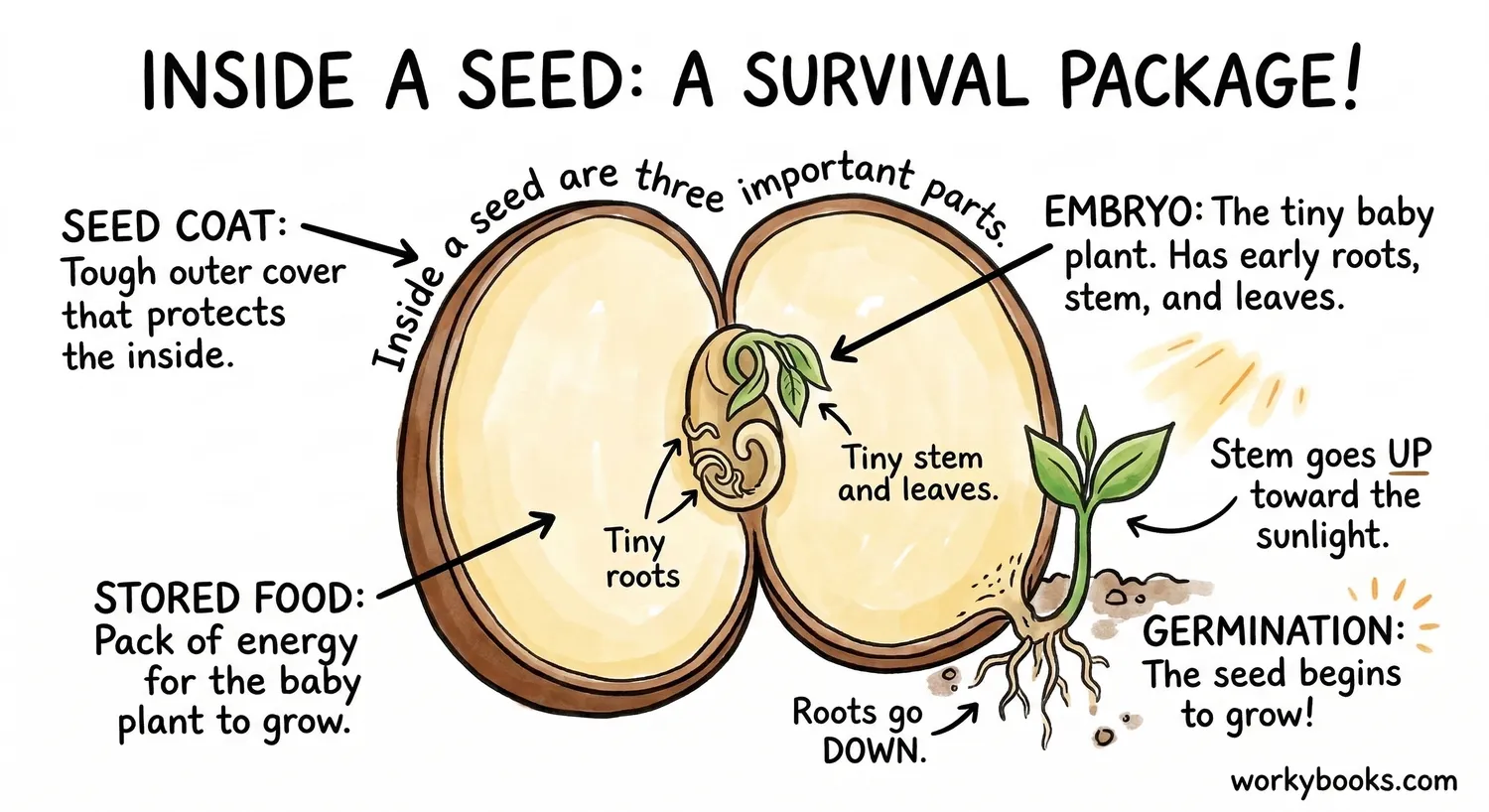
A seed is a tiny "survival package" containing everything a plant needs.
A seed is a tiny survival package that holds everything needed to grow a new plant. Seeds help plants spread to new places and survive through seasons when growing conditions are difficult.
Inside every seed are three important parts. The first part is the embryo, which is the baby plant waiting to grow. The embryo has the beginnings of roots, a stem, and leaves all folded up in a very small space. The second part is stored food, which surrounds the embryo like a lunch box packed with energy. This stored food gives the baby plant the nutrients it needs to start growing before it can make its own food through its leaves. The third part is the seed coat, which is the tough outer covering that protects the embryo and stored food from damage, insects, and drying out.
When conditions are just right—with enough water, warmth, and soil—the seed begins a process called germination. The seed coat softens and splits open. The embryo uses the stored food for energy to push roots down into the soil and a stem up toward the sunlight. Think of it like a packed suitcase that contains everything a traveler needs for a journey. The seed is packed with everything the baby plant needs to begin its life.
Interesting Fact: Some seeds can survive for hundreds of years! Scientists successfully grew a plant from a 2,000-year-old seed found in an ancient palace.
What is a seed?
A survival package for new plantsA type of soilA kind of waterA plant's leaf
What is the embryo?
The seed coatThe baby plant inside the seedThe stored foodThe soil around the seed
What protects the seed from damage?
The embryoThe stored foodThe seed coatThe roots
Why does a seed need stored food?
To attract insectsTo feed the baby plantTo make the seed heavyTo color the seed
What happens during germination?
The seed dries out completelyThe seed gets smallerThe seed opens and growsThe seed changes color only
Seeds need water, warmth, and soil to grow.
TrueFalse
What does germination mean?
When a seed diesWhen a seed begins to growWhen a seed falls offWhen a seed gets wet
Which part pushes down into soil?
The leavesThe seed coatThe rootsThe stored food
Perfect For:
👩🏫 Teachers
• Reading comprehension practice
• Auto-graded assessments
• Literacy skill development
👨👩👧👦 Parents
• Reading practice at home
• Comprehension improvement
• Educational reading time
🏠 Homeschoolers
• Reading curriculum support
• Independent reading practice
• Progress monitoring
Reading Features:
📖
Reading Passage
Engaging fiction or nonfiction text
❓
Comprehension Quiz
Auto-graded questions
📊
Instant Feedback
Immediate results and scoring
📄
Printable Version
Download for offline reading
🔊
Read Aloud
Voice-over with word highlighting
Reviews & Ratings
No reviews yet. Be the first to share your experience!
Related Content
How Animals See Differently
This engaging 250-word reading passage introduces fourth-grade students to the fascinating world of animal vision and ey...
NGSS 4-LS1-1LS1.D
Animal Internal Structure
This engaging science passage for Grade 4-5 students explores animal internal structure and how organs work together to ...
NGSS 4-LS1-1
What Are Bones Made Of
This engaging 250-word reading passage introduces Grade 4 students to the structure and function of bones, aligned with ...
NGSS 4-LS1-1LS1.A
How Bones Protect Organs
This engaging 250-word reading passage helps Grade 4 students understand how bones protect organs, aligned with NGSS sta...
NGSS 4-LS1-1LS1.A
How Joints Connect Bones
This 250-word reading passage teaches fourth-grade students about joints and their role in the human skeletal system. Al...
NGSS 4-LS1-1LS1.A
How Muscles Move Bones
This comprehensive 250-word reading passage introduces fourth-grade students to the fundamental concept of how muscles a...
NGSS 4-LS1-1
Two Types of Muscles
This 250-word reading passage introduces fourth-grade students to the two main types of muscles in the human body: volun...
NGSS 4-LS1-1
What Are Muscles
This engaging 250-word reading passage introduces fourth-grade students to the essential concept of muscles and how they...
NGSS 4-LS1-1
How Skin Protects Body
This audio-integrated reading passage introduces fourth-grade students to the protective functions of skin, aligned with...
NGSS 4-LS1-1
Layers of the Skin
This engaging 250-word reading passage introduces fourth-grade students to the three layers of skin and their functions....
NGSS 4-LS1-1LS1.A
What Are Plant Structures
This engaging 250-word reading passage introduces fourth-grade students to the fundamental concept of plant structures a...
NGSS 4-LS1-1
Parts of Plant Stems
This engaging 250-word reading passage introduces fourth-grade students to the internal structure and function of plant ...
NGSS 4-LS1-1LS1.A
How Water Moves Inside Plants
This 250-word reading passage introduces fourth-grade students to the concept of water transport in plants, aligned with...
NGSS 4-LS1-1
Parts of a Flower
This comprehensive 250-word reading passage introduces fourth-grade students to the essential parts of a flower and thei...
NGSS 4-LS1-1LS1.A
How Fish Gills Work
This engaging 250-word reading passage introduces fourth-grade students to the concept of fish gills and how they functi...
NGSS 4-LS1-1
How Leaves Make Food
This engaging Grade 4 science reading passage explains how leaves make food through photosynthesis. Students discover th...
NGSS 4-LS1-1LS1.A
How Animal Hearts Work
This 250-word audio-integrated reading passage introduces fourth-grade students to the essential function of the heart a...
NGSS 4-LS1-1LS1.A
Animal Skeleton Structure
This 250-word reading passage introduces fourth grade students to animal skeleton structure, aligned with NGSS 4-LS1-1 a...
NGSS 4-LS1-1LS1.A
How Animal Lungs Work
This 250-word reading passage introduces fourth-grade students to how animal lungs work, aligned with NGSS standard 4-LS...