Reading PassagePremium

How Animals Use Earth's Magnetism

Interactive passage with audio narration, comprehension questions, and printable PDF.

No ratings yet|
1
Grades 5–8ScienceElaEnglish · SpanishInteractive · Printable
Aligned toMS-ESS2-1
Just this resource
$1.50
One-time purchase
Best value
Unlock everything
$49.99$29.99/yr
40% off until Aug 1 — 10,000+ resources
Renews at $49.99/year.
Unlock above to use these actions

What's included

Reading passage
Audio narration
Comprehension quiz
Writing activity
Glossary & flashcards
Differentiated version
Spanish translation

How Animals Use Earth's Magnetism preview and details

About this printable How Animals Use Earth's Magnetism science reading passage, NGSS-aligned (Grades 5-8)

This 400-500 word informational science reading passage explores how animals use Earth's magnetic field for navigation, aligned with NGSS standard MS-ESS2-1 and DCI MS-ESS2.A. Students in grades 6-8 discover that many species, including migrating birds, sea turtles, salmon, and monarch butterflies, can detect the planet's geomagnetic field and use it like a built-in compass. The passage explains magnetoreception, describes real-world examples of animal navigation, and discusses how scientists are working to understand the biological mechanisms behind this ability. Audio-integrated features support diverse learners. The content connects Earth science to biology, showing how the magnetic field generated deep in Earth's core influences life across the entire planet. This passage includes vocabulary development, comprehension questions, writing activities, and graphic organizers to reinforce learning about Earth's systems and animal adaptations.
Written by Workybooks TeamPublished by Workybooks
Preview

Sample passage and quiz from How Animals Use Earth's Magnetism

Reading passage and comprehension quiz preview

How Animals Use Earth's Magnetism
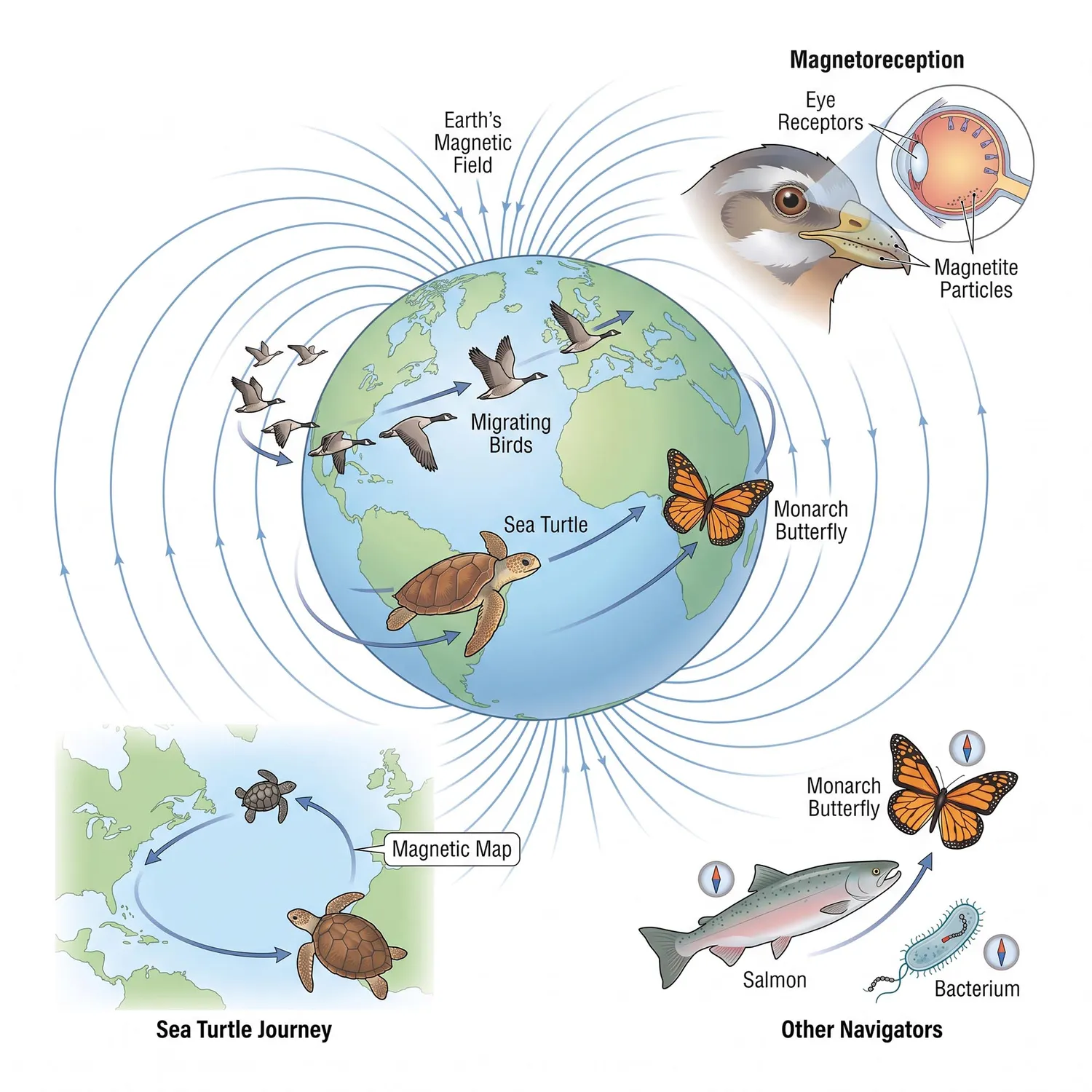
Animals navigate using Earth's magnetic field through magnetoreception during migration
Earth's magnetic field guides animal migration through magnetoreception.

Many animals can sense Earth's magnetic field and use it for navigation. This invisible force acts like a built-in compass that guides them across vast distances. Scientists call this ability magnetoreception, and it helps animals find their way during long journeys.

Earth's magnetic field is generated deep in the planet's core. The field extends from the North Pole to the South Pole and surrounds the entire planet. While humans cannot sense this field without instruments, many animals can detect it naturally. Evidence shows that migrating birds use the magnetic field to fly thousands of miles in the correct direction. Sea turtles rely on it to cross entire oceans and return to the exact beach where they hatched. Salmon use magnetic cues to navigate upstream to their birthplace. Even monarch butterflies and some bacteria can sense Earth's magnetism.

Scientists are still working to understand exactly how animals detect magnetic fields. One explanation involves tiny magnetic particles called magnetite found in animal tissues. These particles may act like microscopic compass needles that respond to Earth's field. Another possibility involves special proteins in animal cells that react to magnetic forces. Researchers observe that some birds have cells in their eyes that can sense magnetic fields. This may allow them to actually see magnetic patterns as they fly.

Sea turtles provide a remarkable real-world example of magnetic navigation. Baby loggerhead turtles hatch on beaches in Florida and immediately swim into the Atlantic Ocean. They follow a migration route that takes them around the entire North Atlantic. Scientists explain that turtles create a magnetic map by remembering the unique magnetic signature of different ocean regions. Years later, adult turtles use this map to return to the same beach where they were born.

Understanding how animals use Earth's magnetism matters for several reasons. It connects Earth science to biology and shows how the geomagnetic field influences life across the planet. This knowledge can help scientists protect migrating animals and their habitats. It also raises questions about how human activities that produce magnetic fields might affect animal navigation.

Interesting Fact: Some scientists think that pigeons have magnetite crystals in their beaks that help them sense Earth's magnetic field. This may explain why pigeons are such excellent navigators and can find their way home from unfamiliar locations hundreds of miles away.

Comprehension quiz (10 questions)

1. What is magnetoreception?

The ability of animals to detect and sense magnetic fields
The process of creating magnetic fields in animal bodies
A tool scientists use to study Earth's magnetic field
The movement of animals during migration

2. Where is Earth's magnetic field generated?

In the atmosphere surrounding Earth
Deep in the planet's core
At the North and South Poles only
In the ocean currents

3. Which animals are mentioned in the passage as using Earth's magnetic field for navigation?

Only birds and sea turtles
Birds, sea turtles, salmon, monarch butterflies, and some bacteria
Only migrating birds
Sea turtles and whales

4. In the passage, what does the word 'detect' mean when scientists say animals can detect magnetic fields?

To ignore or avoid something
To create or produce something
To sense or discover the presence of something
To destroy or eliminate something

5. What is magnetite?

A type of bacteria that lives in the ocean
Tiny magnetic particles found in animal tissues
A special protein in animal cells
A region in the Atlantic Ocean

6. Based on the passage, why do scientists think some birds might be able to see magnetic patterns?

Because birds have better eyesight than other animals
Because birds fly at high altitudes where magnetic fields are stronger
Because some birds have cells in their eyes that can sense magnetic fields
Because birds have magnetite in their wings

7. How do loggerhead sea turtles use magnetic navigation to return to their birthplace?

They follow other turtles who know the way
They create a magnetic map by remembering unique magnetic signatures of ocean regions
They use the sun and stars to navigate
They swim randomly until they find the right beach

8. According to the passage, what concern do scientists have about human activities?

Human activities might produce magnetic fields that affect animal navigation
Humans are destroying all magnetic particles in nature
Human activities are making Earth's magnetic field disappear
Humans are preventing animals from migrating

9. True or False: Humans can sense Earth's magnetic field without using instruments.

True
False

10. True or False: Scientists completely understand how all animals detect magnetic fields.

True
False
Who it's for

Perfect for the way you teach

Teachers
  • Build comprehension skills
  • Auto-graded quiz
  • Differentiated reading
Parents
  • Read together at home
  • Improve fluency
  • Quiet reading time
Homeschoolers
  • Reading curriculum support
  • Independent practice
  • Track Lexile growth
Topics

Reviews & Ratings

No reviews yet. Be the first to share your experience!

More reading you might love

20 more
Passage
Frost Wedging: How Ice Splits Rock - reading educational content
Grades 5–8

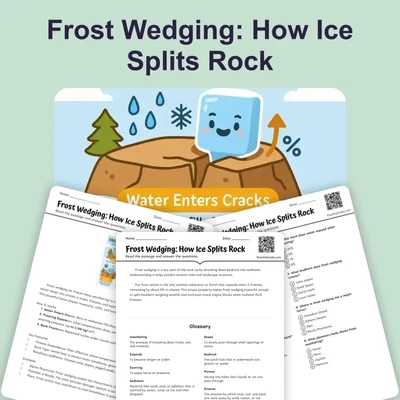
Frost Wedging: How Ice Splits Rock

earth and space science · MS-ESS2-1

$1.50
Passage
Limestone Caves: Nature’s Underground Wonders - reading educational content
Grades 5–8

Limestone Caves: Nature’s Underground Wonders

science · MS-ESS2-1

Free
Passage
Chemical Weathering: The Breakdown of Rocks Through Chemical Reactions - reading educational content
Grades 5–8

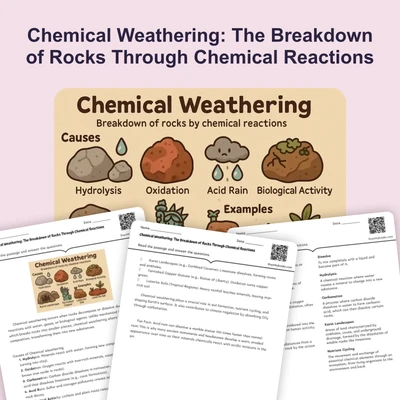
Chemical Weathering: The Breakdown of Rocks Through Chemical Reactions

earth and space science · MS-ESS2-1

Free
Passage
Talus Slopes: Formation and Features - reading educational content
Grades 5–8

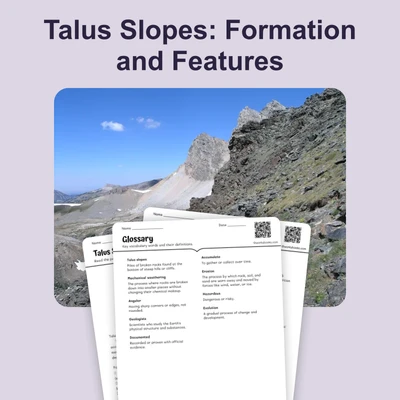
Talus Slopes: Formation and Features

science · MS-ESS2-1

Free
Passage
Biological Weathering: Types and Examples - reading educational content
Grades 5–8

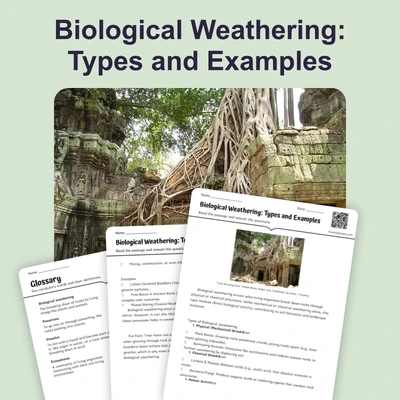
Biological Weathering: Types and Examples

science · MS-ESS2-1

Free
Passage
The Coldest City in the World: Yakutsk - reading educational content
Grades 5–8

The Coldest City in the World: Yakutsk

weather and climate · MS-ESS2-1

$1.50
Passage
Igneous Rocks - reading educational content
Grades 5–8

Igneous Rocks

earth and space science · MS-ESS2-1

$1.50
Passage
Sedimentary Rocks - reading educational content
Grades 5–8

Sedimentary Rocks

earth and space science · MS-ESS2-1

$1.50
Passage
Metamorphic Rocks - reading educational content
Grades 5–8

Metamorphic Rocks

earth and space science · MS-ESS2-1

Free
Passage
Scientific Inquiry in Earth Science - reading educational content
Grades 5–8

Scientific Inquiry in Earth Science

earth and space science · MS-ESS1-4

$1.50
Passage
Contour Lines and Elevation - reading educational content
Grades 5–8

Contour Lines and Elevation

earth and space science · MS-ESS2-2

$1.50
Passage
Weathering - reading educational content
Grades 5–8

Weathering

earth and space science · MS-ESS2-1

$1.50
Passage
Erosion - reading educational content
Grades 5–8

Erosion

earth and space science · MS-ESS2-1

$1.50
Passage
Stream Erosion and Deposition - reading educational content
Grades 5–8

Stream Erosion and Deposition

earth and space science · MS-ESS2-1

$1.50
Passage
Wind Erosion and Deposition - reading educational content
Grades 5–8

Wind Erosion and Deposition

earth and space science · MS-ESS2-1

$1.50
Passage
Glacial Erosion and Deposition - reading educational content
Grades 5–8

Glacial Erosion and Deposition

earth and space science · MS-ESS2-1

$1.50
Passage
Mass Movements - reading educational content
Grades 5–8

Mass Movements

science · MS-ESS2-1

$1.50
Passage
Soil Formation and Composition - reading educational content
Grades 5–8

Soil Formation and Composition

earth and space science · MS-ESS2-1

$1.50
Passage
Constructive and Destructive Forces - reading educational content
Grades 5–8

Constructive and Destructive Forces

earth and space science · MS-ESS2-1

Free
Passage
Mountains and Mountain Building - reading educational content
Grades 5–8

Mountains and Mountain Building

earth and space science · MS-ESS2-1

$1.50
Copyright © 2026 Workybooks. Made with ♥ in California.