How Aphelion Affects Seasons — Reading Comprehension
Rate this
Premium Resource
Present
Present in classroom. No work saved
Assign
Classroom with student accounts, Track progress
Quick Play
No student accounts, assign with a link
Grades
6
PRINT+DIGITAL RESOURCE
This learning resource is available in interactive and printable formats. The interactive worksheet can be played online and assigned to students. The Printable PDF version can be downloaded and printed for completion by hand.
This educational passage, audio-integrated for enhanced learning, explores the fascinating topic of "How Aphelion Affects Seasons." Designed for a Grade 6 reading level, it delves into Earth's elliptical orbit and the crucial role of its axial tilt in creating the seasons. Students will learn about key concepts like aphelion, perihelion, and why distance from the sun isn't the primary cause of seasonal changes. This content aligns with NGSS MS-ESS1-1, helping students develop a model of the Earth-sun system to describe cyclic patterns like seasons. It includes a reading passage, multiple-choice questions, vocabulary, and short-answer questions.
CONTENT PREVIEW
Expand content preview
Earth’s axial tilt and orbit explain seasonal sunlight angles.
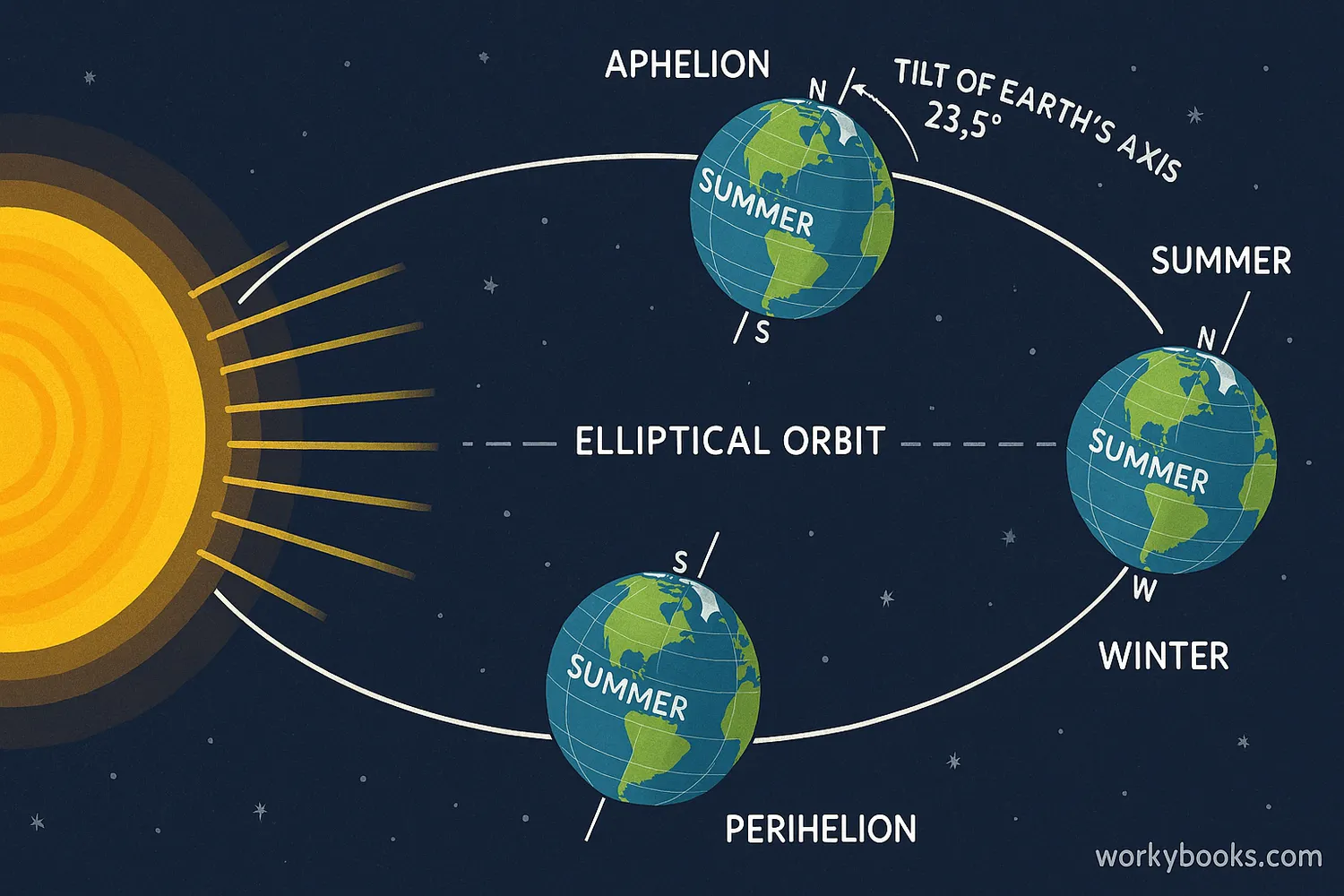
Have you ever wondered why we have different seasons throughout the year? Many people think it's because Earth is closer or farther away from the sun. While Earth's orbit around the sun isn't a perfect circle – it's actually an ellipse, or an oval shape – the distance doesn't cause our seasons. Instead, it's Earth's axial tilt, the slant of its axis, that creates the wonderful changes we experience as spring, summer, autumn, and winter.
Let's talk about Earth's orbit. There are two important points in our planet's journey around the sun. When Earth is farthest from the sun, this point is called aphelion. This usually happens in early July. When Earth is closest to the sun, it's called perihelion, which typically occurs in early January. So, if Earth is farthest from the sun in July, why is July often a summer month in the Northern Hemisphere? This is where the axial tilt comes in.
Earth's axis is tilted about 23.5 degrees. Imagine an imaginary pole going through Earth from the North Pole to the South Pole. This pole isn't straight up and down compared to our orbit around the sun; it's tilted. As Earth orbits, this tilt stays pointed in roughly the same direction in space. This means that at different times of the year, either the Northern Hemisphere or the Southern Hemisphere is tilted more directly towards the sun.
When a hemisphere is tilted towards the sun, it receives more direct sunlight. This direct sunlight spreads over a smaller area, making it more intense and warming the land and oceans more effectively. This leads to longer days and warmer temperatures – in other words, summer! When a hemisphere is tilted away from the sun, the sunlight hits at a shallower angle. It spreads over a larger area, making it less intense. This causes shorter days and colder temperatures, bringing about winter. The opposite season occurs in the other hemisphere.
So, even though Earth is at aphelion (farthest from the sun) in July, the Northern Hemisphere is tilted towards the sun, causing summer. At the same time, the Southern Hemisphere is tilted away, experiencing winter. The small difference in distance between aphelion and perihelion has a tiny effect on temperature, but the tilt is the main driver of our seasonal patterns. Understanding this helps us describe the cyclic patterns of seasons as part of the Earth-sun system.
Interesting Fact: The tilt of Earth's axis also causes the sun to appear at different heights in the sky throughout the year.
What shape is Earth's orbit?
An oval shapeA perfect circleA square shapeA triangular shape
When is Earth farthest from the sun?
In early JulyIn early JanuaryIn late SeptemberIn mid-March
True or False: Earth's distance from the sun is the main cause of seasons.
TrueFalse
Which term describes when Earth is farthest from the sun?
AphelionPerihelionEquinoxSolstice
What causes warmer temperatures during summer?
Less direct sunlightMore direct sunlightShorter daysEarth being closer
If the Northern Hemisphere is tilted towards the sun, what season is it experiencing?
WinterSpringSummerAutumn
How does sunlight hit a hemisphere tilted away?
DirectlyAt a steeper angleMore intenselyAt a shallower angle
Why does the Southern Hemisphere experience winter when the Northern Hemisphere has summer in July?
It's closer to sunIt's tilted awayIt's tilted towardsIt has longer days
Imagine Earth's axis was not tilted. What would likely happen to seasons?
Seasons would be strongerSeasons would be weakerNo distinct seasonsSeasons would reverse
If Earth's orbit became a perfect circle, how would it affect seasons?
Seasons would disappearSeasons would be longerNo major changeSeasons would be colder
Perfect For:
👩🏫 Teachers
• Reading comprehension practice
• Auto-graded assessments
• Literacy skill development
👨👩👧👦 Parents
• Reading practice at home
• Comprehension improvement
• Educational reading time
🏠 Homeschoolers
• Reading curriculum support
• Independent reading practice
• Progress monitoring
Reading Features:
📖
Reading Passage
Engaging fiction or nonfiction text
❓
Comprehension Quiz
Auto-graded questions
📊
Instant Feedback
Immediate results and scoring
📄
Printable Version
Download for offline reading
🔊
Read Aloud
Voice-over with word highlighting
Reviews & Ratings
No reviews yet. Be the first to share your experience!
Related Content
Earth: Our Home in Space
This engaging Grade 4-5 science passage, aligned to NGSS, introduces students to Earth's special place in the solar syst...
Tools and Technology in Earth Science
This middle school science reading passage explores the wide range of tools and technologies used in Earth science, from...
MS-ESS2-2MS-ESS3-2MS-ETS1-1MS-PS4-3
Earth's Place in the Universe
This reading passage explains Earth's place in the universe, supporting NGSS 1-ESS1-1. It describes how Earth is one of ...
1-ESS1-1
Scientific Inquiry in Earth Science
This passage explores scientific inquiry in Earth science for grades 6-8, aligned with NGSS standards MS-ESS1-4, MS-ESS2...
MS-ESS1-4MS-ESS2-1MS-ESS3-5SEP
What Is Space Weather and How Does It Affect the Earth?
This NGSS-aligned science passage for middle school explains what space weather is and how it affects Earth. Students le...
MS-ESS2-2
Escape Velocity and Space Travel
This middle school science passage introduces students to the concept of escape velocity—the minimum speed required to b...
MS-ESS1-2MS-PS2-4
Space Stations
This informational science reading passage for grades 6-8 explores the complex systems and technology behind space stati...
MS-ESS1-3MS-ETS1-1
What Is Earth Science?
This engaging middle school science passage introduces students to the field of Earth science, aligning with NGSS standa...
MS-ESS1MS-ESS2MS-ESS3SEP
The Space Garden
This innovative passage combines plant science with space exploration, aligning with NGSS standards for life sciences an...
RL.3.1RL.2.1RL.4.9
Measuring Distances in Space
This middle school science passage explores how astronomers measure the vast distances in space, aligning with NGSS stan...
MS-ESS1-3
Earth: Our Home Planet
This comprehensive science passage for grades 6-8 explores Earth’s unique characteristics and the interconnected systems...
MS-ESS1-2
Meteorite Impacts on Earth
This engaging science reading passage for Grades 4-5 explores meteorite impacts on Earth, aligning with NGSS standards. ...
Earth's Rotation
This middle school science passage, aligned with NGSS standard MS-ESS1-1, focuses on Earth's rotation—how Earth spins on...
MS-ESS1-1
Exploring Space: Rockets and Spacecraft
Space exploration has been one of humanity's greatest achievements, made possible by rockets and spacecraft. Rockets act...
RI.4.4RI.4.2
Facts About Earth
This engaging science reading passage introduces Grade 4 and 5 students to Earth, our home planet. Aligned with NGSS sta...
Earth's Moon Facts
This engaging science passage, 'The Moon: Earth's Companion,' is designed for Grade 4-5 students and aligns with NGSS ge...
Venus: Earth's Twin?
This comprehensive science passage for grades 6-8 examines Venus—often called Earth's twin—by exploring its similarities...
MS-ESS1-2MS-ESS1-3
Earth's Seasons
This comprehensive reading passage for grades 6-8 explains why Earth has seasons, revealing the scientific mechanisms be...
MS-ESS1-1
International Space Station
Discover the wonders of the International Space Station with this informative coloring page showcasing the orbiting outpost where astronauts live and work in space. As children color the complex modul...
What Makes Earth Perfect for Life?
This Grade 4-5 science passage, aligned with NGSS standards, explores the essential features that make Earth the perfect...