This learning resource is available in interactive and printable formats. The interactive worksheet can be played online and assigned to students. The Printable PDF version can be downloaded and printed for completion by hand.
This educational module, aligned with NGSS MS-ESS2-2, delves into the fascinating process of how basalt rock forms. Students will read an engaging, audio-integrated passage that explains the role of volcanic activity, magma, and lava in creating this common igneous rock. Key terms like 'volcano,' 'magma chamber,' 'eruption,' 'cooling,' and 'minerals' are defined in simple language suitable for a Grade 6 reading level. The module includes comprehension questions, a glossary, and short answer questions to reinforce understanding of how geoscience processes change Earth's surface. It's an excellent resource for exploring rock formation and the dynamic nature of our planet.
CONTENT PREVIEW
Expand content preview
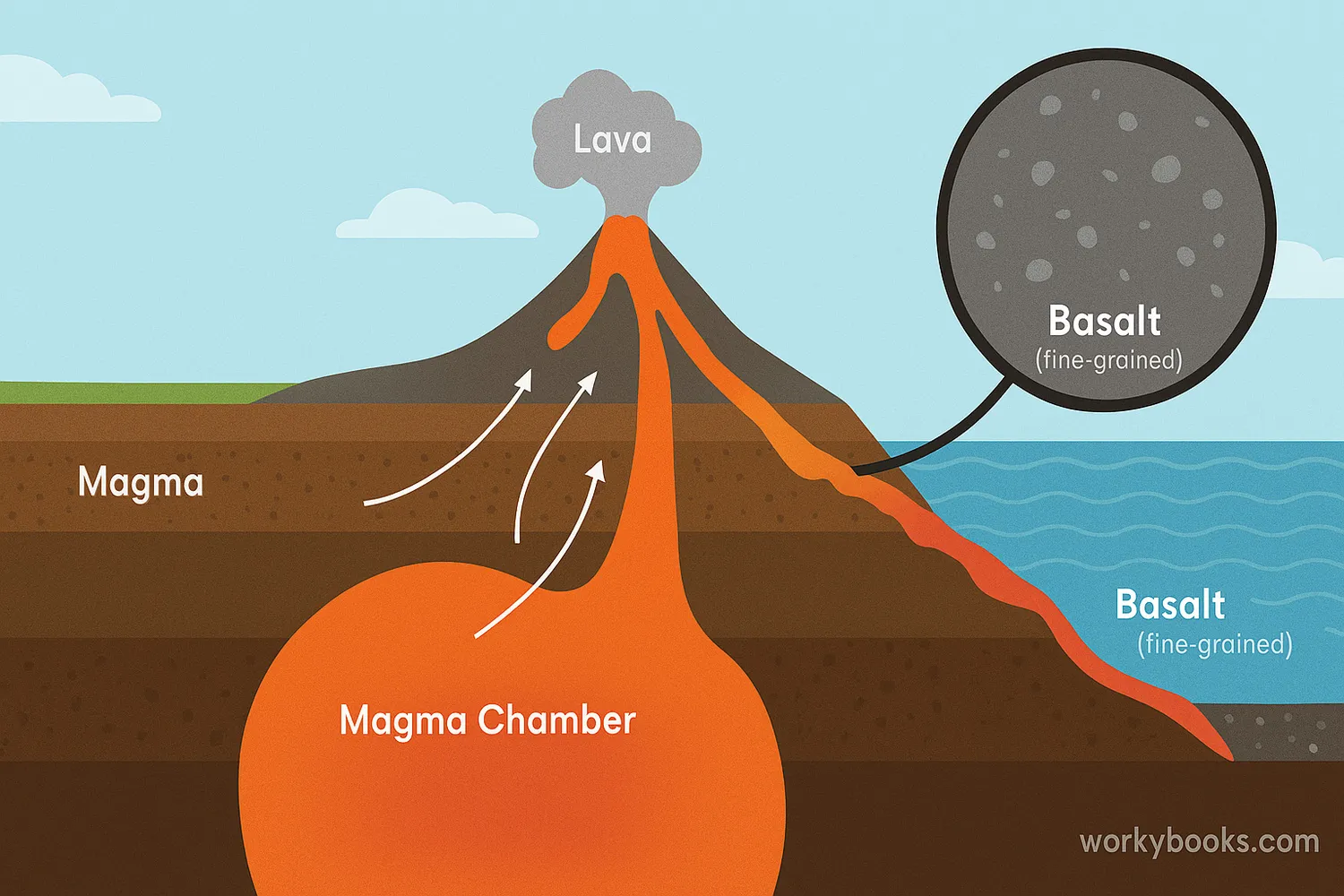
Basalt forms when lava cools quickly after erupting from a volcano onto land or sea.
Have you ever wondered how some of the most common rocks on Earth are made? Let's explore how basalt rock forms, a fascinating process that helps us understand how our planet's surface changes over time. Basalt is a type of igneous rock, which means it forms from the cooling and hardening of molten material.
The journey of basalt begins deep inside Earth, where intense heat melts solid rock into a thick, hot liquid called magma. This magma often gathers in large underground spaces known as magma chambers. Think of these chambers as giant storage tanks for molten rock. When pressure builds up in these chambers, the magma can force its way through cracks in the Earth's crust.
If magma reaches the Earth's surface, it becomes lava. This usually happens during a volcanic eruption. When lava flows out of a volcano, it is incredibly hot, often reaching temperatures over 1,000 degrees Celsius (1,800 degrees Fahrenheit)! As this lava spreads across the land or ocean floor, it begins to cool down very quickly when it touches the cooler air or water.
This rapid cooling is key to how basalt forms. When lava cools quickly, the tiny minerals inside it don't have much time to grow large. Instead, they form very small crystals, making basalt a fine-grained rock. If you look closely at a piece of basalt, you might see these tiny crystals, but they are often too small to see without a magnifying glass. Basalt is typically dark gray or black in color and is one of the most common rocks found on Earth's ocean floors and in many volcanic regions.
Basalt formation is a crucial part of geoscience processes that have shaped Earth's surface for billions of years. It's a clear example of how molten material from deep within our planet can create new landforms and change landscapes dramatically through volcanic activity.
Interesting Fact: The Moon's dark areas, called maria (Latin for 'seas'), are actually vast plains of basalt rock formed from ancient volcanic eruptions!
What is magma?
Solid rock undergroundMolten rock undergroundRock on Earth's surfaceCooled volcanic rock
What color is basalt typically?
Light grayDark gray or blackRed or orangeWhite or clear
How does basalt rock typically form?
Slow cooling of magmaQuick cooling of lavaWeathering of other rocksPressure on sediments
Why do minerals in basalt form small crystals?
Not enough mineralsSlow cooling occursLava cools rapidlyMagma stays underground
Where is basalt commonly found on Earth?
Mountain peaksDesert sandsOcean floorsDeep in forests
What is the molten material called once it reaches Earth's surface?
MagmaBasaltLavaMineral
Which process is key to basalt formation?
Sediment depositionRapid coolingErosion by windHigh pressure
If lava cooled very slowly, what kind of crystals would likely form?
No crystalsLarger crystalsSmaller crystalsFlat crystals
Basalt is a type of sedimentary rock. (True/False)
TrueFalse
What is the definition of a 'volcano' as used in the passage?
An underground caveA mountain made of iceAn opening where lava eruptsA type of crystal
Perfect For:
👩🏫 Teachers
• Reading comprehension practice
• Auto-graded assessments
• Literacy skill development
👨👩👧👦 Parents
• Reading practice at home
• Comprehension improvement
• Educational reading time
🏠 Homeschoolers
• Reading curriculum support
• Independent reading practice
• Progress monitoring
Reading Features:
📖
Reading Passage
Engaging fiction or nonfiction text
❓
Comprehension Quiz
Auto-graded questions
📊
Instant Feedback
Immediate results and scoring
📄
Printable Version
Download for offline reading
🔊
Read Aloud
Voice-over with word highlighting
Reviews & Ratings
No reviews yet. Be the first to share your experience!
Related Content
Tools and Technology in Earth Science
This middle school science reading passage explores the wide range of tools and technologies used in Earth science, from...
MS-ESS2-2MS-ESS3-2MS-ETS1-1MS-PS4-3
Scientific Inquiry in Earth Science
This passage explores scientific inquiry in Earth science for grades 6-8, aligned with NGSS standards MS-ESS1-4, MS-ESS2...
MS-ESS1-4MS-ESS2-1MS-ESS3-5SEP
What Is Earth Science?
This engaging middle school science passage introduces students to the field of Earth science, aligning with NGSS standa...
MS-ESS1MS-ESS2MS-ESS3SEP
Earth: Our Home in Space
This engaging Grade 4-5 science passage, aligned to NGSS, introduces students to Earth's special place in the solar syst...
Earth's Spheres
This middle school science passage introduces students to Earth's four major spheres: the geosphere, hydrosphere, atmosp...
MS-ESS2-4MS-ESS2-6
What Is Space Weather and How Does It Affect the Earth?
This NGSS-aligned science passage for middle school explains what space weather is and how it affects Earth. Students le...
MS-ESS2-2
Earth's Energy Balance
This engaging, NGSS-aligned science passage for grades 6–8 explores Earth's energy balance, a key process that keeps our...
MS-ESS2-6
Earth's Rotation
This middle school science passage, aligned with NGSS standard MS-ESS1-1, focuses on Earth's rotation—how Earth spins on...
MS-ESS1-1
Earth's Land and Water
This 250-word reading passage introduces fourth-grade students to the fundamental concept of how land and water are dist...
NGSS 4-ESS2-2ESS2.B
Earth's Interior
This comprehensive passage for grades 6-8 explores Earth's layered interior, including the crust, mantle, outer core, an...
MS-ESS2-1MS-ESS2-2
Facts About Earth
This engaging science reading passage introduces Grade 4 and 5 students to Earth, our home planet. Aligned with NGSS sta...
Meteorite Impacts on Earth
This engaging science reading passage for Grades 4-5 explores meteorite impacts on Earth, aligning with NGSS standards. ...
Venus: Earth's Twin?
This comprehensive science passage for grades 6-8 examines Venus—often called Earth's twin—by exploring its similarities...
MS-ESS1-2MS-ESS1-3
Earth Changes Over Millions of Years
This engaging, audio-integrated science passage for Grade 4-5 students explores how Earth has changed over millions of y...
Volcano Patterns on Earth
This Grade 4 science reading passage introduces students to volcano patterns on Earth, aligned with NGSS standard 4-ESS2...
NGSS 4-ESS2-2
Earth's Moon Facts
This engaging science passage, 'The Moon: Earth's Companion,' is designed for Grade 4-5 students and aligns with NGSS ge...
Earth's Quick and Slow Changes
In 'Earth's Quick and Slow Changes,' students categorize 12 Earth events by their speed of occurrence, enhancing underst...
Earth: Our Home Planet
This comprehensive science passage for grades 6-8 explores Earth’s unique characteristics and the interconnected systems...
MS-ESS1-2
Earth's Revolution
This middle school science passage explores the science behind Earth's revolution around the Sun, closely aligned with N...
MS-ESS1-1
Earthquake Patterns on Earth
This engaging 250-word reading passage introduces fourth-grade students to earthquake patterns on Earth, aligned with NG...