How Beaks and Teeth Help Animals Eat โ Reading Comprehension
Rate this
Premium Resource
Present
Present in classroom. No work saved
Assign
Classroom with student accounts, Track progress
Quick Play
No student accounts, assign with a link
Grades
3
4
5
Standards
NGSS 4-LS1-1
LS1.A
PRINT+DIGITAL RESOURCE
This learning resource is available in interactive and printable formats. The interactive worksheet can be played online and assigned to students. The Printable PDF version can be downloaded and printed for completion by hand.
This 250-word reading passage introduces fourth-grade students to the relationship between animal structures and their functions, specifically focusing on how beaks and teeth help animals eat. Aligned with NGSS standard 4-LS1-1 and Disciplinary Core Idea LS1.A, the passage explains that external structures like beaks and teeth are shaped for the type of food an animal eats. Students discover how sharp teeth help predators tear meat, flat teeth help herbivores grind plants, and various beak shapes enable birds to access different food sources. The passage uses concrete examples including hawks with hooked beaks for tearing, hummingbirds with long thin beaks for reaching nectar, and parrots with strong curved beaks for cracking seeds. Written at a fourth-grade reading level, the passage includes bolded vocabulary terms with immediate definitions, real-world examples, and an engaging fact about woodpecker beaks. The audio-integrated lesson includes a simplified differentiated version for struggling readers, Spanish translations of both versions, comprehension questions, writing activities, and graphic organizers. This resource helps students build foundational understanding of structure-function relationships in living organisms through accessible, age-appropriate language and scaffolded learning activities.
CONTENT PREVIEW
Expand content preview
Teeth shapes match diets.
Animals have different body parts that help them eat the foods they need to survive. External structures are body parts on the outside of an animal that help it do important jobs. Two important external structures for eating are beaks and teeth. The shape of these structures matches the type of food an animal eats.
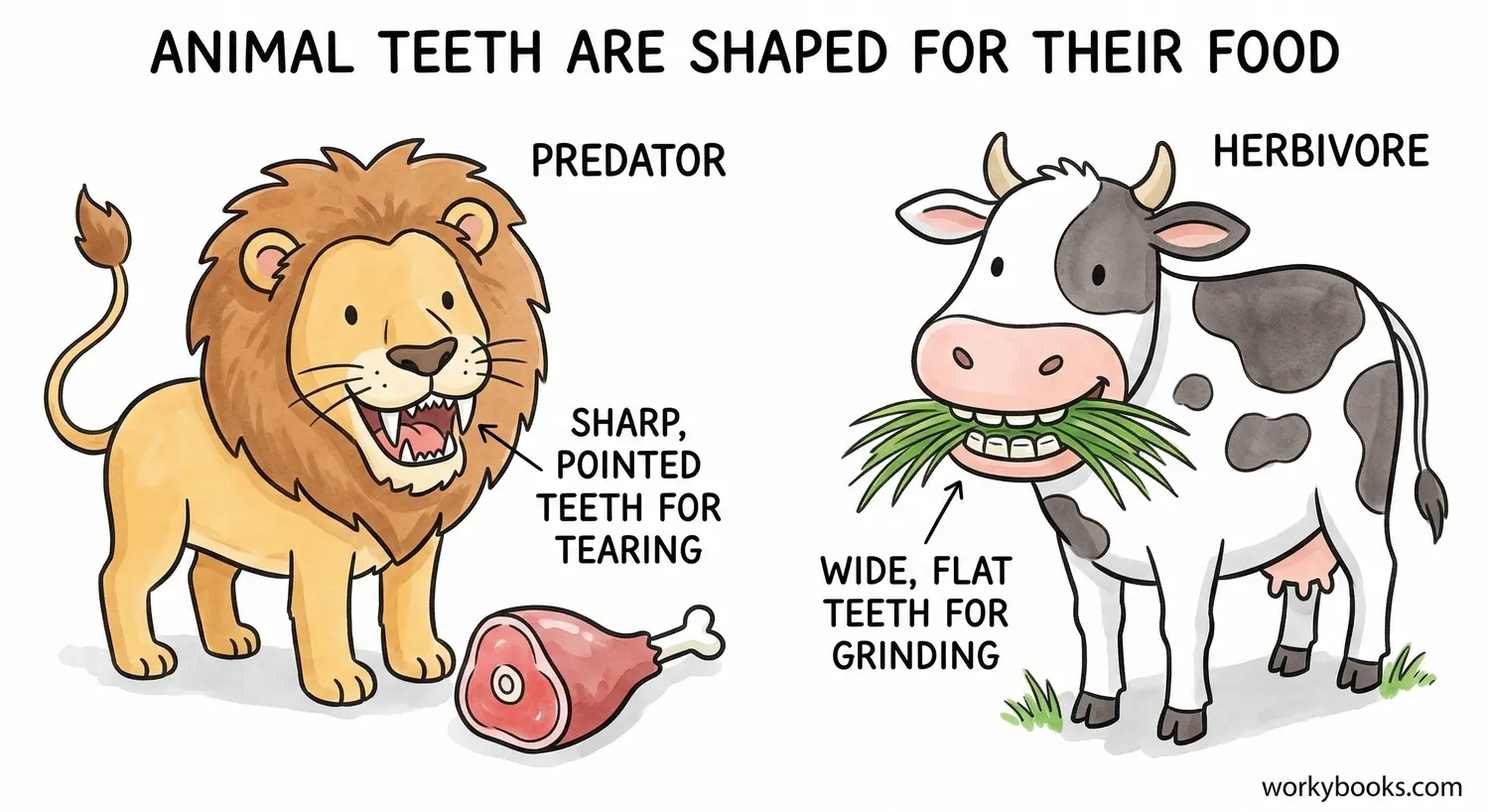
Animals that eat meat are called predators. Predators have sharp, pointed teeth that help them tear and rip meat from their prey. A lion has long, sharp teeth perfect for grabbing and tearing. Animals that eat plants are called herbivores. Herbivores have wide, flat teeth that work like grinding stones to crush tough plant material. A cow's flat back teeth help it chew grass for a long time until the plants are soft enough to swallow.
Birds do not have teeth, but their beaks are shaped for different foods too. A hawk has a sharp, hooked beak that works like a knife to tear meat. A hummingbird has a long, thin beak like a straw that reaches deep inside flowers to drink sweet nectar. A parrot has a thick, curved beak that acts like a nutcracker to break open hard seeds and nuts.
By looking at an animal's teeth or beak, you can figure out what kind of food it eats. The shape of these structures gives you clues about the animal's diet and how it survives in its environment.
Interesting Fact: A woodpecker's beak is so strong it can hammer into tree bark up to 20 times per second without hurting the bird's brain!
What are external structures?
Body parts inside an animalBody parts outside an animalOnly teeth and beaksParts that help animals sleep
What kind of teeth do predators have?
Wide and flat teethNo teeth at allSharp and pointed teethSmall and round teeth
What does a parrot's beak do?
Tears meat from preyReaches into flowers for nectarCracks open seeds and nutsDigs holes in trees
Why do herbivores have flat teeth?
To tear meat easilyTo grind tough plant materialTo catch flying insectsTo dig in the ground
How does a hummingbird's beak help it?
It breaks hard nuts openIt tears meat like a knifeIt reaches deep into flowersIt grinds seeds into powder
What can beak shape tell you?
How fast the bird fliesWhat color the bird isWhat food the bird eatsWhere the bird sleeps
Birds have teeth like other animals.
TrueFalse
What does the word 'herbivore' mean?
An animal that eats only meatAn animal that eats only plantsAn animal that eats everythingAn animal with a beak
Perfect For:
๐ฉโ๐ซ Teachers
โข Reading comprehension practice
โข Auto-graded assessments
โข Literacy skill development
๐จโ๐ฉโ๐งโ๐ฆ Parents
โข Reading practice at home
โข Comprehension improvement
โข Educational reading time
๐ Homeschoolers
โข Reading curriculum support
โข Independent reading practice
โข Progress monitoring
Reading Features:
๐
Reading Passage
Engaging fiction or nonfiction text
โ
Comprehension Quiz
Auto-graded questions
๐
Instant Feedback
Immediate results and scoring
๐
Printable Version
Download for offline reading
๐
Read Aloud
Voice-over with word highlighting
Reviews & Ratings
No reviews yet. Be the first to share your experience!
Related Content
What Are Bones Made Of
This engaging 250-word reading passage introduces Grade 4 students to the structure and function of bones, aligned with ...
NGSS 4-LS1-1LS1.A
How Bones Protect Organs
This engaging 250-word reading passage helps Grade 4 students understand how bones protect organs, aligned with NGSS sta...
NGSS 4-LS1-1LS1.A
How Joints Connect Bones
This 250-word reading passage teaches fourth-grade students about joints and their role in the human skeletal system. Al...
NGSS 4-LS1-1LS1.A
Layers of the Skin
This engaging 250-word reading passage introduces fourth-grade students to the three layers of skin and their functions....
NGSS 4-LS1-1LS1.A
Parts of Plant Stems
This engaging 250-word reading passage introduces fourth-grade students to the internal structure and function of plant ...
NGSS 4-LS1-1LS1.A
Parts of a Flower
This comprehensive 250-word reading passage introduces fourth-grade students to the essential parts of a flower and thei...
NGSS 4-LS1-1LS1.A
How Leaves Make Food
This engaging Grade 4 science reading passage explains how leaves make food through photosynthesis. Students discover th...
NGSS 4-LS1-1LS1.A
How Animal Hearts Work
This 250-word audio-integrated reading passage introduces fourth-grade students to the essential function of the heart a...
NGSS 4-LS1-1LS1.A
Animal Skeleton Structure
This 250-word reading passage introduces fourth grade students to animal skeleton structure, aligned with NGSS 4-LS1-1 a...
NGSS 4-LS1-1LS1.A
How Animal Lungs Work
This 250-word reading passage introduces fourth-grade students to how animal lungs work, aligned with NGSS standard 4-LS...
NGSS 4-LS1-1LS1.A
Parts of a Leaf
This 250-word reading passage introduces Grade 4 students to the internal structure of leaves, aligned with NGSS standar...
NGSS 4-LS1-1LS1.A
Stamen and Pistil
This 250-word reading passage introduces fourth-grade students to the stamen and pistil, the key reproductive structures...
NGSS 4-LS1-1LS1.A
How Internal Structures Help Plants Survive
This 250-word informational reading passage is designed for Grade 4 students and aligns with NGSS standard 4-LS1-1 (LS1....
NGSS 4-LS1-1LS1.A
How Stems Support Plants
This engaging 250-word reading passage helps Grade 4 students understand how stems support plants and contribute to thei...
NGSS 4-LS1-1LS1.A
How Plants Reproduce
This 250-word reading passage introduces fourth-grade students to plant reproduction aligned with NGSS 4-LS1-1 and the D...
NGSS 4-LS1-1LS1.A
How External Structures Help Plants Survive
This 250-word reading passage introduces fourth-grade students to how external plant structures help plants survive, gro...
NGSS 4-LS1-1LS1.A
How Internal Structures Keep Animals Alive
This engaging 250-word reading passage introduces fourth-grade students to the essential internal structures that keep a...
NGSS 4-LS1-1LS1.A
Animal External Structures
This engaging 250-word reading passage introduces fourth-grade students to the concept of animal external structures ali...
NGSS 4-LS1-1LS1.A
What Are Exoskeletons
This engaging 250-word reading passage introduces fourth-grade students to the concept of exoskeletons, aligning with NG...
NGSS 4-LS1-1LS1.A
How Skin Protects Animals
This engaging 250-word reading passage introduces fourth-grade students to the protective functions of skin, the largest...