How Climate Shapes Biomes
Interactive passage with audio narration, comprehension questions, and printable PDF.
By completing this purchase you agree to our Terms of Use and Privacy Policy. Your subscription renews automatically until you cancel. You can cancel anytime from your account settings. All sales are final and non-refundable. Digital content is available for download in your account immediately upon purchase.
What's included
How Climate Shapes Biomes preview and details
About this printable How Climate Shapes Biomes science reading passage, NGSS-aligned (Grades 5-8)
Sample passage and quiz from How Climate Shapes Biomes
Reading passage and comprehension quiz preview
Climate Determines Biome
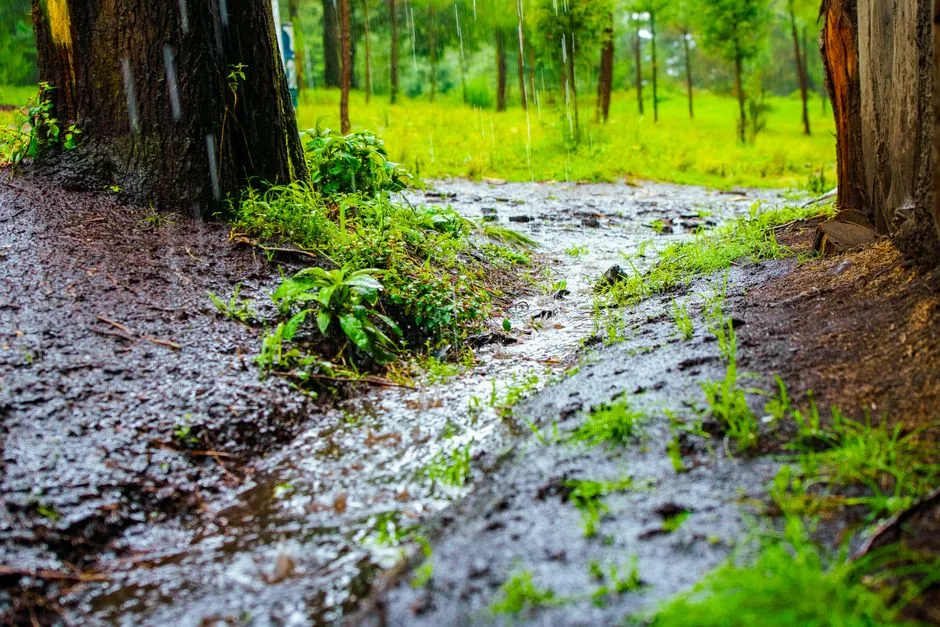
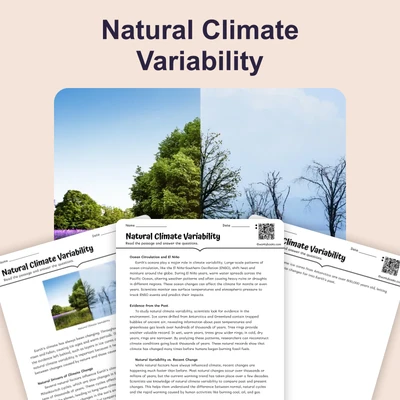
"A serene rainy day in a lush forest in Estado de México, showcasing vibrant greenery and earthy tones." by Jesus Alfonso / Pexels.
The distribution of living things on Earth is not random. Each region supports certain types of plants and animals because of its climate, which is defined by long-term patterns of temperature and precipitation. For example, dense forests thrive in regions with high rainfall and moderate temperatures, while deserts are found where it is hot and dry. Scientists study these patterns to predict what types of large ecological communities, known as biomes, will develop in each region.
How Climate Shapes Biomes
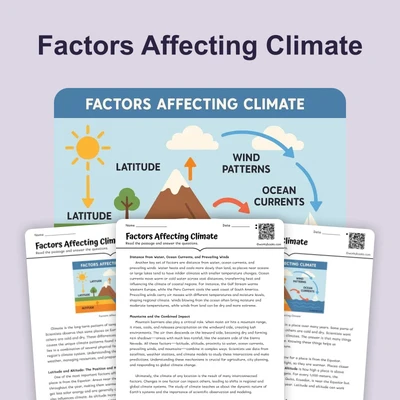
The main drivers of biome formation are temperature and precipitation. These two factors interact to create unique combinations of environmental conditions. For instance, a region with warm temperatures and year-round rainfall becomes a tropical rainforest, supporting tall, broad-leaved trees and diverse animal species. In contrast, an area with low precipitation and extreme temperature fluctuations forms a desert, where only specially adapted plants like cacti and animals like lizards can survive. Scientists use tools called climatographs—graphs that show average monthly temperature and precipitation—to compare climates of different regions. By reading these graphs, scientists can predict the likely biome for a location. For example, if a climatograph shows less than 25 centimeters of rainfall per year and high temperatures, it almost always indicates a desert biome.
Similar Climates, Similar Biomes
One of the most fascinating findings in ecology is that similar climates on different continents often produce similar biomes, even though the species are not related. This is because the same environmental pressures—such as drought or cold—lead to similar adaptations in plants and animals. This phenomenon is called convergent evolution. For instance, the grasslands of North America (prairies) and Africa (savannas) both have grasses as the dominant plants and large grazing animals, despite being on opposite sides of the world. Likewise, deserts in Australia and the Americas have spiny plants and burrowing animals, even though these species evolved separately. This pattern shows how climate acts as a system, shaping life through cause-and-effect relationships that repeat across the globe.
Real-World Applications and Broader Connections
Understanding how climate determines biomes is crucial for predicting how ecosystems might change with global warming. As average temperatures rise or rainfall patterns shift, the boundaries of biomes may move, threatening the survival of species adapted to specific climates. Scientists use this knowledge to model future changes and to plan conservation strategies. This topic connects to the broader scientific principle that living systems depend on and adapt to their physical environment, a key idea in both Earth and life sciences.
Interesting Fact: There are only about 10 major terrestrial biomes on Earth, but each supports thousands of different species shaped by their unique climate conditions!
Comprehension quiz (10 questions)
1. What are the two main climate factors that determine a biome?
2. What tool do scientists use to compare climates and predict biomes?
3. Which biome is usually found in regions with warm temperatures and a lot of rainfall?
4. What is convergent evolution?
5. Based on the passage, what would you expect in an area with less than 25 cm of rainfall per year and high temperatures?
6. What does the word 'biome' mean as used in the passage?
7. What does the word 'adaptation' mean in the context of this passage?
8. Why is it important to understand how climate determines biomes?
9. True or False: Similar climates on different continents can produce similar biomes.
10. True or False: All biomes have the same types of plants and animals.
Perfect for the way you teach
- Build comprehension skills
- Auto-graded quiz
- Differentiated reading
- Read together at home
- Improve fluency
- Quiet reading time
- Reading curriculum support
- Independent practice
- Track Lexile growth