How DEPTHX Explores Underwater Caves
Interactive passage with audio narration, comprehension questions, and printable PDF.
By completing this purchase you agree to our Terms of Use and Privacy Policy. Your subscription renews automatically until you cancel. You can cancel anytime from your account settings. All sales are final and non-refundable. Digital content is available for download in your account immediately upon purchase.
What's included
How DEPTHX Explores Underwater Caves preview and details
About this printable How DEPTHX Explores Underwater Caves science reading passage, NGSS-aligned (Grades 6-8)
Sample passage and quiz from How DEPTHX Explores Underwater Caves
Reading passage and comprehension quiz preview
How DEPTHX Explores Underwater Caves
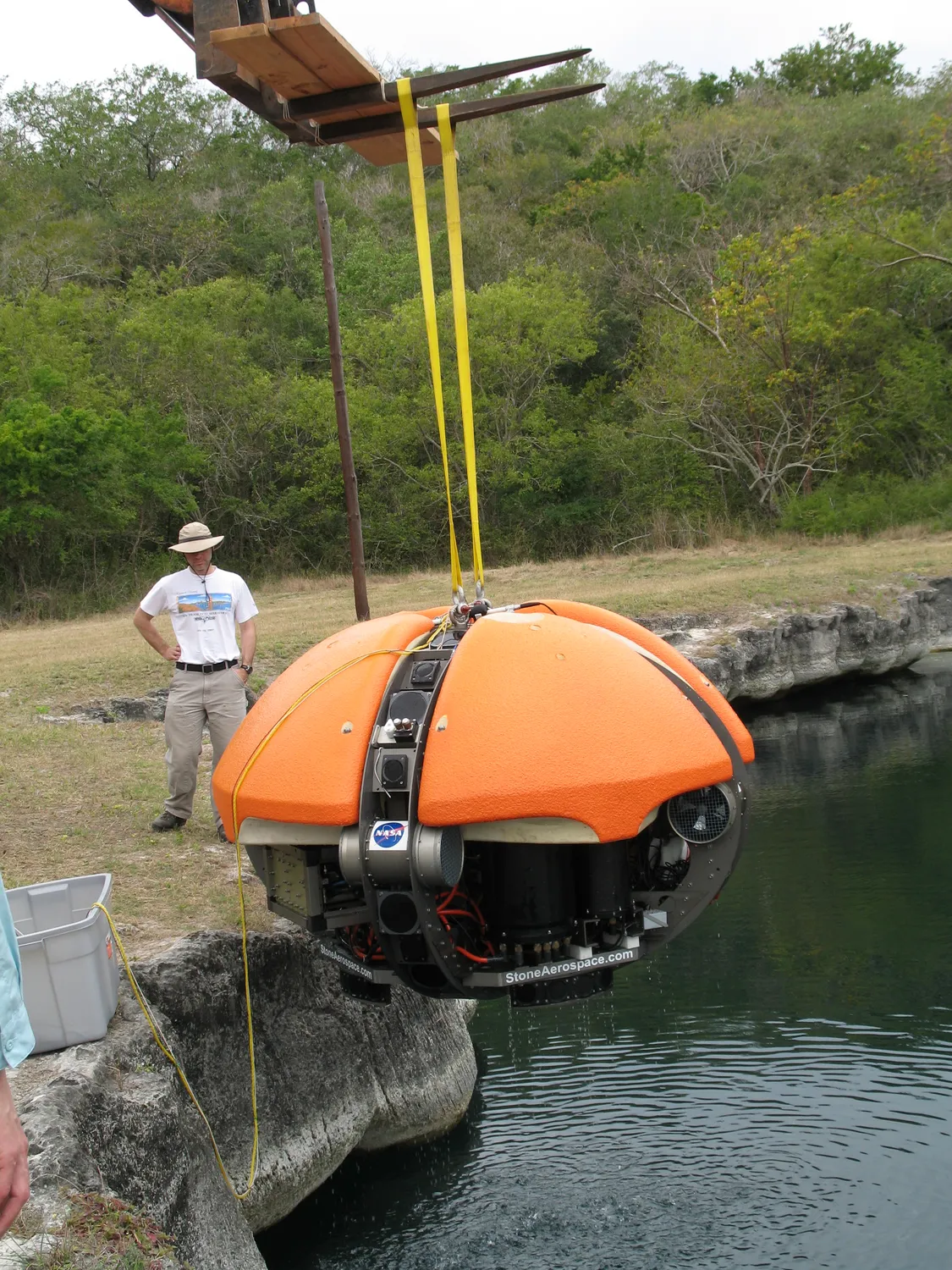
"Depthx" by Marc Airhart (Marcairhart at en.wikipedia) / Wikimedia Commons
DEPTHX is an autonomous underwater robot that explores flooded cave systems without any human control. The name DEPTHX stands for Deep Phreatic Thermal Explorer. Scientists designed this robot to travel into dangerous underwater caves where humans cannot safely go. DEPTHX is shaped like a cylinder, measures about 8 feet long, and weighs approximately 3,000 pounds. Unlike remotely operated vehicles that need cables connecting them to surface operators, DEPTHX makes all its own decisions using onboard artificial intelligence.
The robot uses sonar technology to navigate through completely dark underwater caves. Sonar works by sending out sound waves that bounce off cave walls, rocks, and other objects. When these sound waves return to DEPTHX, the robot's computer calculates distances and creates a three-dimensional map of its surroundings. This process is similar to how bats use echolocation to fly in the dark. DEPTHX sends out sonar pulses constantly as it moves, updating its map in real time. The robot can detect objects and openings that are too small for it to pass through, allowing it to avoid getting stuck.
DEPTHX carries multiple sensors that collect scientific data about the cave environment. Temperature sensors measure water warmth at different depths. Chemical sensors detect dissolved minerals and gases in the water. The robot also carries cameras that capture images when its lights illuminate the darkness. Biological sensors can identify microscopic life forms living in the cave water. All this data gets stored in the robot's memory banks for scientists to analyze later. The sensors work together to create a complete picture of the cave ecosystem.
The artificial intelligence system inside DEPTHX allows it to make complex decisions without human input. The robot must choose which tunnels to explore, when to turn around, and how to return safely to its starting point. It monitors its battery levels and calculates whether it has enough power to explore farther or needs to head back. If DEPTHX encounters an unexpected obstacle, its AI system evaluates different options and selects the safest path. This level of independence is essential because radio signals and cables cannot reach into deep cave systems. The robot operates in complete isolation from its human operators on the surface.
Scientists use DEPTHX to explore extreme environments on Earth that resemble conditions on other planets and moons. Deep underwater caves contain unique life forms called extremophiles that survive without sunlight in harsh chemical conditions. These organisms provide clues about how life might exist in the underground oceans of Jupiter's moon Europa or Saturn's moon Enceladus. Both moons have thick ice shells covering liquid water oceans beneath. By studying how life survives in Earth's extreme cave environments, scientists develop better strategies for searching for extraterrestrial life.
The technology developed for DEPTHX has applications beyond cave exploration. The navigation and mapping systems help engineers design better autonomous vehicles for ocean research, space exploration, and even self-driving cars. The sensor technology improves our ability to monitor water quality in lakes and oceans. The artificial intelligence systems contribute to robotics research across many fields. DEPTHX demonstrates how exploring extreme environments on Earth advances both our understanding of our own planet and our ability to search for life elsewhere in the solar system.
Interesting Fact: DEPTHX successfully explored Zacatón cenote in Mexico, the deepest known water-filled sinkhole in the world at 1,099 feet deep, creating the first complete three-dimensional map of this extreme underwater environment.
Comprehension quiz (10 questions)
1. What does the acronym DEPTHX stand for?
2. How does DEPTHX navigate through dark underwater caves?
3. What is the main advantage of DEPTHX being autonomous?
4. According to the passage, extremophiles are organisms that:
5. Why do scientists study underwater caves on Earth to learn about extraterrestrial life?
6. Which sensors does DEPTHX use to collect scientific data?
7. What important decision must DEPTHX's artificial intelligence make during exploration?
8. How is DEPTHX's use of sonar similar to how bats navigate?
9. DEPTHX can operate without cables connecting it to the surface.
10. The technology developed for DEPTHX has no applications beyond cave exploration.
Perfect for the way you teach
- Build comprehension skills
- Auto-graded quiz
- Differentiated reading
- Read together at home
- Improve fluency
- Quiet reading time
- Reading curriculum support
- Independent practice
- Track Lexile growth