This learning resource is available in interactive and printable formats. The interactive worksheet can be played online and assigned to students. The Printable PDF version can be downloaded and printed for completion by hand.
This audio-integrated reading passage, "How Do Glaciers Form?", introduces Grade 6 students to the fascinating process of glacier formation. It explains how snow compacts over time into ice, leading to the creation of these massive moving ice bodies. The passage uses simple language to define key terms like 'firn' and 'glaciers,' and discusses how glaciers contribute to changing Earth's surface, a core concept within NGSS MS-ESS2-2. Students will learn about the role of cold climates and snowfall in glacier development, and how these geoscience processes impact our planet. This educational content is designed to enhance understanding of geological changes and is supported by engaging activities.
CONTENT PREVIEW
Expand content preview
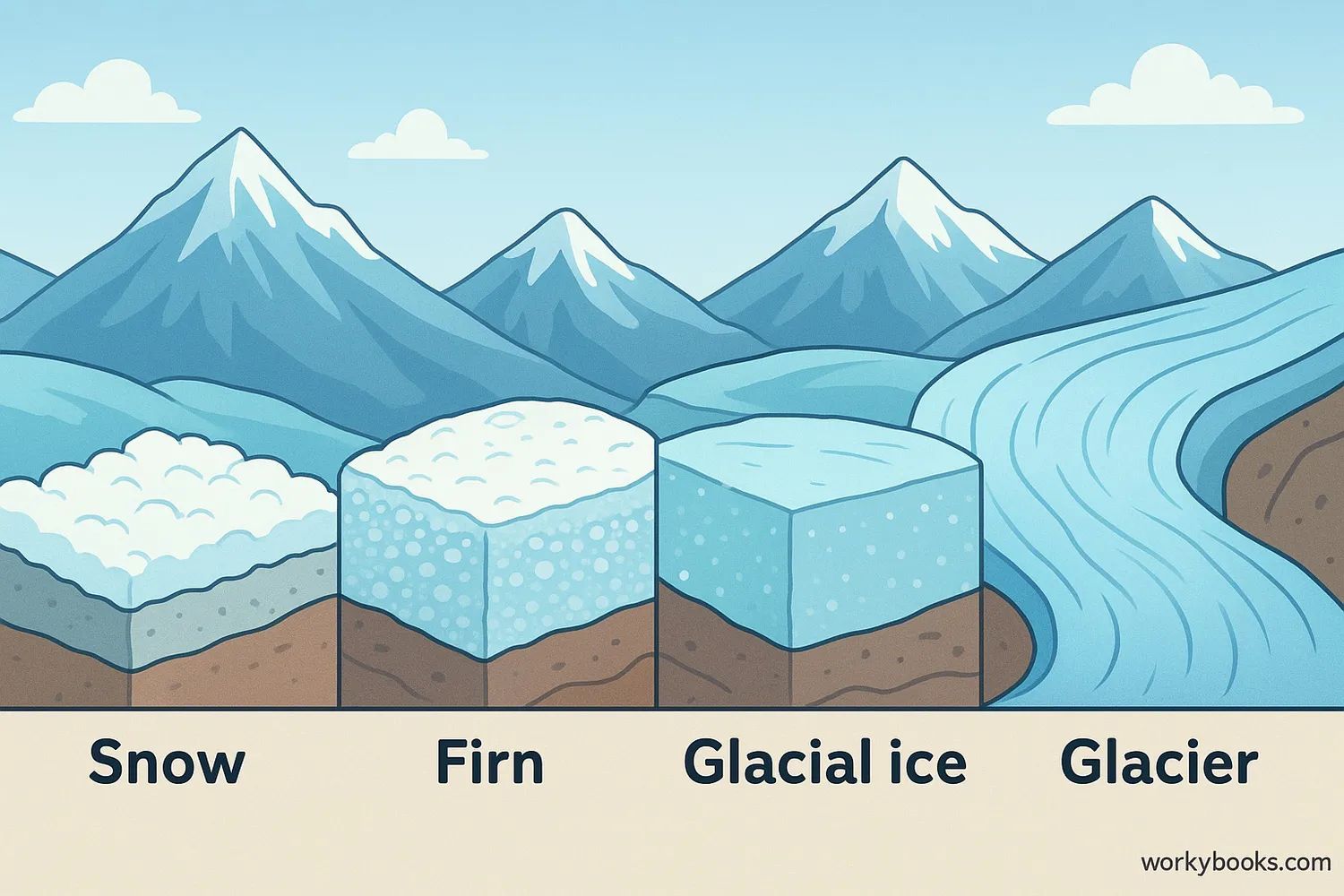
Snow compacts into firn and ice, forming glaciers that reshape mountains and valleys.Let me know if you'd like to expand this into a full set on Earth processes or climate systems!
Glaciers are incredible movers of Earth’s surface, and their creation is a slow, powerful process that takes place over many, many years. It all starts with snow!
For a glacier to form, you need specific conditions: very cold temperatures all year round and a lot of snowfall. These conditions are usually found in high mountains or in polar regions, like the Arctic and Antarctic. When snow falls in these cold places, it doesn't melt completely in the summer. Instead, it stays on the ground, year after year, building up in layers.
Imagine fresh, fluffy snow. As more snow falls on top of it, the weight of the new snow begins to press down on the older layers. This pressure squeezes the air out from between the snowflakes, making the snow denser. The snowflakes also start to change shape, becoming smaller, rounder ice grains. This compacted, granular snow is called firn.
Firn is like a stepping stone between fresh snow and solid glacial ice. Over many decades, or even centuries, the firn continues to get buried under more snow. The pressure increases even more, causing the ice grains to grow larger and interlock, eventually forming solid, dense glacial ice.
This ice is so dense that it often appears blue because it absorbs all other colors of light. Once this massive body of ice becomes thick enough (at least 50 meters or 160 feet deep), its own weight causes it to slowly flow downhill or spread outwards. This slow movement is what officially makes it a glacier.
These geoscience processes continuously shape our planet, showing how the Earth's surface changes over long spatial scales. Glaciers are not just frozen bodies of water; they are powerful agents of erosion and deposition. As they move, they pick up rocks and sediment, grinding down mountainsides and carving out valleys. When the glacier melts, it deposits these materials, creating new landforms. These processes are a vital part of Earth's ever-changing landscape, sometimes taking thousands of years to create dramatic changes in our global climate.
Interesting Fact: About 10% of Earth's land area is covered by glaciers, and if all the ice sheets and glaciers melted, global sea levels would rise by about 230 feet!
What is the first step in glacier formation?
SnowfallIce meltingRocks movingOcean currents
What is granular snow called?
FirnGlacier iceSnowdriftSleet
Why does glacial ice often look blue?
It absorbs light colorsIt reflects blue lightIt contains mineralsIt's near blue sky
What causes the snow to compact and densify?
Weight of new snowSunlight exposureWind erosionOcean water
Where are glaciers typically found?
High mountains, polar regionsDeserts, rainforestsBeaches, swampsUrban areas, grasslands
How deep does a body of ice need to be to flow?
At least 50 metersExactly 20 metersLess than 10 metersOver 500 meters
Glaciers are considered agents of erosion and deposition.
TrueFalse
What does 'deposition' mean in the passage?
Dropping off materialsPicking up materialsFreezing waterMelting ice
If a region has heavy snowfall but warm summers, will a glacier likely form?
No, snow would meltYes, snow would compactMaybe, depending on rainOnly if it rains
How does the formation of firn contribute to glacier formation?
It's an intermediate stageIt speeds up meltingIt stops ice formationIt creates warm spots
Perfect For:
👩🏫 Teachers
• Reading comprehension practice
• Auto-graded assessments
• Literacy skill development
👨👩👧👦 Parents
• Reading practice at home
• Comprehension improvement
• Educational reading time
🏠 Homeschoolers
• Reading curriculum support
• Independent reading practice
• Progress monitoring
Reading Features:
📖
Reading Passage
Engaging fiction or nonfiction text
❓
Comprehension Quiz
Auto-graded questions
📊
Instant Feedback
Immediate results and scoring
📄
Printable Version
Download for offline reading
🔊
Read Aloud
Voice-over with word highlighting
Reviews & Ratings
No reviews yet. Be the first to share your experience!
Related Content
Tools and Technology in Earth Science
This middle school science reading passage explores the wide range of tools and technologies used in Earth science, from...
MS-ESS2-2MS-ESS3-2MS-ETS1-1MS-PS4-3
Scientific Inquiry in Earth Science
This passage explores scientific inquiry in Earth science for grades 6-8, aligned with NGSS standards MS-ESS1-4, MS-ESS2...
MS-ESS1-4MS-ESS2-1MS-ESS3-5SEP
What Is Earth Science?
This engaging middle school science passage introduces students to the field of Earth science, aligning with NGSS standa...
MS-ESS1MS-ESS2MS-ESS3SEP
Earth: Our Home in Space
This engaging Grade 4-5 science passage, aligned to NGSS, introduces students to Earth's special place in the solar syst...
Earth's Spheres
This middle school science passage introduces students to Earth's four major spheres: the geosphere, hydrosphere, atmosp...
MS-ESS2-4MS-ESS2-6
What Is Space Weather and How Does It Affect the Earth?
This NGSS-aligned science passage for middle school explains what space weather is and how it affects Earth. Students le...
MS-ESS2-2
Earth's Energy Balance
This engaging, NGSS-aligned science passage for grades 6–8 explores Earth's energy balance, a key process that keeps our...
MS-ESS2-6
Earth's Rotation
This middle school science passage, aligned with NGSS standard MS-ESS1-1, focuses on Earth's rotation—how Earth spins on...
MS-ESS1-1
Earth's Interior
This comprehensive passage for grades 6-8 explores Earth's layered interior, including the crust, mantle, outer core, an...
MS-ESS2-1MS-ESS2-2
Facts About Earth
This engaging science reading passage introduces Grade 4 and 5 students to Earth, our home planet. Aligned with NGSS sta...
Meteorite Impacts on Earth
This engaging science reading passage for Grades 4-5 explores meteorite impacts on Earth, aligning with NGSS standards. ...
Venus: Earth's Twin?
This comprehensive science passage for grades 6-8 examines Venus—often called Earth's twin—by exploring its similarities...
MS-ESS1-2MS-ESS1-3
Earth Changes Over Millions of Years
This engaging, audio-integrated science passage for Grade 4-5 students explores how Earth has changed over millions of y...
Earth's Moon Facts
This engaging science passage, 'The Moon: Earth's Companion,' is designed for Grade 4-5 students and aligns with NGSS ge...
Earth's Quick and Slow Changes
In 'Earth's Quick and Slow Changes,' students categorize 12 Earth events by their speed of occurrence, enhancing underst...
Earth: Our Home Planet
This comprehensive science passage for grades 6-8 explores Earth’s unique characteristics and the interconnected systems...
MS-ESS1-2
Earth's Revolution
This middle school science passage explores the science behind Earth's revolution around the Sun, closely aligned with N...
MS-ESS1-1
Earth's Seasons
This comprehensive reading passage for grades 6-8 explains why Earth has seasons, revealing the scientific mechanisms be...
MS-ESS1-1
Earth's Place in the Universe
This reading passage explains Earth's place in the universe, supporting NGSS 1-ESS1-1. It describes how Earth is one of ...
1-ESS1-1
Aphelion and Perihelion
This engaging reading passage, 'Aphelion and Perihelion,' delves into the fascinating aspects of Earth's elliptical orbi...
MS-ESS1-1: DEVELOP AND USE A MODEL OF THE EARTH-SUN-MOON SYSTEM TO DESCRIBE THE CYCLIC PATTERNS OF LUNAR PHASESECLIPSES OF THE SUN AND MOONAND SEASONS.