How Do Scientists Predict Eclipses
Interactive passage with audio narration, comprehension questions, and printable PDF.
By completing this purchase you agree to our Terms of Use and Privacy Policy. Your subscription renews automatically until you cancel. You can cancel anytime from your account settings. All sales are final and non-refundable. Digital content is available for download in your account immediately upon purchase.
What's included
How Do Scientists Predict Eclipses preview and details
About this printable How Do Scientists Predict Eclipses science reading passage, NGSS-aligned (Grades 5-8)
Sample passage and quiz from How Do Scientists Predict Eclipses
Reading passage and comprehension quiz preview
How Do Scientists Predict Eclipses
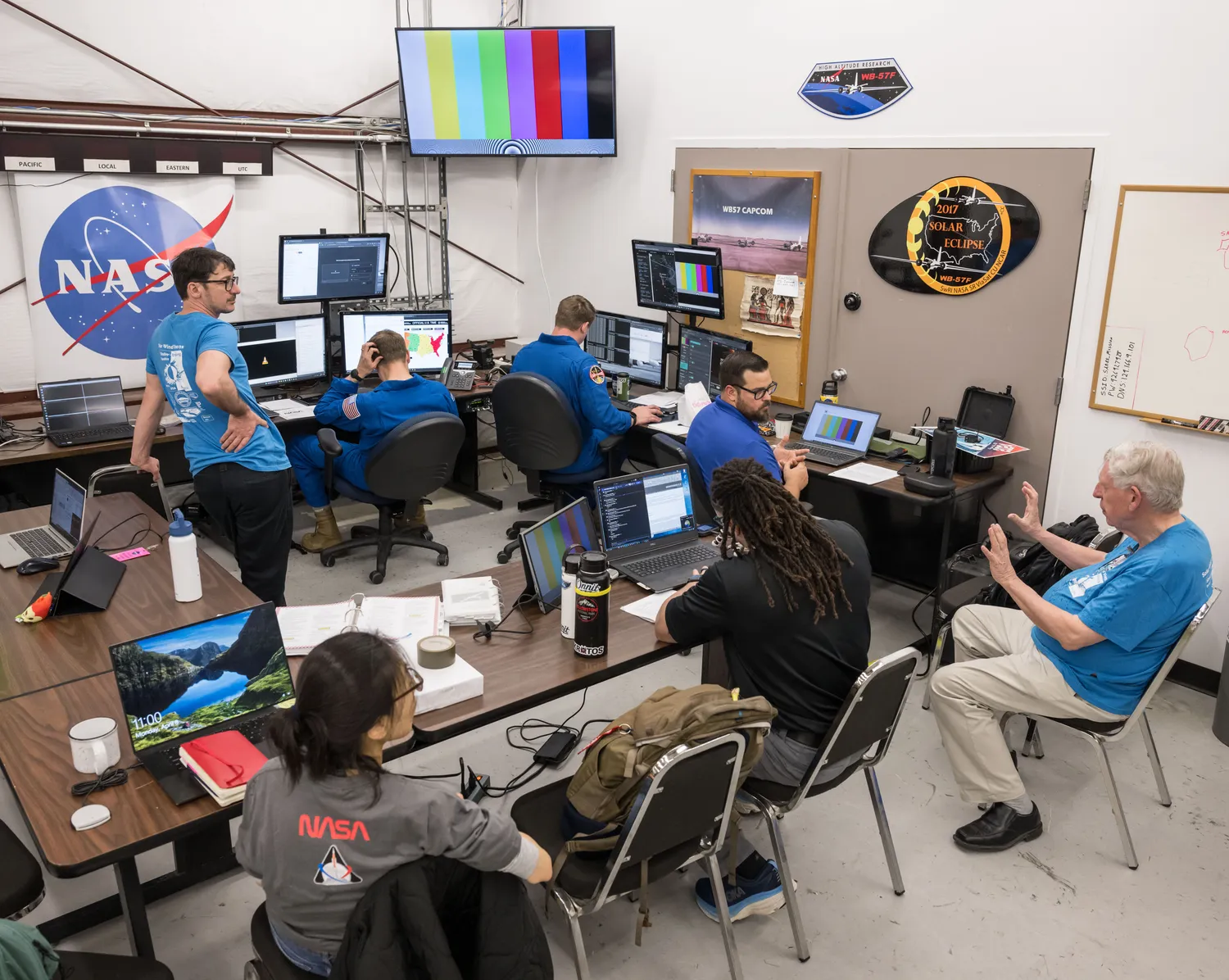
Science teams prepare for the 2024 total solar eclipse experiments on the WB-57 jets on April 8, 2024, at Ellington Field in Houston, Texas.Credit: NASA/James Blair.
Scientists predict eclipses by using precise mathematical calculations based on the orbits of Earth and the Moon. An eclipse occurs when one celestial body moves into the shadow of another. Solar eclipses happen when the Moon passes between Earth and the Sun. Lunar eclipses occur when Earth blocks sunlight from reaching the Moon. Because these orbits follow predictable patterns, astronomers can calculate exactly when and where eclipses will occur.
The key to eclipse prediction lies in understanding orbital mechanics. Earth orbits the Sun once every 365.25 days. The Moon orbits Earth approximately every 29.5 days. Scientists measure the exact speed, distance, and angle of these orbits. They use this data to determine when the three bodies will align. This alignment must be nearly perfect for an eclipse to happen. The Moon's orbit tilts about five degrees compared to Earth's orbit around the Sun. This tilt means eclipses only occur during specific windows when the orbital paths cross.
Ancient cultures discovered eclipse patterns without modern technology. The Babylonians identified the saros cycle around 2,400 years ago. This 18-year, 11-day cycle shows that eclipse patterns repeat. Evidence shows they could predict lunar eclipses with reasonable accuracy. Chinese astronomers also kept detailed records of eclipses for centuries. These observations helped them recognize patterns in celestial movements.
Modern scientists use powerful computers to create detailed eclipse maps. NASA publishes predictions showing eclipse paths thousands of years into the past and future. For example, NASA's eclipse catalog includes data from 2000 BCE to 3000 CE. These maps show the exact path of totality, where observers can see a complete solar eclipse. The maps also indicate the precise time an eclipse will begin and end at any location. This precision helps scientists, travelers, and researchers plan observations years in advance.
Eclipse prediction matters because it demonstrates how mathematical models can describe natural phenomena. Understanding orbital mechanics allows scientists to make accurate long-term forecasts. This same mathematical approach helps astronomers study other planetary systems. It also supports space missions that require precise calculations of celestial positions. Eclipse predictions show how observation, measurement, and mathematics work together in science.
Interesting Fact: The next total solar eclipse visible from the contiguous United States will occur on August 23, 2044. Scientists calculated this date decades in advance using orbital data.
Comprehension quiz (10 questions)
1. What is the main reason scientists can predict eclipses centuries in advance?
2. How often does the Moon orbit Earth?
3. What does the term 'orbital mechanics' mean in the passage?
4. What is the saros cycle?
5. Why do eclipses only occur during specific windows of time?
6. Based on the passage, which ancient culture identified the saros cycle?
7. What can be inferred about NASA's eclipse catalog spanning from 2000 BCE to 3000 CE?
8. How does understanding eclipse prediction help space missions?
9. True or False: A lunar eclipse occurs when the Moon passes between Earth and the Sun.
10. True or False: Ancient Chinese astronomers kept detailed records of eclipses that helped them recognize patterns.
Perfect for the way you teach
- Build comprehension skills
- Auto-graded quiz
- Differentiated reading
- Read together at home
- Improve fluency
- Quiet reading time
- Reading curriculum support
- Independent practice
- Track Lexile growth