Reading PassagePremium

How Do Scientists Study Earth's Interior

Interactive passage with audio narration, comprehension questions, and printable PDF.

No ratings yet|
1
Grades 5–8ScienceElaEnglish · SpanishInteractive · Printable
Aligned toMS-ESS2-1
Just this resource
$1.50
One-time purchase
Best value
Unlock everything
$49.99$29.99/yr
40% off until Aug 1 — 10,000+ resources
Renews at $49.99/year.
Unlock above to use these actions

What's included

Reading passage
Audio narration
Comprehension quiz
Writing activity
Glossary & flashcards
Differentiated version
Spanish translation

How Do Scientists Study Earth's Interior preview and details

About this printable How Do Scientists Study Earth's Interior science reading passage, NGSS-aligned (Grades 5-8)

science,ela
Written by Workybooks TeamPublished by Workybooks
Preview

Sample passage and quiz from How Do Scientists Study Earth's Interior

Reading passage and comprehension quiz preview

How Do Scientists Study Earth's Interior
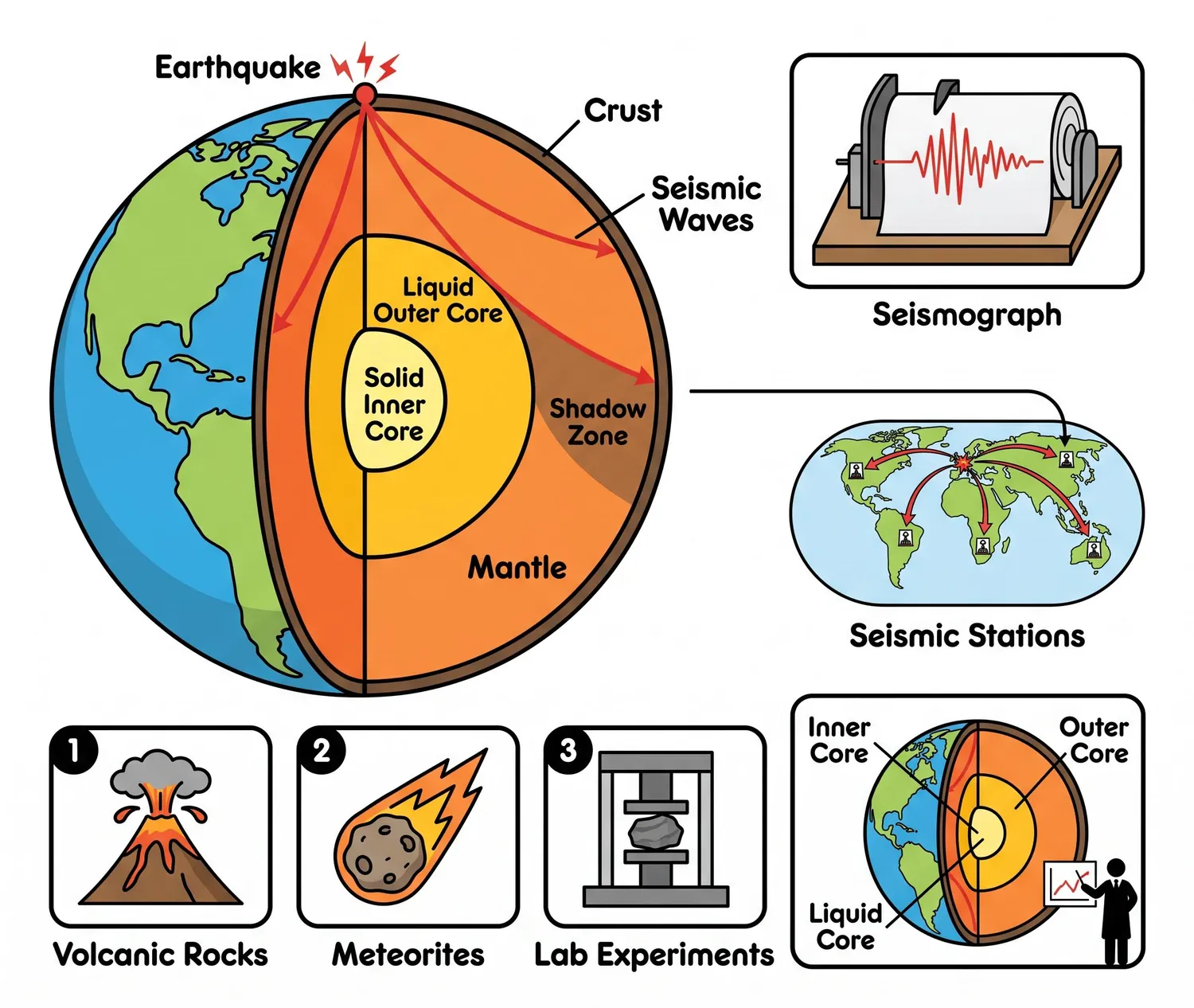
Scientists use seismic waves to study Earth's interior and layered structure.
Seismic waves reveal Earth's hidden layers and liquid outer core.

Scientists face a challenging puzzle when studying Earth's interior. No one has ever traveled to the center of our planet. The deepest hole humans have drilled reaches only about 12 kilometers into the crust. Earth's radius measures over 6,000 kilometers. Scientists cannot observe the inner layers directly, yet they have mapped them with surprising accuracy.

The main tool scientists use is seismic waves. These are energy waves that travel through Earth during earthquakes. When rocks break and shift underground, they release energy that moves outward in waves. Scientists observe how these waves behave as they pass through different materials. Seismic waves speed up, slow down, or bend depending on what they encounter. Some waves even stop completely when they hit certain materials.

Scientists use instruments called seismographs to detect and record seismic waves. By comparing data from many earthquakes recorded at stations around the world, scientists can identify patterns. Evidence shows that some waves travel straight through solid rock but cannot pass through liquid. This discovery revealed that Earth's outer core must be liquid. The waves that could not travel through this layer simply disappeared from the recordings on the opposite side of Earth.

Scientists also study other types of evidence to understand Earth's interior. Volcanic rocks bring material from deep in the mantle to the surface. Meteorites provide clues because many formed at the same time as Earth from similar materials. Laboratory experiments help scientists test how rocks and metals behave under extreme heat and pressure. These conditions match what exists deep inside our planet.

In 1936, scientist Inge Lehmann analyzed seismic wave data and discovered Earth has both an outer and inner core. She noticed that some waves appeared in places they should not have reached if the core was entirely liquid. Her careful analysis of indirect evidence led to the discovery that the inner core is solid. This finding changed our understanding of Earth's structure.

Understanding Earth's interior matters for many reasons. The liquid outer core generates Earth's magnetic field, which protects us from harmful solar radiation. Studying seismic waves helps scientists predict where earthquakes may occur. This knowledge of Earth's layers also explains how continents move and why volcanoes form in certain locations.

Interesting Fact: Seismic waves from large earthquakes can travel completely through Earth and be detected on the opposite side of the planet in about 20 minutes. Some waves even bounce back and forth through Earth multiple times before their energy fades away.

Comprehension quiz (10 questions)

1. What is the main tool scientists use to study Earth's interior?

Deep drilling equipment
Seismic waves from earthquakes
Satellite imagery
Volcanic eruptions

2. How deep is the deepest hole humans have ever drilled into Earth's crust?

About 12 kilometers
About 120 kilometers
About 1,200 kilometers
About 6,000 kilometers

3. What does the term 'indirect evidence' mean in the context of studying Earth's interior?

Evidence collected by drilling into Earth
Information that helps scientists understand something they cannot observe directly
Data collected from space satellites
Measurements taken at Earth's surface only

4. Based on the passage, what can you infer about why seismic waves are useful for studying Earth's interior?

They are the only waves that exist in nature
They change behavior when passing through different materials
They only travel through liquid materials
They are easy to create in laboratories

5. How did scientists determine that Earth's outer core is liquid?

By drilling into the outer core
By observing volcanic eruptions
By noticing that certain seismic waves could not pass through it
By studying meteorites from space

6. Who discovered that Earth has both an outer core and an inner core?

Albert Einstein
Marie Curie
Inge Lehmann
Isaac Newton

7. If a new earthquake occurred, how might scientists use seismic wave data to learn more about Earth's structure?

By measuring only the earthquake's strength
By comparing wave patterns from multiple recording stations
By counting how many people felt the earthquake
By looking at pictures of damaged buildings

8. Why is understanding Earth's interior important for predicting earthquakes?

It helps scientists know where earthquakes may occur
It allows scientists to stop earthquakes from happening
It makes earthquakes less dangerous
It helps people feel less scared of earthquakes

9. True or False: Scientists can directly observe Earth's inner core by drilling deep holes.

True
False

10. True or False: The liquid outer core generates Earth's magnetic field, which protects us from harmful solar radiation.

True
False
Who it's for

Perfect for the way you teach

Teachers
  • Build comprehension skills
  • Auto-graded quiz
  • Differentiated reading
Parents
  • Read together at home
  • Improve fluency
  • Quiet reading time
Homeschoolers
  • Reading curriculum support
  • Independent practice
  • Track Lexile growth
Topics

Reviews & Ratings

No reviews yet. Be the first to share your experience!

More reading you might love

20 more
Passage
Frost Wedging: How Ice Splits Rock - reading educational content
Grades 5–8

Frost Wedging: How Ice Splits Rock

earth and space science · MS-ESS2-1

$1.50
Passage
Limestone Caves: Nature’s Underground Wonders - reading educational content
Grades 5–8

Limestone Caves: Nature’s Underground Wonders

science · MS-ESS2-1

Free
Passage
Chemical Weathering: The Breakdown of Rocks Through Chemical Reactions - reading educational content
Grades 5–8

Chemical Weathering: The Breakdown of Rocks Through Chemical Reactions

earth and space science · MS-ESS2-1

Free
Passage
Talus Slopes: Formation and Features - reading educational content
Grades 5–8

Talus Slopes: Formation and Features

science · MS-ESS2-1

Free
Passage
Biological Weathering: Types and Examples - reading educational content
Grades 5–8

Biological Weathering: Types and Examples

science · MS-ESS2-1

Free
Passage
The Coldest City in the World: Yakutsk - reading educational content
Grades 5–8

The Coldest City in the World: Yakutsk

weather and climate · MS-ESS2-1

$1.50
Passage
Igneous Rocks - reading educational content
Grades 5–8

Igneous Rocks

earth and space science · MS-ESS2-1

$1.50
Passage
Sedimentary Rocks - reading educational content
Grades 5–8

Sedimentary Rocks

earth and space science · MS-ESS2-1

$1.50
Passage
Metamorphic Rocks - reading educational content
Grades 5–8

Metamorphic Rocks

earth and space science · MS-ESS2-1

Free
Passage
Scientific Inquiry in Earth Science - reading educational content
Grades 5–8

Scientific Inquiry in Earth Science

earth and space science · MS-ESS1-4

$1.50
Passage
Contour Lines and Elevation - reading educational content
Grades 5–8

Contour Lines and Elevation

earth and space science · MS-ESS2-2

$1.50
Passage
Weathering - reading educational content
Grades 5–8

Weathering

earth and space science · MS-ESS2-1

$1.50
Passage
Erosion - reading educational content
Grades 5–8

Erosion

earth and space science · MS-ESS2-1

$1.50
Passage
Stream Erosion and Deposition - reading educational content
Grades 5–8

Stream Erosion and Deposition

earth and space science · MS-ESS2-1

$1.50
Passage
Wind Erosion and Deposition - reading educational content
Grades 5–8

Wind Erosion and Deposition

earth and space science · MS-ESS2-1

$1.50
Passage
Glacial Erosion and Deposition - reading educational content
Grades 5–8

Glacial Erosion and Deposition

earth and space science · MS-ESS2-1

$1.50
Passage
Mass Movements - reading educational content
Grades 5–8

Mass Movements

science · MS-ESS2-1

$1.50
Passage
Soil Formation and Composition - reading educational content
Grades 5–8

Soil Formation and Composition

earth and space science · MS-ESS2-1

$1.50
Passage
Constructive and Destructive Forces - reading educational content
Grades 5–8

Constructive and Destructive Forces

earth and space science · MS-ESS2-1

Free
Passage
Mountains and Mountain Building - reading educational content
Grades 5–8

Mountains and Mountain Building

earth and space science · MS-ESS2-1

$1.50
Copyright © 2026 Workybooks. Made with ♥ in California.