Reading PassagePremium

How Does Heat Move Through Earth

Interactive passage with audio narration, comprehension questions, and printable PDF.

No ratings yet|
2
Grades 5–8ScienceElaEnglish · SpanishInteractive · Printable
Aligned toMS-ESS2-1
Just this resource
$1.50
One-time purchase
Best value
Unlock everything
$49.99$29.99/yr
40% off until Aug 1 — 10,000+ resources
Renews at $49.99/year.
Unlock above to use these actions

What's included

Reading passage
Audio narration
Comprehension quiz
Writing activity
Glossary & flashcards
Differentiated version
Spanish translation

How Does Heat Move Through Earth preview and details

About this printable How Does Heat Move Through Earth science reading passage, NGSS-aligned (Grades 5-8)

science,ela
Written by Workybooks TeamPublished by Workybooks
Preview

Sample passage and quiz from How Does Heat Move Through Earth

Reading passage and comprehension quiz preview

How Does Heat Move Through Earth
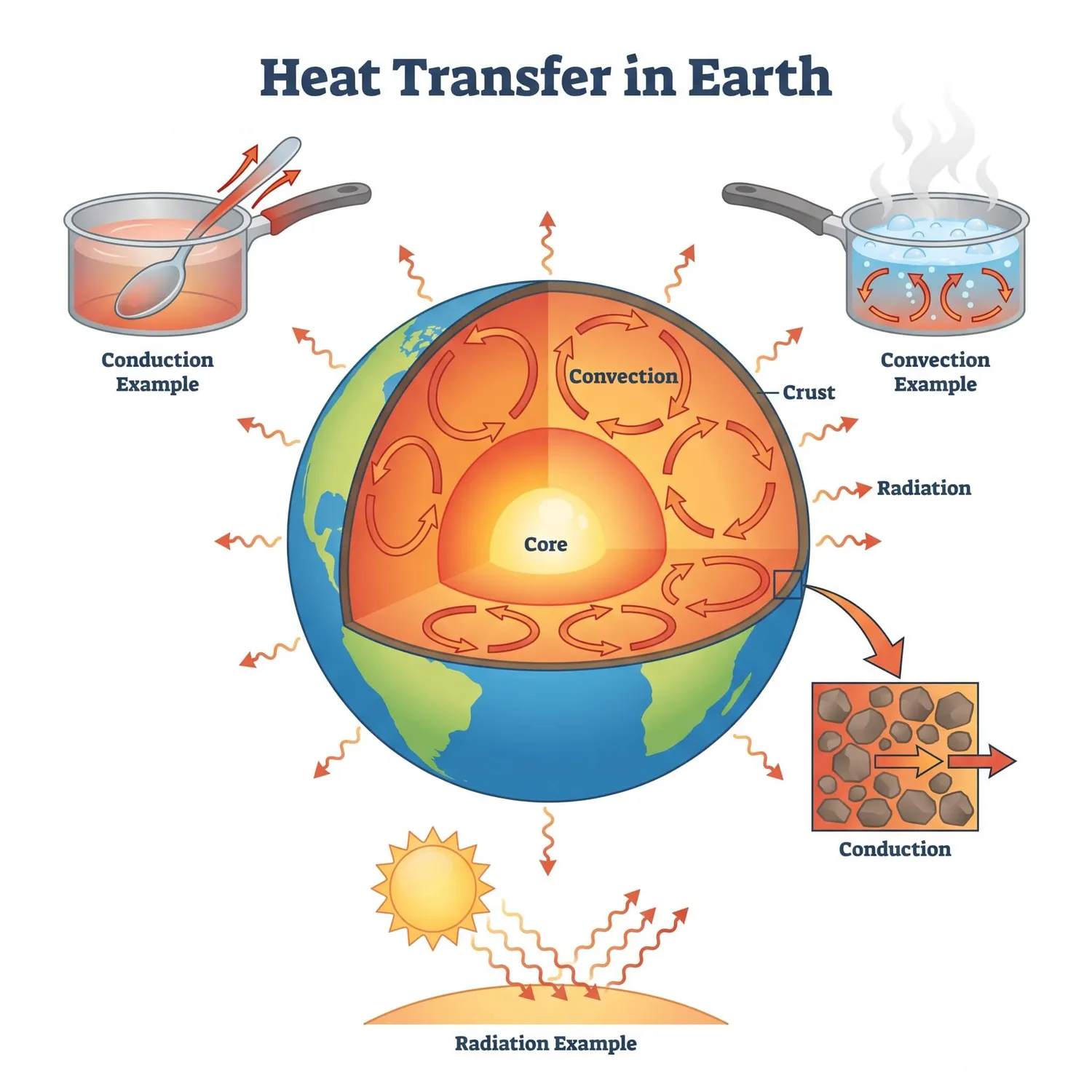
Earth heat transfer diagram showing conduction, convection, and radiation inside Earth's interior processes
Earth transfers heat through conduction, convection, and radiation driving geological activity continuously.

Heat moves through Earth in three main ways: conduction, convection, and radiation. Each method transfers thermal energy differently. Understanding these processes helps scientists explain how Earth's interior works and why our planet stays geologically active.

Conduction happens when heat passes directly through solid material. Particles in the material vibrate and bump into neighboring particles. This bumping transfers energy from one particle to the next. A metal spoon warming in hot soup demonstrates conduction. Inside Earth, conduction moves heat through rigid rock in the crust and upper mantle. However, rock conducts heat slowly, so conduction alone cannot explain all heat movement in Earth's interior.

Convection transfers heat through the movement of material itself. Warmer material becomes less dense and rises. Cooler material becomes more dense and sinks. This creates a circular flow pattern called a convection current. Soup swirling in a pot shows convection in action. Inside Earth, convection occurs in the slowly flowing mantle and the liquid outer core. Evidence shows that convection in the mantle can move rock several centimeters per year. This movement drives plate tectonics and shapes Earth's surface over millions of years.

Radiation transfers energy as waves that can travel through empty space. The Sun's warmth reaching Earth demonstrates radiation. Inside Earth, radiation plays a smaller role than conduction and convection. The core radiates some energy outward, but most heat moves through the other two methods.

Scientists observe that convection is the most important heat transfer method in Earth's interior. The mantle's convection currents carry tremendous amounts of thermal energy upward from the core. This process powers volcanoes, earthquakes, and mountain building. Without convection, Earth would be a geologically dead planet. The combination of all three heat transfer methods keeps our planet dynamic and ever-changing.

Interesting Fact: The mantle's convection currents move so slowly that a single complete cycle can take 100 million years to finish!

Comprehension quiz (10 questions)

1. What are the three main ways heat moves through Earth?

Conduction, convection, and radiation
Vibration, circulation, and emission
Melting, flowing, and cooling
Compression, expansion, and rotation

2. How does conduction transfer heat?

Through waves traveling in empty space
Through particles bumping into neighboring particles
Through material rising and sinking
Through chemical reactions in rocks

3. What does the term 'dense' mean in the context of this passage?

Very hot and liquid
Moving in a circular pattern
Having particles packed tightly together
Able to conduct electricity

4. According to the passage, a 'convection current' is best described as:

Electricity flowing through metal
A circular flow pattern of rising warm material and sinking cool material
Waves of energy traveling through space
Particles vibrating and bumping each other

5. Based on the passage, why is convection more important than conduction in Earth's interior?

Conduction only works in empty space
Rock conducts heat slowly, while convection moves large amounts of heat through flowing material
Convection happens only in the crust
Conduction requires sunlight to work

6. Which layer of Earth experiences convection according to the passage?

Only the crust
The mantle and outer core
Only the inner core
The atmosphere only

7. If you wanted to apply the concept of convection to predict what would happen in a pot of water on a stove, what would you expect?

The water would stay completely still
Warmer water would rise and cooler water would sink, creating circular movement
The water would turn into ice
Only the top layer would get warm

8. How does convection in the mantle affect Earth's surface?

It has no effect on the surface
It drives plate tectonics and shapes Earth's surface over millions of years
It only affects ocean currents
It makes the surface perfectly smooth

9. True or False: Radiation is the most important method of heat transfer inside Earth.

True
False

10. True or False: Without convection, Earth would be a geologically active planet with many volcanoes and earthquakes.

True
False
Who it's for

Perfect for the way you teach

Teachers
  • Build comprehension skills
  • Auto-graded quiz
  • Differentiated reading
Parents
  • Read together at home
  • Improve fluency
  • Quiet reading time
Homeschoolers
  • Reading curriculum support
  • Independent practice
  • Track Lexile growth
Topics

Reviews & Ratings

No reviews yet. Be the first to share your experience!

More reading you might love

20 more
Passage
Frost Wedging: How Ice Splits Rock - reading educational content
Grades 5–8

Frost Wedging: How Ice Splits Rock

earth and space science · MS-ESS2-1

$1.50
Passage
Limestone Caves: Nature’s Underground Wonders - reading educational content
Grades 5–8

Limestone Caves: Nature’s Underground Wonders

science · MS-ESS2-1

Free
Passage
Chemical Weathering: The Breakdown of Rocks Through Chemical Reactions - reading educational content
Grades 5–8

Chemical Weathering: The Breakdown of Rocks Through Chemical Reactions

earth and space science · MS-ESS2-1

Free
Passage
Talus Slopes: Formation and Features - reading educational content
Grades 5–8

Talus Slopes: Formation and Features

science · MS-ESS2-1

Free
Passage
Biological Weathering: Types and Examples - reading educational content
Grades 5–8

Biological Weathering: Types and Examples

science · MS-ESS2-1

Free
Passage
The Coldest City in the World: Yakutsk - reading educational content
Grades 5–8

The Coldest City in the World: Yakutsk

weather and climate · MS-ESS2-1

$1.50
Passage
Igneous Rocks - reading educational content
Grades 5–8

Igneous Rocks

earth and space science · MS-ESS2-1

$1.50
Passage
Sedimentary Rocks - reading educational content
Grades 5–8

Sedimentary Rocks

earth and space science · MS-ESS2-1

$1.50
Passage
Metamorphic Rocks - reading educational content
Grades 5–8

Metamorphic Rocks

earth and space science · MS-ESS2-1

Free
Passage
Scientific Inquiry in Earth Science - reading educational content
Grades 5–8

Scientific Inquiry in Earth Science

earth and space science · MS-ESS1-4

$1.50
Passage
Contour Lines and Elevation - reading educational content
Grades 5–8

Contour Lines and Elevation

earth and space science · MS-ESS2-2

$1.50
Passage
Weathering - reading educational content
Grades 5–8

Weathering

earth and space science · MS-ESS2-1

$1.50
Passage
Erosion - reading educational content
Grades 5–8

Erosion

earth and space science · MS-ESS2-1

$1.50
Passage
Stream Erosion and Deposition - reading educational content
Grades 5–8

Stream Erosion and Deposition

earth and space science · MS-ESS2-1

$1.50
Passage
Wind Erosion and Deposition - reading educational content
Grades 5–8

Wind Erosion and Deposition

earth and space science · MS-ESS2-1

$1.50
Passage
Glacial Erosion and Deposition - reading educational content
Grades 5–8

Glacial Erosion and Deposition

earth and space science · MS-ESS2-1

$1.50
Passage
Mass Movements - reading educational content
Grades 5–8

Mass Movements

science · MS-ESS2-1

$1.50
Passage
Soil Formation and Composition - reading educational content
Grades 5–8

Soil Formation and Composition

earth and space science · MS-ESS2-1

$1.50
Passage
Constructive and Destructive Forces - reading educational content
Grades 5–8

Constructive and Destructive Forces

earth and space science · MS-ESS2-1

Free
Passage
Mountains and Mountain Building - reading educational content
Grades 5–8

Mountains and Mountain Building

earth and space science · MS-ESS2-1

$1.50
Copyright © 2026 Workybooks. Made with ♥ in California.