How Does Mantle Convection Work
Interactive passage with audio narration, comprehension questions, and printable PDF.
By completing this purchase you agree to our Terms of Use and Privacy Policy. Your subscription renews automatically until you cancel. You can cancel anytime from your account settings. All sales are final and non-refundable. Digital content is available for download in your account immediately upon purchase.
What's included
How Does Mantle Convection Work preview and details
About this printable How Does Mantle Convection Work science reading passage, NGSS-aligned (Grades 5-8)
Sample passage and quiz from How Does Mantle Convection Work
Reading passage and comprehension quiz preview
How Does Mantle Convection Work
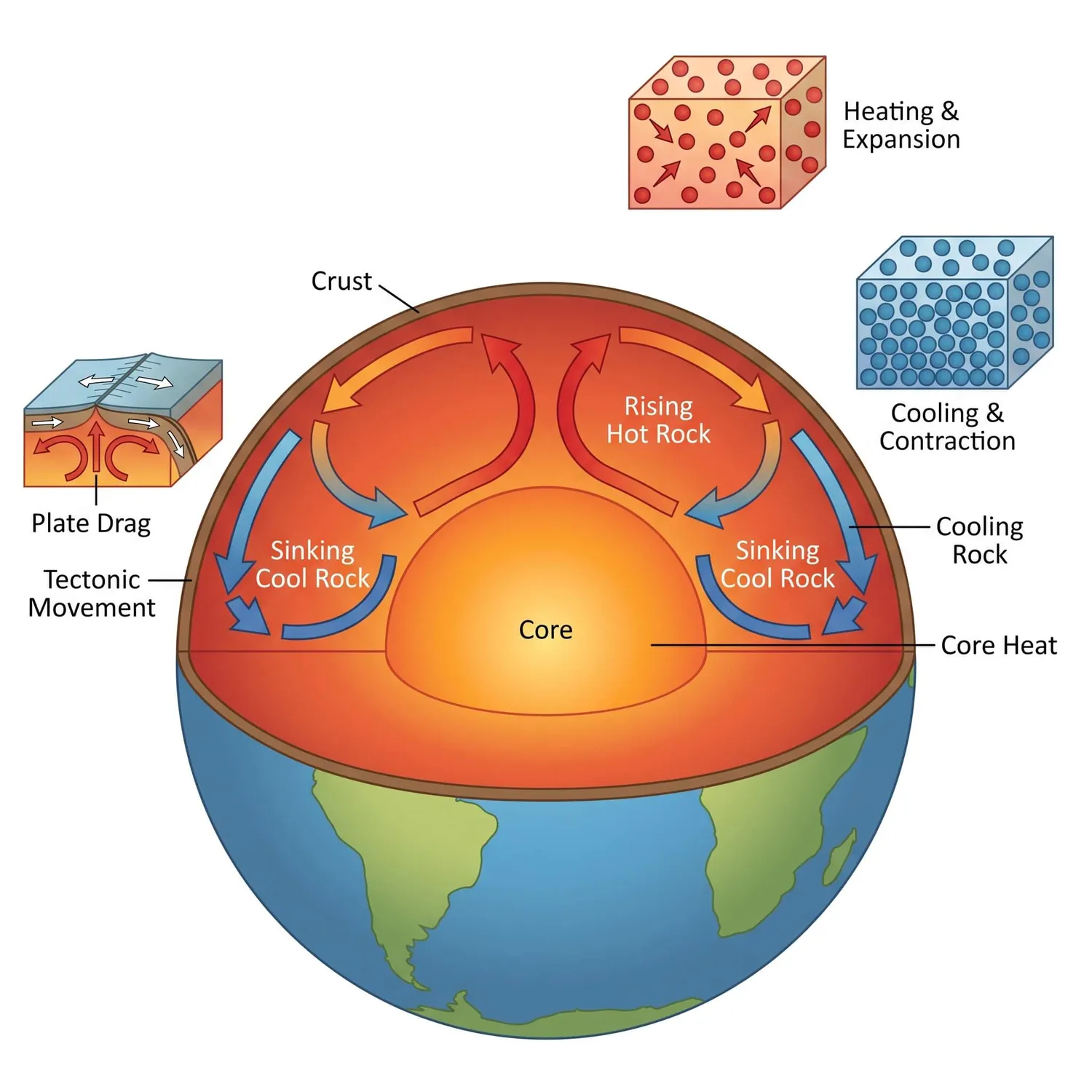
How does mantle convection work? Heat from Earth's scorching core creates slow, powerful currents in the thick layer of rock called the mantle. These currents move in giant loops that take millions of years to complete. Scientists explain that mantle convection is the engine that drives plate movement at Earth's surface.
The process begins deep in the mantle, near the boundary with Earth's core. Heat from the core warms the rock at the bottom of the mantle. When rock heats up, its particles spread apart slightly. This makes the hot rock less dense than the cooler rock above it. Evidence shows that less dense materials rise through denser materials, just like warm air rises in a room. The heated mantle rock slowly rises toward Earth's surface, moving through the asthenosphere, a zone where rock can flow like thick honey.
As the hot rock rises closer to the surface, it begins to cool. The cooling happens because heat escapes through the crust above. When rock cools, its particles move closer together again. This makes the rock denser. The denser, cooled rock then sinks back down toward the core. Scientists observe that this creates a continuous loop called a convection cell or convection current. Multiple convection cells operate throughout the mantle at the same time.
Mantle convection moves incredibly slowly, only a few centimeters per year. This is about the same rate that your fingernails grow. However, over millions of years, these currents transport enormous amounts of rock and heat. The rising and sinking rock creates drag on the bottom of tectonic plates above. This drag is one of the main forces that moves the plates. Scientists have used seismic wave data to map convection patterns in the mantle. Evidence from earthquake waves shows variations in temperature and density that support the convection model.
Understanding mantle convection helps scientists explain many Earth processes. Volcanic activity, mountain building, and earthquakes all connect to plate movements driven by convection. The heat that powers convection comes from two sources: leftover heat from Earth's formation and heat produced by radioactive decay of elements in the mantle. This internal heat engine will continue operating for billions of years, constantly reshaping our planet's surface.
Interesting Fact: The hottest rock in the mantle can reach temperatures of about 4,000 degrees Celsius, yet it remains solid due to the immense pressure deep inside Earth!
Comprehension quiz (10 questions)
1. What causes hot rock in the mantle to rise toward Earth's surface?
2. According to the passage, how fast does mantle convection move each year?
3. What is the asthenosphere?
4. What happens to mantle rock as it rises closer to Earth's surface?
5. Which term describes the continuous loop of rising and sinking rock in the mantle?
6. What are the two sources of heat that power mantle convection?
7. How do scientists study convection patterns in the mantle?
8. What effect does mantle convection have on tectonic plates?
9. True or False: Mantle rock remains solid even at temperatures of 4,000 degrees Celsius due to immense pressure.
10. True or False: Mantle convection will stop within the next few thousand years.
Perfect for the way you teach
- Build comprehension skills
- Auto-graded quiz
- Differentiated reading
- Read together at home
- Improve fluency
- Quiet reading time
- Reading curriculum support
- Independent practice
- Track Lexile growth