How does the Ozone Layer High in the Atmosphere Protect Life on Earth? — Reading Comprehension
Rate this
Premium Resource
Present
Present in classroom. No work saved
Assign
Classroom with student accounts, Track progress
Quick Play
No student accounts, assign with a link
Grades
3
4
5
6
7
8
PRINT+DIGITAL RESOURCE
This learning resource is available in interactive and printable formats. The interactive worksheet can be played online and assigned to students. The Printable PDF version can be downloaded and printed for completion by hand.
"This educational science passage, aligned with NGSS standards, explores the critical role of the ozone layer in shielding Earth from the Sun's harmful ultraviolet (UV) radiation. Designed for middle school students (grades 6-8), the text details the formation of ozone molecules (O3) in the stratosphere and explains how this natural process protects human health and ecosystems. It also covers the impact of human-made chlorofluorocarbons (CFCs) on the ozone layer, the discovery of the ozone hole, and the successful global response through the Montreal Protocol. The passage integrates key vocabulary and real-world connections to provide a comprehensive and engaging overview of this important environmental topic."
CONTENT PREVIEW
Expand content preview
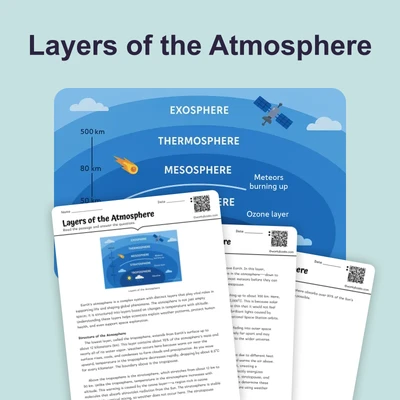
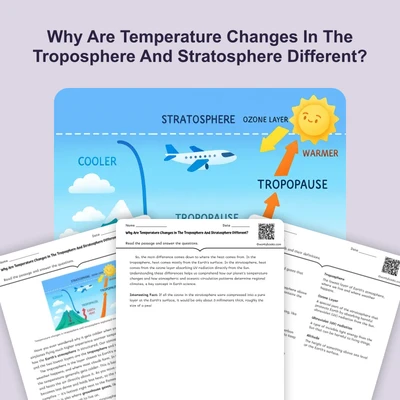
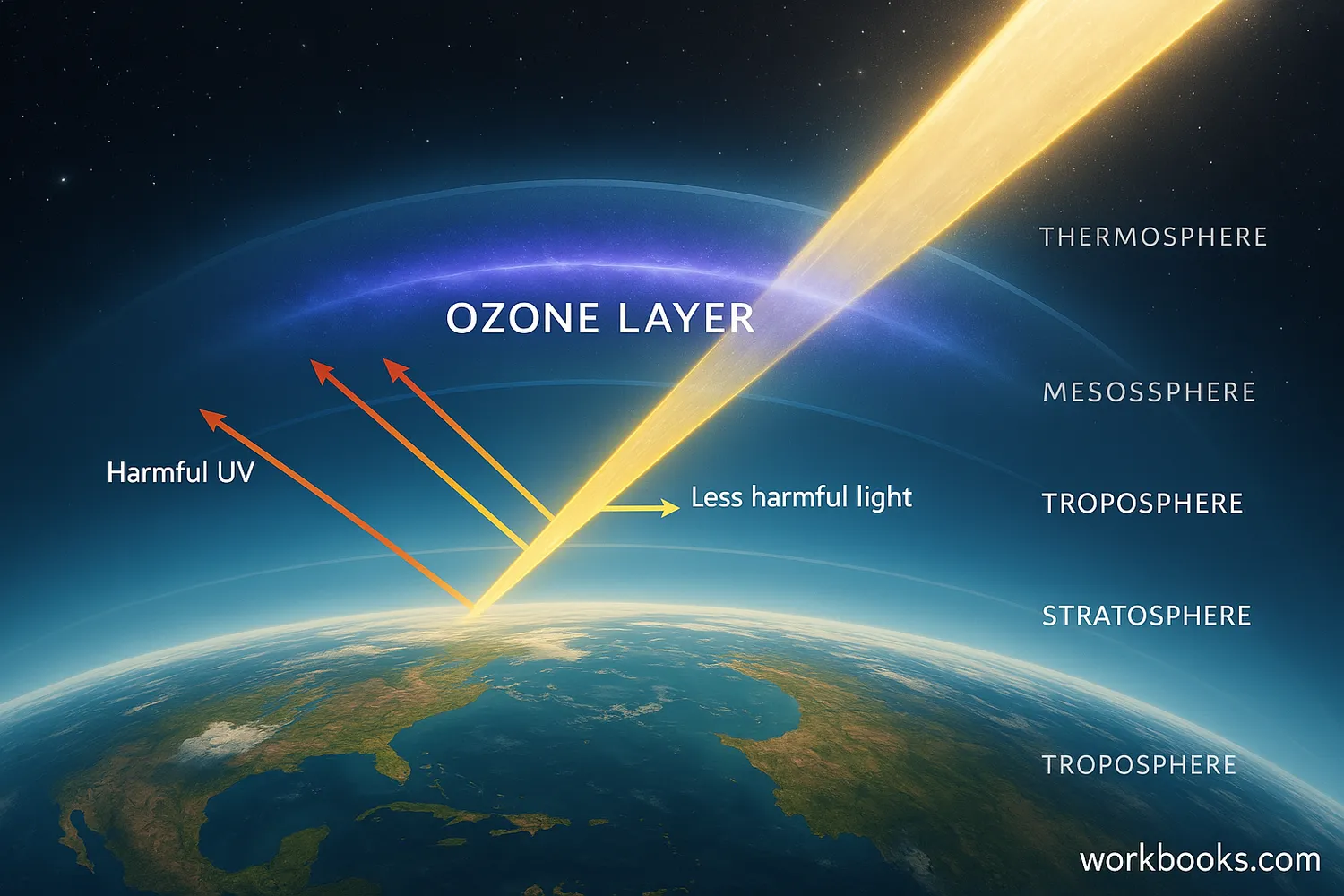
The stratosphere protects life by absorbing most of the sun's harmful ultraviolet (UV) radiation.
The ozone layer is a critical part of Earth's atmosphere, acting as a natural shield that protects all living things from harmful solar radiation. This protective layer is located in the stratosphere, a region of the atmosphere that sits high above our planet’s surface. It is composed of ozone (O3), a molecule made of three oxygen atoms. While ozone near the ground is a pollutant, the ozone layer high up is essential for life. Its primary function is to absorb most of the Sun's dangerous ultraviolet (UV) radiation, particularly the most harmful types, such as UV-B and UV-C rays.
The process of protection begins when high-energy UV radiation from the Sun strikes an oxygen molecule (O2) in the stratosphere. This energy splits the oxygen molecule into two separate, highly reactive oxygen atoms (O). Each of these single oxygen atoms then quickly combines with another oxygen molecule (O2) to form a new ozone molecule (O3). This continuous cycle of creation and destruction of ozone molecules is a delicate balance. As the ozone molecules form, they absorb the UV radiation, preventing it from reaching the Earth's surface in large quantities. This absorption is what makes the ozone layer so vital.
Without the ozone layer, the amount of UV radiation reaching Earth would be significantly higher. This would have devastating effects on ecosystems and human health. Increased exposure to UV radiation can lead to higher rates of skin cancer and cataracts in humans. For plants, it can damage cells and reduce their ability to perform photosynthesis, impacting crop yields and disrupting food chains. Marine life, especially tiny organisms like phytoplankton, are also vulnerable to UV radiation, which could harm the base of the ocean’s food web.
The discovery of the ozone hole—a dramatic thinning of the ozone layer, particularly over Antarctica—brought global attention to its vulnerability. Scientists linked this thinning to the use of human-made chemicals called chlorofluorocarbons (CFCs), which were once common in aerosol sprays and refrigerants. When CFCs rise to the stratosphere, they release chlorine atoms that destroy ozone molecules. International agreements like the Montreal Protocol have successfully phased out many of these chemicals, allowing the ozone layer to slowly begin its recovery. This global effort shows how human actions can both harm and help our planet.
Fun Fact: A 1% decrease in the ozone layer can lead to a 2% increase in the amount of harmful UV radiation reaching Earth's surface.
What is the primary function of the ozone layer?
To produce oxygen for breathing.To absorb most of the Sun’s harmful UV radiation.To help regulate the Earth's temperature.To create a habitat for airborne organisms.
What is an ozone molecule composed of?
Two oxygen atoms and one nitrogen atom.Three nitrogen atoms.Three oxygen atoms.Two oxygen atoms.
In which part of the atmosphere is the ozone layer located?
The troposphere.The mesosphere.The stratosphere.The exosphere.
According to the passage, what is a potential effect of increased UV radiation on plants?
Increased rate of photosynthesis.Damage to cells and reduced crop yields.Longer growing seasons.More efficient water absorption.
How does the Sun's energy help create ozone molecules?
It heats up oxygen molecules, causing them to bond.It splits oxygen molecules into individual atoms.It converts nitrogen into oxygen.It combines three nitrogen molecules.
What is the main idea of the provided passage?
The ozone layer is a natural shield that protects life from UV radiation.Ozone is a pollutant that is harmful to humans.The Montreal Protocol solved all problems related to atmospheric chemicals.The Earth's atmosphere is made up of many different layers.
How would the food web in the ocean be affected if the ozone layer were completely destroyed?
Phytoplankton would grow faster, strengthening the food web.All marine life would adapt to the higher UV radiation.Phytoplankton would be harmed, disrupting the base of the food web.The temperature of the ocean would rise, killing all marine life.
What type of human-made chemicals were found to be responsible for the thinning of the ozone layer?
No reviews yet. Be the first to share your experience!
Related Content
Earth: Our Home in Space
This engaging Grade 4-5 science passage, aligned to NGSS, introduces students to Earth's special place in the solar syst...
Tools and Technology in Earth Science
This middle school science reading passage explores the wide range of tools and technologies used in Earth science, from...
MS-ESS2-2MS-ESS3-2MS-ETS1-1MS-PS4-3
Earth's Place in the Universe
This reading passage explains Earth's place in the universe, supporting NGSS 1-ESS1-1. It describes how Earth is one of ...
1-ESS1-1
Scientific Inquiry in Earth Science
This passage explores scientific inquiry in Earth science for grades 6-8, aligned with NGSS standards MS-ESS1-4, MS-ESS2...
MS-ESS1-4MS-ESS2-1MS-ESS3-5SEP
What Is Space Weather and How Does It Affect the Earth?
This NGSS-aligned science passage for middle school explains what space weather is and how it affects Earth. Students le...
MS-ESS2-2
Escape Velocity and Space Travel
This middle school science passage introduces students to the concept of escape velocity—the minimum speed required to b...
MS-ESS1-2MS-PS2-4
Space Stations
This informational science reading passage for grades 6-8 explores the complex systems and technology behind space stati...
MS-ESS1-3MS-ETS1-1
What Is Earth Science?
This engaging middle school science passage introduces students to the field of Earth science, aligning with NGSS standa...
MS-ESS1MS-ESS2MS-ESS3SEP
The Space Garden
This innovative passage combines plant science with space exploration, aligning with NGSS standards for life sciences an...
RL.3.1RL.2.1RL.4.9
Measuring Distances in Space
This middle school science passage explores how astronomers measure the vast distances in space, aligning with NGSS stan...
MS-ESS1-3
Earth: Our Home Planet
This comprehensive science passage for grades 6-8 explores Earth’s unique characteristics and the interconnected systems...
MS-ESS1-2
Meteorite Impacts on Earth
This engaging science reading passage for Grades 4-5 explores meteorite impacts on Earth, aligning with NGSS standards. ...
Exploring Space: Rockets and Spacecraft
Space exploration has been one of humanity's greatest achievements, made possible by rockets and spacecraft. Rockets act...
RI.4.4RI.4.2
Earth's Rotation
This middle school science passage, aligned with NGSS standard MS-ESS1-1, focuses on Earth's rotation—how Earth spins on...
MS-ESS1-1
Facts About Earth
This engaging science reading passage introduces Grade 4 and 5 students to Earth, our home planet. Aligned with NGSS sta...
Earth's Moon Facts
This engaging science passage, 'The Moon: Earth's Companion,' is designed for Grade 4-5 students and aligns with NGSS ge...
International Space Station
Discover the wonders of the International Space Station with this informative coloring page showcasing the orbiting outpost where astronauts live and work in space. As children color the complex modul...
Earth's Seasons
This comprehensive reading passage for grades 6-8 explains why Earth has seasons, revealing the scientific mechanisms be...
MS-ESS1-1
Venus: Earth's Twin?
This comprehensive science passage for grades 6-8 examines Venus—often called Earth's twin—by exploring its similarities...
MS-ESS1-2MS-ESS1-3
The Space Needle
Students read a passage about the history and features of Seattle's Space Needle, then answer comprehension questions to...