This comprehensive middle school science reading passage aligned to NGSS standard MS-ESS1-1 explores how Earth orbits the Sun. Students discover that Earth follows a slightly elliptical path around the Sun, traveling at approximately 67,000 miles per hour and completing one full revolution every 365.25 days. The passage explains how the Sun's gravitational force keeps Earth in its orbital path and how this orbital motion, combined with Earth's axial tilt of 23.5 degrees, creates the seasonal changes we observe throughout the year. Audio-integrated features support diverse learners, while differentiated versions ensure accessibility for English Language Learners and struggling readers. The passage includes real-world connections, scientific terminology appropriate for grades 6-8, and engaging facts that help students understand Earth's place in the solar system. Activities reinforce understanding of MS-ESS1.B Earth and the Solar System concepts through multiple-choice questions, writing prompts, and graphic organizers.
Written by Workybooks TeamPublished by Workybooks
Preview
Sample passage and quiz content
CONTENT PREVIEW
Expand content preview
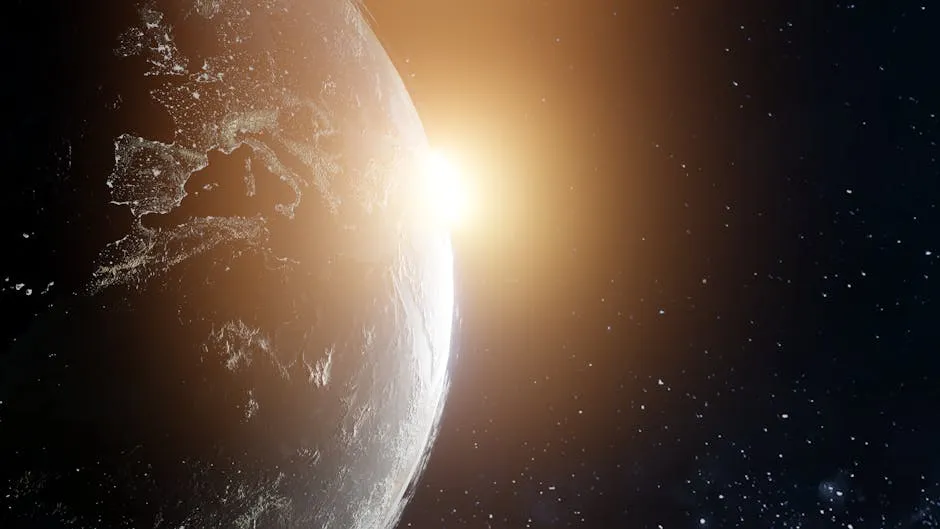
"A stunning view of Earth at sunrise from space, highlighting cosmic beauty." by Zelch Csaba / Pexels.
Earth constantly moves through space on a path around the Sun. This motion is called an orbit. Earth follows a slightly elliptical path, which means the orbit is shaped like a stretched circle rather than a perfect circle. Our planet completes one full trip around the Sun every 365.25 days. This time period defines one year on Earth.
Earth travels at an incredible speed during its journey around the Sun. Scientists have measured that our planet moves at about 67,000 miles per hour through space. Despite this tremendous speed, we do not feel the motion because everything on Earth moves together at the same rate. The force of gravity from the Sun keeps Earth in its orbital path. Gravity acts like an invisible rope that pulls Earth toward the Sun. However, Earth's forward motion prevents it from falling into the Sun.
The combination of Earth's orbit and its axial tilt creates the seasons we experience. Earth's axis tilts at an angle of 23.5 degrees compared to its orbital path. As Earth moves around the Sun, different parts of the planet lean toward or away from the Sun at different times. When the Northern Hemisphere tilts toward the Sun, it receives more direct sunlight and experiences summer. At the same time, the Southern Hemisphere tilts away and experiences winter. Six months later, the positions reverse.
Evidence from satellite observations shows that Earth maintains a relatively stable orbit. The distance between Earth and the Sun varies slightly throughout the year because of the elliptical shape. Earth comes closest to the Sun in January at about 91 million miles. It reaches its farthest point in July at about 94 million miles. This difference in distance is small compared to the total orbital path. The tilt of Earth's axis affects seasons much more than the changing distance does.
Understanding Earth's orbit helps scientists explain many patterns we observe. The revolution of Earth around the Sun combined with Earth's rotation on its axis creates our calendar system. The extra quarter day each year is why we add a leap day every four years. Without this adjustment, our calendar would slowly drift out of alignment with the seasons. Earth's predictable orbital motion allows scientists to calculate the positions of planets and plan space missions years in advance.
Interesting Fact: Because Earth travels in an elliptical orbit, the Sun appears slightly larger in our sky during January when Earth is closest. The difference is only about 3 percent, which is too small for most people to notice without special equipment.
How long does it take Earth to complete one full orbit around the Sun?
365.25 days24 hours30 days7 days
What shape is Earth's orbit around the Sun?
A perfect circleA slightly elliptical pathA straight lineA square
What force keeps Earth in orbit around the Sun?
MagnetismWindGravityElectricity
In the passage, what does the word 'axial tilt' refer to?
The speed at which Earth travelsThe angle at which Earth's axis leansThe distance from Earth to the SunThe shape of Earth's orbit
What does 'revolution' mean in the context of Earth's motion?
Earth spinning on its axisThe complete trip Earth makes around the SunThe tilt of Earth's axisThe force of gravity
Why do we experience different seasons on Earth?
Because Earth moves faster in summerBecause the Sun gets hotter and coolerBecause of Earth's axial tilt and orbit combinedBecause Earth stops moving in winter
Based on the passage, what can you infer about why we don't feel Earth moving at 67,000 mph?
Earth actually moves very slowlyEverything on Earth moves together at the same rateGravity holds us too tightly to feel movementThe atmosphere blocks our ability to feel motion
If Earth's axial tilt suddenly became zero degrees, what would most likely happen to seasons?
Seasons would become more extremeSeasons would disappear or become very weakOnly the Northern Hemisphere would have seasonsSeasons would happen twice as fast
True or False: Earth is closer to the Sun during summer in the Northern Hemisphere.
TrueFalse
True or False: We add a leap day every four years because Earth's orbit takes 365.25 days.
TrueFalse
Who it's for
Perfect for the way you teach
Teachers
Build comprehension skills
Auto-graded quiz
Differentiated reading
Parents
Read together at home
Improve fluency
Quiet reading time
Homeschoolers
Reading curriculum support
Independent practice
Track Lexile growth
Topics
Earth's orbitsolar systemgravityelliptical orbitseasonsEarth's revolutionaxial tiltNGSS MS-ESS1-1middle school science
Reviews & Ratings
No reviews yet. Be the first to share your experience!
More reading you might love
20 more
What is Solar Radiation
This NGSS-aligned science reading passage for middle school students explores the concept of solar radiation. Solar radi...
MS-ESS1-1
How Incoming Solar Radiation Changes with Latitude
This NGSS-aligned science reading passage helps middle school students understand how solar radiation, or insolation, ch...
MS-ESS1-1
Tides and Tidal Forces
This middle school science passage explores the mechanisms of tides and tidal forces, aligning with NGSS standards MS-ES...
MS-ESS1-1MS-ESS1-2
The Night Sky
This comprehensive science reading passage for grades 6-8 aligns with NGSS standard MS-ESS1-1 and explores the systems a...
MS-ESS1-1
Ancient Astronomy
This engaging passage for grades 6-8 explores the history of astronomy through the lens of ancient observations. Student...
MS-ESS1-1
Tools of Modern Astronomy
This passage introduces middle school students to modern astronomy, aligning with NGSS standard MS-ESS1-1. It explains h...
MS-ESS1-1
How Astronomy Became a Science
This passage explores the transformative period known as the Scientific Revolution, with a special focus on the history ...
MS-ESS1-1
Earth's Rotation
This middle school science passage, aligned with NGSS standard MS-ESS1-1, focuses on Earth's rotation—how Earth spins on...
MS-ESS1-1
Earth's Revolution
This middle school science passage explores the science behind Earth's revolution around the Sun, closely aligned with N...
MS-ESS1-1
Why We Have Seasons
This comprehensive middle school science reading passage explains the mechanisms behind Earth's seasons, directly addres...
MS-ESS1-1
Earth's Seasons
This comprehensive reading passage for grades 6-8 explains why Earth has seasons, revealing the scientific mechanisms be...
MS-ESS1-1
Phases of the Moon
This comprehensive middle school science passage explains the phases of the Moon, focusing on the mechanisms behind the ...
MS-ESS1-1
Tides
This comprehensive middle school science reading passage explores the phenomenon of ocean tides, aligned to NGSS standar...
MS-ESS1-1MS-ESS1-2
Eclipses
This comprehensive passage for grades 6-8 explores the science behind eclipses, including solar and lunar eclipses, thei...
MS-ESS1-1
The Moon's Characteristics
This comprehensive science reading passage for grades 6-8 examines the Moon's physical characteristics, including its si...
MS-ESS1-1MS-ESS1-2
Lunar Eclipses
This passage introduces middle school students to the phenomenon of lunar eclipses, connecting observable events to the ...
MS-ESS1-1
The Sun's Characteristics
This engaging science passage introduces middle school students to the Sun’s key characteristics, such as its classifica...
MS-ESS1-1MS-ESS1-2
What Is a Galaxy?
This comprehensive middle school science passage answers the question: What is a galaxy? Aligned to NGSS standard MS-ESS...
MS-ESS1-1
The Milky Way: Our Home Galaxy
This comprehensive science passage introduces middle school students to the Milky Way, the barred spiral galaxy that is ...
MS-ESS1-1
Types of Galaxies
This comprehensive middle school science passage introduces students to the classification and characteristics of galaxi...