How Earthquakes Reveal Earth's Layers
Interactive passage with audio narration, comprehension questions, and printable PDF.
By completing this purchase you agree to our Terms of Use and Privacy Policy. Your subscription renews automatically until you cancel. You can cancel anytime from your account settings. All sales are final and non-refundable. Digital content is available for download in your account immediately upon purchase.
What's included
How Earthquakes Reveal Earth's Layers preview and details
About this printable How Earthquakes Reveal Earth's Layers science reading passage, NGSS-aligned (Grades 5-8)
Sample passage and quiz from How Earthquakes Reveal Earth's Layers
Reading passage and comprehension quiz preview
How Earthquakes Reveal Earth's Layers
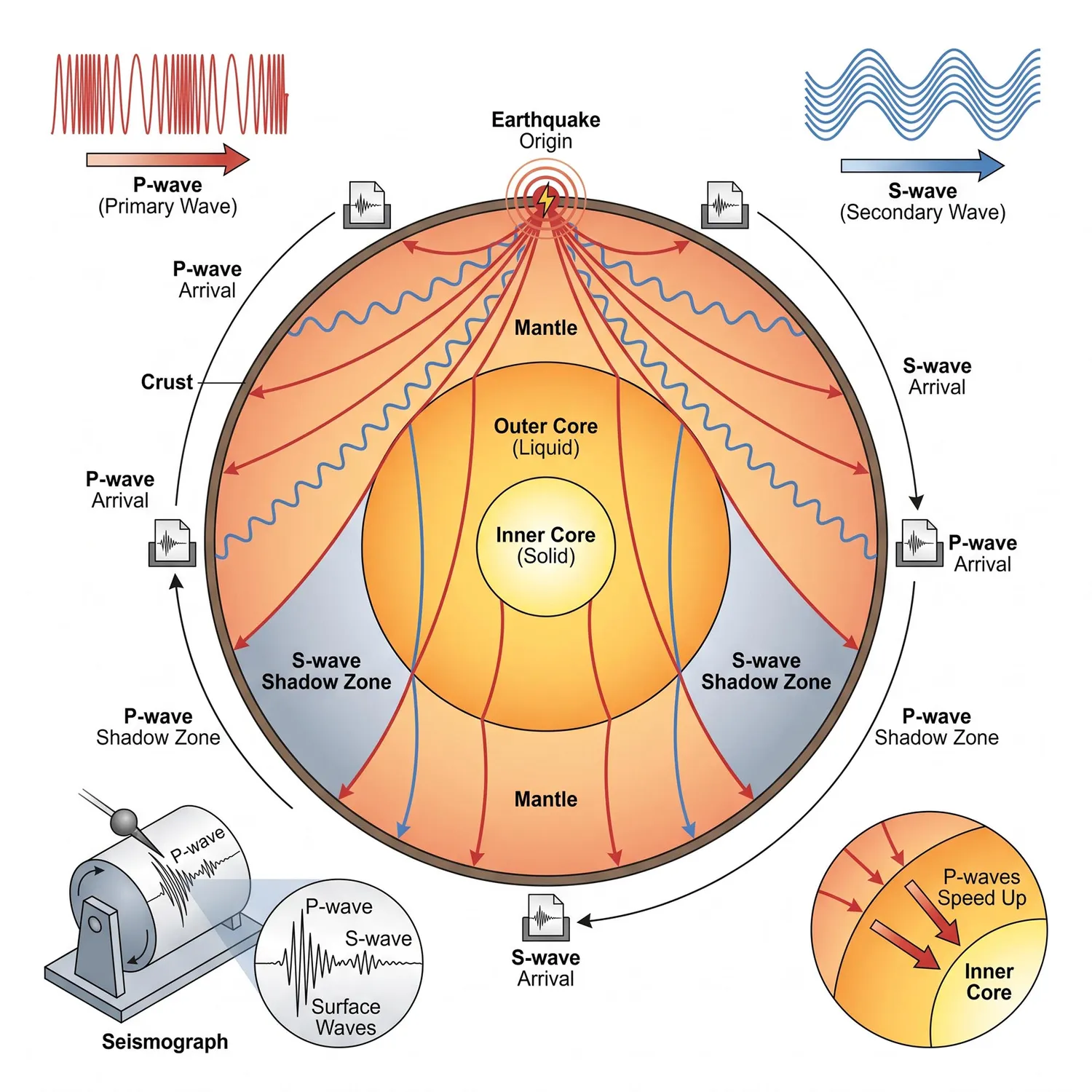
Scientists cannot dig to Earth's center, but earthquakes give them a powerful tool to study our planet's interior. When an earthquake occurs, it sends energy waves called seismic waves through the entire planet. These waves act like an X-ray machine, revealing the hidden layers deep below our feet.
Earthquakes produce two main types of seismic waves that behave very differently. P-waves, or primary waves, travel fastest and can move through both solid rock and liquid material. S-waves, or secondary waves, move more slowly and can only travel through solid materials. When S-waves encounter liquid, they stop completely. This difference provides scientists with crucial evidence about Earth's structure.
Scientists observe seismic waves using instruments called seismographs placed around the world. When they track where waves arrive after an earthquake, they notice something remarkable. S-waves create a shadow zone on the opposite side of Earth from the earthquake. In this zone, S-waves never arrive at all. Evidence shows this happens because S-waves cannot pass through a liquid layer deep inside Earth. This discovery proved that Earth has a liquid outer core approximately 2,900 kilometers below the surface.
Seismic waves also change speed and direction when they cross boundaries between different layers. This bending, called refraction, occurs because each layer has different density and composition. Scientists analyze these changes to determine where one layer ends and another begins. P-waves speed up when they enter the dense inner core, suggesting it is solid metal rather than liquid.
The 1906 San Francisco earthquake helped scientists develop early models of Earth's interior. Modern seismologists now use data from thousands of earthquakes each year. They can map Earth's layers with remarkable precision, identifying the crust, mantle, outer core, and inner core. Each earthquake provides more information, refining our understanding of the planet's structure.
This research matters because understanding Earth's layers helps explain many surface processes. The liquid outer core generates Earth's magnetic field, which protects us from harmful solar radiation. Movement in the mantle drives plate tectonics, causing earthquakes and volcanic eruptions. Seismic waves continue to reveal new details about our dynamic planet.
Interesting Fact: Scientists have detected seismic waves that traveled completely through Earth and emerged on the opposite side, taking about 20 minutes to complete the journey through more than 12,000 kilometers of rock and metal.
Comprehension quiz (10 questions)
1. What is the main way scientists study Earth's interior layers?
2. Which statement about P-waves and S-waves is correct?
3. What does the shadow zone prove about Earth's structure?
4. The term 'refraction' in the passage refers to:
5. Why do scientists believe the inner core is solid rather than liquid?
6. Based on the passage, what can you infer about the relationship between wave behavior and material properties?
7. If scientists detected S-waves arriving at all locations around Earth after an earthquake, what would this suggest?
8. How does understanding Earth's layers help explain surface processes?
9. True or False: Seismic waves can travel completely through Earth from one side to the other.
10. True or False: The 1906 San Francisco earthquake provided no useful information about Earth's interior.
Perfect for the way you teach
- Build comprehension skills
- Auto-graded quiz
- Differentiated reading
- Read together at home
- Improve fluency
- Quiet reading time
- Reading curriculum support
- Independent practice
- Track Lexile growth