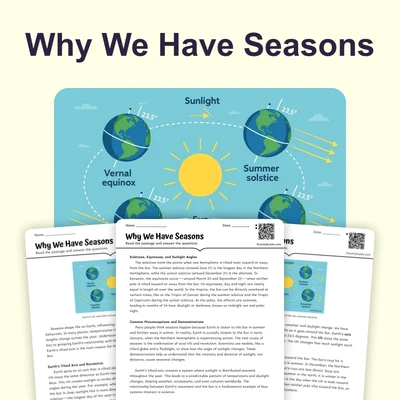
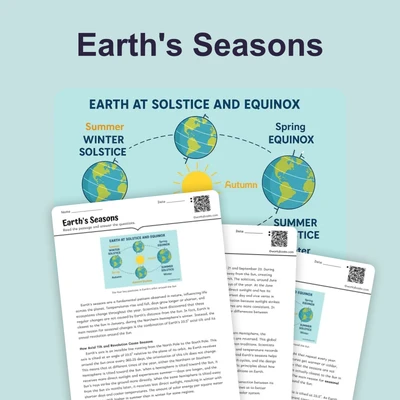
This comprehensive 400-500 word reading passage explores how Earth's axial tilt causes seasons, aligned with NGSS standard MS-ESS1-1 and disciplinary core idea MS-ESS1.B. Students in grades 6-8 will discover the mechanism behind seasonal changes as Earth orbits the Sun with its axis tilted at 23.5 degrees. The passage explains how the Northern Hemisphere receives more direct sunlight and experiences longer days during summer, while six months later it tilts away and experiences winter conditions. Through clear explanations and real-world examples, students understand the relationship between axial tilt, solar radiation intensity, and seasonal temperature changes. The content includes audio integration for enhanced accessibility, vocabulary support with glossary terms, and multiple assessment activities including comprehension questions, writing prompts, and graphic organizers. This science curriculum resource helps students visualize Earth's position relative to the Sun throughout the year and understand why opposite hemispheres experience opposite seasons simultaneously.
Written by Workybooks TeamPublished by Workybooks
Preview
Sample passage and quiz content
CONTENT PREVIEW
Expand content preview
Earth experiences seasons because our planet tilts on its axis as it orbits the Sun "ChangingSeasons NH 01" by NOAA Office of Education / Wikimedia Commons.
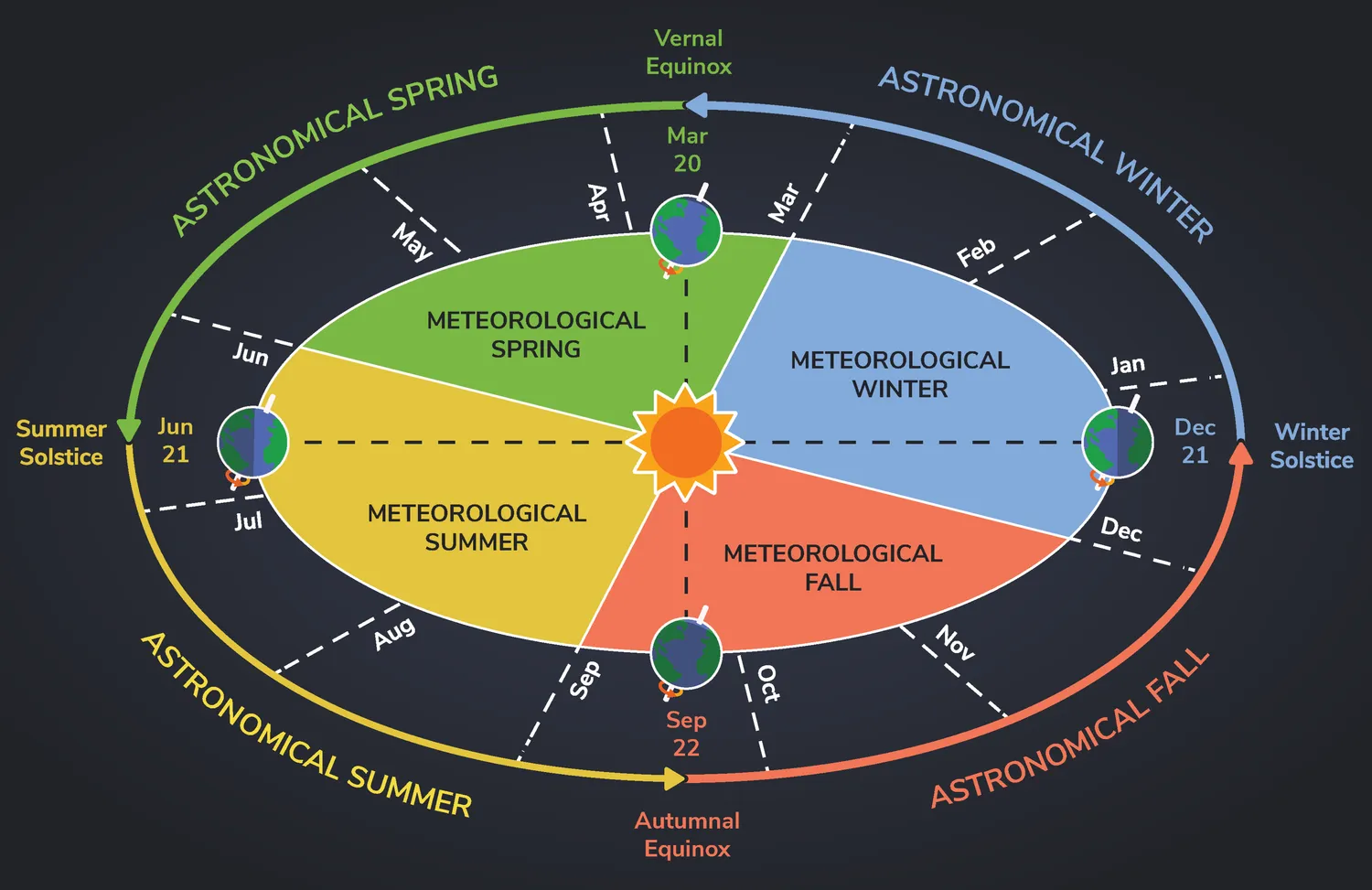
Earth experiences seasons because our planet tilts on its axis as it orbits the Sun. This axial tilt measures 23.5 degrees from vertical. The tilt causes different parts of Earth to receive varying amounts of direct sunlight throughout the year. When one hemisphere tilts toward the Sun, it receives more direct rays and experiences warmer temperatures.
Scientists explain that the angle at which sunlight strikes Earth's surface determines how much energy that area receives. During summer in the Northern Hemisphere, this region tilts toward the Sun. Sunlight hits the surface more directly, concentrating solar radiation over a smaller area. This direct angle delivers more energy per square meter. Additionally, daylight hours increase because the tilted hemisphere remains in sunlight longer as Earth rotates. Evidence shows that longer days and more concentrated sunlight combine to create summer's warmer conditions.
Six months later, Earth moves to the opposite side of its orbit around the Sun. The Northern Hemisphere now tilts away from the Sun. Sunlight strikes at a lower angle, spreading the same amount of energy over a larger surface area. This reduces the intensity of heating. Days become shorter because the tilted hemisphere spends less time facing the Sun during each rotation. These conditions produce winter's colder temperatures. Meanwhile, the Southern Hemisphere tilts toward the Sun and experiences summer.
The summer solstice occurs around June 21 in the Northern Hemisphere. On this day, the North Pole tilts most directly toward the Sun. Locations above the Arctic Circle can experience 24 hours of continuous daylight. Conversely, the winter solstice happens around December 21. The North Pole then tilts farthest from the Sun, creating the shortest day of the year. Some Arctic locations remain in darkness for 24 hours.
Understanding Earth's axial tilt helps scientists predict climate patterns and seasonal changes. This knowledge matters for agriculture, wildlife migration, and human activities worldwide. The tilt remains constant as Earth orbits, but our planet's position relative to the Sun changes continuously. This creates the predictable cycle of seasons that shapes life on Earth.
Interesting Fact: Earth's axial tilt changes very slowly over thousands of years, shifting between 22.1 and 24.5 degrees. This gradual change can affect long-term climate patterns on our planet.
What is the measurement of Earth's axial tilt?
22.1 degrees23.5 degrees24.5 degrees25.0 degrees
What happens when the Northern Hemisphere tilts toward the Sun?
It experiences winter with shorter daysIt experiences summer with longer daysIt experiences the same weather year-roundIt receives no sunlight at all
Based on the passage, what does the term 'solar radiation' mean?
The spinning motion of Earth on its axisThe curved path Earth follows around the SunEnergy from the Sun that reaches Earth as light and heatThe angle at which Earth tilts
What does 'hemisphere' mean in the context of this passage?
The entire planet EarthHalf of Earth divided by the equatorThe axis on which Earth rotatesThe path Earth takes around the Sun
Why does summer have warmer temperatures than winter?
Earth moves closer to the Sun during summerThe Sun produces more energy during summer monthsDirect sunlight concentrates more energy and days are longerThe atmosphere is thinner during summer
What can scientists predict by understanding Earth's axial tilt?
Earthquakes and volcanic eruptionsClimate patterns and seasonal changesThe formation of new continentsChanges in Earth's mass
When the Northern Hemisphere experiences winter, what season does the Southern Hemisphere experience?
WinterSpringSummerFall
Around what date does the summer solstice occur in the Northern Hemisphere?
March 21June 21September 21December 21
True or False: Earth's axial tilt remains exactly the same forever and never changes.
TrueFalse
True or False: When sunlight strikes Earth at a lower angle, it spreads energy over a larger area and provides less heating.
TrueFalse
Who it's for
Perfect for the way you teach
Teachers
Build comprehension skills
Auto-graded quiz
Differentiated reading
Parents
Read together at home
Improve fluency
Quiet reading time
Homeschoolers
Reading curriculum support
Independent practice
Track Lexile growth
Topics
Earth's axial tiltseasonsEarth sciencesolar radiationhemispheresummer solsticewinter solsticeNGSS MS-ESS1-1middle school science
Reviews & Ratings
No reviews yet. Be the first to share your experience!
More reading you might love
20 more
What is Solar Radiation
This NGSS-aligned science reading passage for middle school students explores the concept of solar radiation. Solar radi...
MS-ESS1-1
How Incoming Solar Radiation Changes with Latitude
This NGSS-aligned science reading passage helps middle school students understand how solar radiation, or insolation, ch...
MS-ESS1-1
Tides and Tidal Forces
This middle school science passage explores the mechanisms of tides and tidal forces, aligning with NGSS standards MS-ES...
MS-ESS1-1MS-ESS1-2
The Night Sky
This comprehensive science reading passage for grades 6-8 aligns with NGSS standard MS-ESS1-1 and explores the systems a...
MS-ESS1-1
Ancient Astronomy
This engaging passage for grades 6-8 explores the history of astronomy through the lens of ancient observations. Student...
MS-ESS1-1
Tools of Modern Astronomy
This passage introduces middle school students to modern astronomy, aligning with NGSS standard MS-ESS1-1. It explains h...
MS-ESS1-1
How Astronomy Became a Science
This passage explores the transformative period known as the Scientific Revolution, with a special focus on the history ...
MS-ESS1-1
Earth's Rotation
This middle school science passage, aligned with NGSS standard MS-ESS1-1, focuses on Earth's rotation—how Earth spins on...
MS-ESS1-1
Earth's Revolution
This middle school science passage explores the science behind Earth's revolution around the Sun, closely aligned with N...
MS-ESS1-1
Why We Have Seasons
This comprehensive middle school science reading passage explains the mechanisms behind Earth's seasons, directly addres...
MS-ESS1-1
Earth's Seasons
This comprehensive reading passage for grades 6-8 explains why Earth has seasons, revealing the scientific mechanisms be...
MS-ESS1-1
Phases of the Moon
This comprehensive middle school science passage explains the phases of the Moon, focusing on the mechanisms behind the ...
MS-ESS1-1
Tides
This comprehensive middle school science reading passage explores the phenomenon of ocean tides, aligned to NGSS standar...
MS-ESS1-1MS-ESS1-2
Eclipses
This comprehensive passage for grades 6-8 explores the science behind eclipses, including solar and lunar eclipses, thei...
MS-ESS1-1
The Moon's Characteristics
This comprehensive science reading passage for grades 6-8 examines the Moon's physical characteristics, including its si...
MS-ESS1-1MS-ESS1-2
Lunar Eclipses
This passage introduces middle school students to the phenomenon of lunar eclipses, connecting observable events to the ...
MS-ESS1-1
The Sun's Characteristics
This engaging science passage introduces middle school students to the Sun’s key characteristics, such as its classifica...
MS-ESS1-1MS-ESS1-2
What Is a Galaxy?
This comprehensive middle school science passage answers the question: What is a galaxy? Aligned to NGSS standard MS-ESS...
MS-ESS1-1
The Milky Way: Our Home Galaxy
This comprehensive science passage introduces middle school students to the Milky Way, the barred spiral galaxy that is ...
MS-ESS1-1
Types of Galaxies
This comprehensive middle school science passage introduces students to the classification and characteristics of galaxi...