This learning resource is available in interactive and printable formats. The interactive worksheet can be played online and assigned to students. The Printable PDF version can be downloaded and printed for completion by hand.
This Grade 4-5 science reading passage explores how fossils form in rocks, aligning with NGSS standards for understanding Earth’s processes and history. Students will discover the steps of fossilization, learn key vocabulary like sediment, mineral, paleontologist, and more, and see real-world examples of how fossils help us learn about ancient life. The passage includes definitions of important terms, a fun 'Did You Know?' fact, and both English and Spanish versions for accessibility. Activities include multiple-choice quiz questions and writing prompts that challenge students to explain scientific concepts, connect science to daily life, and analyze cause and effect. The material is audio integrated for diverse learning needs and is ideal for classrooms or home study. The content is designed to build foundational science knowledge and reading comprehension, while sparking curiosity about Earth’s history and the wonders of fossils.
CONTENT PREVIEW
Expand content preview
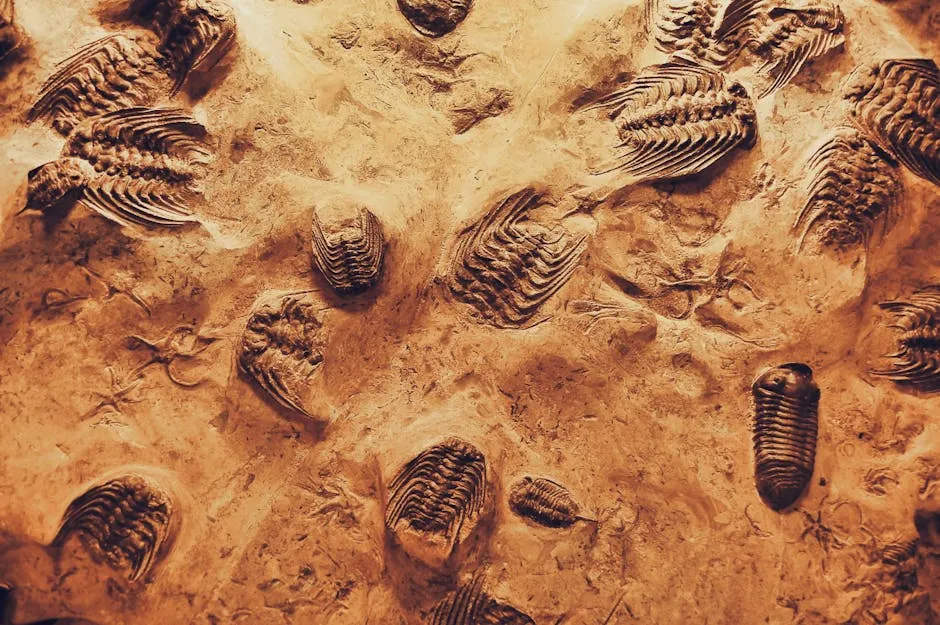
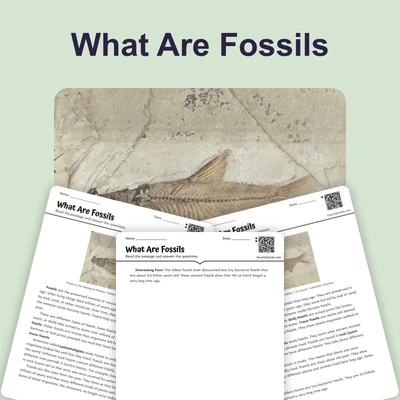
"Detailed view of trilobite fossils embedded in sedimentary rock, showcasing ancient marine life." Image by Alejandro Quintanar / Source: Pexels.
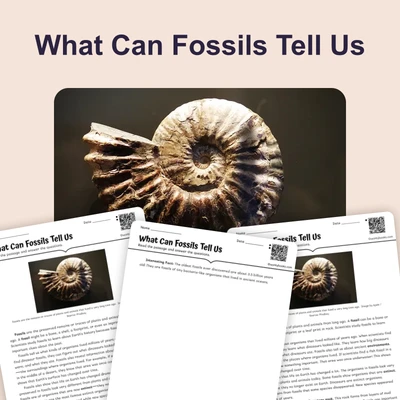
A fossil is the preserved remains or traces of a plant or animal that lived long ago. Fossils help scientists learn about Earth's history and the living things that existed millions of years before humans. Understanding how fossils form helps us discover what life was like in the past.
When a plant or animal dies, it usually gets eaten by other animals or breaks down and disappears. However, sometimes the remains are quickly buried by mud, sand, or ash before they can decay. This burial protects the remains from being destroyed. Over a very long time, more and more layers of sediment—tiny pieces of rock, sand, and dirt—pile on top. The weight of these layers presses down on the remains below.
As thousands or even millions of years pass, the layers of sediment harden into solid rock. Deep underground, the buried remains slowly change. Minerals—natural substances found in rocks and water—seep into the remains and replace the original material bit by bit. This process is called mineralization. The remains turn into stone, creating a fossil. Think of it like making a mold: the original shape stays the same, but the material becomes rock.
Not every plant or animal becomes a fossil. It takes special conditions, such as quick burial and the right type of sediment. This is why fossils are relatively rare and so valuable to scientists who study Earth's past.
Interesting Fact: The oldest fossils ever found are about 3.5 billion years old! They are tiny bacteria fossils discovered in rocks in Australia.
What is a fossil?
A type of rock found undergroundPreserved remains of ancient plants or animalsLayers of sand and dirtA tool scientists use
What usually happens when organisms die?
They always become fossilsThey turn into minerals immediatelyThey are eaten or decayThey sink into the ocean
What protects remains from being destroyed?
Quick burial by mud, sand, or ashBeing eaten by animalsExposure to sunlightFreezing temperatures only
Why do sediment layers press down?
Because water pushes themBecause of their weight piling upBecause wind moves themBecause animals step on them
How do minerals help form fossils?
They protect remains from animalsThey make remains colorfulThey replace original material, turning it to stoneThey speed up decay
Why are fossils considered rare?
Because scientists hide themBecause they require special conditions to formBecause animals eat all of themBecause they only form in water
Every dead organism becomes a fossil.
TrueFalse
What does 'mineralization' mean in the passage?
When remains are buried quicklyWhen minerals replace remains, turning them to stoneWhen sediment piles up in layersWhen scientists study fossils
Perfect For:
👩🏫 Teachers
• Reading comprehension practice
• Auto-graded assessments
• Literacy skill development
👨👩👧👦 Parents
• Reading practice at home
• Comprehension improvement
• Educational reading time
🏠 Homeschoolers
• Reading curriculum support
• Independent reading practice
• Progress monitoring
Reading Features:
📖
Reading Passage
Engaging fiction or nonfiction text
❓
Comprehension Quiz
Auto-graded questions
📊
Instant Feedback
Immediate results and scoring
📄
Printable Version
Download for offline reading
🔊
Read Aloud
Voice-over with word highlighting
Reviews & Ratings
No reviews yet. Be the first to share your experience!
Related Content
Tools and Technology in Earth Science
This middle school science reading passage explores the wide range of tools and technologies used in Earth science, from...
MS-ESS2-2MS-ESS3-2MS-ETS1-1MS-PS4-3
Scientific Inquiry in Earth Science
This passage explores scientific inquiry in Earth science for grades 6-8, aligned with NGSS standards MS-ESS1-4, MS-ESS2...
MS-ESS1-4MS-ESS2-1MS-ESS3-5SEP
What Is Earth Science?
This engaging middle school science passage introduces students to the field of Earth science, aligning with NGSS standa...
MS-ESS1MS-ESS2MS-ESS3SEP
Earth: Our Home in Space
This engaging Grade 4-5 science passage, aligned to NGSS, introduces students to Earth's special place in the solar syst...
Earth's Spheres
This middle school science passage introduces students to Earth's four major spheres: the geosphere, hydrosphere, atmosp...
MS-ESS2-4MS-ESS2-6
What Is Space Weather and How Does It Affect the Earth?
This NGSS-aligned science passage for middle school explains what space weather is and how it affects Earth. Students le...
MS-ESS2-2
Earth's Energy Balance
This engaging, NGSS-aligned science passage for grades 6–8 explores Earth's energy balance, a key process that keeps our...
MS-ESS2-6
Earth's Rotation
This middle school science passage, aligned with NGSS standard MS-ESS1-1, focuses on Earth's rotation—how Earth spins on...
MS-ESS1-1
Earth's Interior
This comprehensive passage for grades 6-8 explores Earth's layered interior, including the crust, mantle, outer core, an...
MS-ESS2-1MS-ESS2-2
Facts About Earth
This engaging science reading passage introduces Grade 4 and 5 students to Earth, our home planet. Aligned with NGSS sta...
Meteorite Impacts on Earth
This engaging science reading passage for Grades 4-5 explores meteorite impacts on Earth, aligning with NGSS standards. ...
Venus: Earth's Twin?
This comprehensive science passage for grades 6-8 examines Venus—often called Earth's twin—by exploring its similarities...
MS-ESS1-2MS-ESS1-3
Earth Changes Over Millions of Years
This engaging, audio-integrated science passage for Grade 4-5 students explores how Earth has changed over millions of y...
Earth's Moon Facts
This engaging science passage, 'The Moon: Earth's Companion,' is designed for Grade 4-5 students and aligns with NGSS ge...
Earth's Quick and Slow Changes
In 'Earth's Quick and Slow Changes,' students categorize 12 Earth events by their speed of occurrence, enhancing underst...
Earth: Our Home Planet
This comprehensive science passage for grades 6-8 explores Earth’s unique characteristics and the interconnected systems...
MS-ESS1-2
Earth's Revolution
This middle school science passage explores the science behind Earth's revolution around the Sun, closely aligned with N...
MS-ESS1-1
Earth's Seasons
This comprehensive reading passage for grades 6-8 explains why Earth has seasons, revealing the scientific mechanisms be...
MS-ESS1-1
Earth's Place in the Universe
This reading passage explains Earth's place in the universe, supporting NGSS 1-ESS1-1. It describes how Earth is one of ...
1-ESS1-1
Aphelion and Perihelion
This engaging reading passage, 'Aphelion and Perihelion,' delves into the fascinating aspects of Earth's elliptical orbi...
MS-ESS1-1: DEVELOP AND USE A MODEL OF THE EARTH-SUN-MOON SYSTEM TO DESCRIBE THE CYCLIC PATTERNS OF LUNAR PHASESECLIPSES OF THE SUN AND MOONAND SEASONS.