How Gravity Causes Landslides — Reading Comprehension
Rate this
Premium Resource
Present
Present in classroom. No work saved
Assign
Classroom with student accounts, Track progress
Quick Play
No student accounts, assign with a link
Grades
3
4
5
6
PRINT+DIGITAL RESOURCE
This learning resource is available in interactive and printable formats. The interactive worksheet can be played online and assigned to students. The Printable PDF version can be downloaded and printed for completion by hand.
This engaging Grade 4-5 science reading passage explains how gravity causes landslides. Students will learn key concepts such as gravity, slope, erosion, weathering, and the role of water in landslides. The passage defines important science terms in bold and provides real-world examples, such as landslides in mountains and along roadways. Students will discover how heavy rainfall and human activities can increase the risk of landslides. The passage ends with an interesting fact and includes a Spanish translation, glossary, multiple-choice quiz, and writing prompts. This resource aligns with NGSS standards and is audio integrated, making it accessible for diverse learners. The included activities build reading comprehension, vocabulary, and critical thinking, while the illustration prompt helps visualize the science behind landslides.
CONTENT PREVIEW
Expand content preview
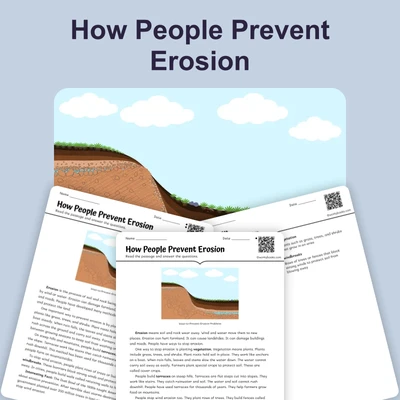
Many hills and mountains have steep slopes. by sandid / Source: Pixabay.
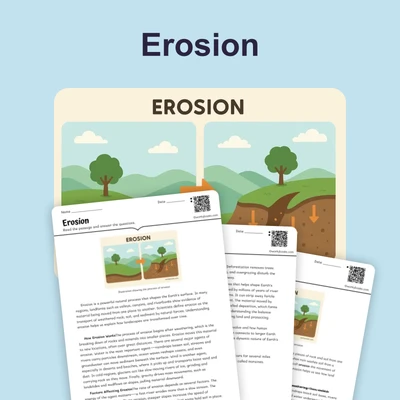
Erosion is the process where wind, water, or gravity moves rocks and soil from one place to another. When erosion happens too quickly, it can wash away good soil that plants need to grow, damage buildings, and harm the land. People have developed many methods to slow down erosion and protect the earth.
Farmers use windbreaks, which are rows of trees planted to block strong winds. These trees act like a fence that stops wind from blowing soil away from farm fields. Construction workers build retaining walls, which are strong walls made of concrete or stone that hold soil in place on steep slopes. Without these walls, gravity would pull the soil downhill.
Engineers place large rocks along coastlines to absorb the energy from ocean waves. The rocks break up the waves before they can wash away the beach. On steep hillsides, people create terracing, which means cutting the slope into flat steps like a staircase. Water flows slowly across each flat step instead of rushing straight down the hill and carrying soil with it.
One of the simplest methods anyone can use is planting grass on bare soil. Grass roots hold soil particles together like tiny fingers gripping the earth. The leaves and stems also slow down rainwater so it soaks into the ground instead of running off and taking soil with it.
Interesting Fact: In the 1930s, poor farming practices and drought caused massive wind erosion in the Great Plains called the Dust Bowl, where huge dust storms buried homes and farms under mountains of soil!
What is erosion?
When plants grow in soilWhen rocks and soil move placesWhen farmers plant treesWhen rain falls from clouds
What do windbreaks do?
They hold water in lakesThey block wind from blowing soilThey make plants grow fasterThey create rain for farms
What are retaining walls made of?
Wood and leavesGrass and flowersConcrete or stoneSand and water
Why do engineers place rocks along coastlines?
To make the beach prettierTo absorb wave energyTo help fish swim betterTo collect rainwater
How does terracing help prevent erosion?
It makes water flow quickly downhillIt removes all plants from hillsIt makes water flow slowly across stepsIt stops all rain from falling
How do grass roots help prevent erosion?
They hold soil particles togetherThey make soil blow away fasterThey stop all water from soaking inThey remove nutrients from soil
Planting grass is the hardest erosion method.
TrueFalse
What does the word 'absorb' mean?
To push something away quicklyTo take in or soak upTo make something grow biggerTo break into small pieces
Perfect For:
👩🏫 Teachers
• Reading comprehension practice
• Auto-graded assessments
• Literacy skill development
👨👩👧👦 Parents
• Reading practice at home
• Comprehension improvement
• Educational reading time
🏠 Homeschoolers
• Reading curriculum support
• Independent reading practice
• Progress monitoring
Reading Features:
📖
Reading Passage
Engaging fiction or nonfiction text
❓
Comprehension Quiz
Auto-graded questions
📊
Instant Feedback
Immediate results and scoring
📄
Printable Version
Download for offline reading
🔊
Read Aloud
Voice-over with word highlighting
Reviews & Ratings
No reviews yet. Be the first to share your experience!
Related Content
Tools and Technology in Earth Science
This middle school science reading passage explores the wide range of tools and technologies used in Earth science, from...
MS-ESS2-2MS-ESS3-2MS-ETS1-1MS-PS4-3
Scientific Inquiry in Earth Science
This passage explores scientific inquiry in Earth science for grades 6-8, aligned with NGSS standards MS-ESS1-4, MS-ESS2...
MS-ESS1-4MS-ESS2-1MS-ESS3-5SEP
What Is Earth Science?
This engaging middle school science passage introduces students to the field of Earth science, aligning with NGSS standa...
MS-ESS1MS-ESS2MS-ESS3SEP
Earth: Our Home in Space
This engaging Grade 4-5 science passage, aligned to NGSS, introduces students to Earth's special place in the solar syst...
Earth's Spheres
This middle school science passage introduces students to Earth's four major spheres: the geosphere, hydrosphere, atmosp...
MS-ESS2-4MS-ESS2-6
What Is Space Weather and How Does It Affect the Earth?
This NGSS-aligned science passage for middle school explains what space weather is and how it affects Earth. Students le...
MS-ESS2-2
Earth's Energy Balance
This engaging, NGSS-aligned science passage for grades 6–8 explores Earth's energy balance, a key process that keeps our...
MS-ESS2-6
Earth's Rotation
This middle school science passage, aligned with NGSS standard MS-ESS1-1, focuses on Earth's rotation—how Earth spins on...
MS-ESS1-1
Earth's Interior
This comprehensive passage for grades 6-8 explores Earth's layered interior, including the crust, mantle, outer core, an...
MS-ESS2-1MS-ESS2-2
Facts About Earth
This engaging science reading passage introduces Grade 4 and 5 students to Earth, our home planet. Aligned with NGSS sta...
Meteorite Impacts on Earth
This engaging science reading passage for Grades 4-5 explores meteorite impacts on Earth, aligning with NGSS standards. ...
Venus: Earth's Twin?
This comprehensive science passage for grades 6-8 examines Venus—often called Earth's twin—by exploring its similarities...
MS-ESS1-2MS-ESS1-3
Earth Changes Over Millions of Years
This engaging, audio-integrated science passage for Grade 4-5 students explores how Earth has changed over millions of y...
Earth's Moon Facts
This engaging science passage, 'The Moon: Earth's Companion,' is designed for Grade 4-5 students and aligns with NGSS ge...
Earth's Quick and Slow Changes
In 'Earth's Quick and Slow Changes,' students categorize 12 Earth events by their speed of occurrence, enhancing underst...
Earth: Our Home Planet
This comprehensive science passage for grades 6-8 explores Earth’s unique characteristics and the interconnected systems...
MS-ESS1-2
Earth's Revolution
This middle school science passage explores the science behind Earth's revolution around the Sun, closely aligned with N...
MS-ESS1-1
Earth's Seasons
This comprehensive reading passage for grades 6-8 explains why Earth has seasons, revealing the scientific mechanisms be...
MS-ESS1-1
Earth's Place in the Universe
This reading passage explains Earth's place in the universe, supporting NGSS 1-ESS1-1. It describes how Earth is one of ...
1-ESS1-1
Aphelion and Perihelion
This engaging reading passage, 'Aphelion and Perihelion,' delves into the fascinating aspects of Earth's elliptical orbi...
MS-ESS1-1: DEVELOP AND USE A MODEL OF THE EARTH-SUN-MOON SYSTEM TO DESCRIBE THE CYCLIC PATTERNS OF LUNAR PHASESECLIPSES OF THE SUN AND MOONAND SEASONS.