Reading PassagePremium

How the Magnetic Field Protects Life

Interactive passage with audio narration, comprehension questions, and printable PDF.

No ratings yet|
2
Grades 5–8ScienceElaEnglish · SpanishInteractive · Printable
Aligned toMS-ESS2-1
Just this resource
$1.50
One-time purchase
Best value
Unlock everything
$49.99$29.99/yr
40% off until Aug 1 — 10,000+ resources
Renews at $49.99/year.
Unlock above to use these actions

What's included

Reading passage
Audio narration
Comprehension quiz
Writing activity
Glossary & flashcards
Differentiated version
Spanish translation

How the Magnetic Field Protects Life preview and details

About this printable How the Magnetic Field Protects Life science reading passage, NGSS-aligned (Grades 5-8)

This comprehensive 500-word reading passage explores how Earth's magnetic field protects life on our planet. Students in grades 6-8 learn about the magnetosphere, a protective bubble formed by Earth's magnetic field that deflects dangerous solar wind and harmful radiation away from our planet. The passage explains the cause-and-effect relationship between the magnetic field and atmospheric protection, using Mars as a real-world example of what can happen when a planet loses its magnetic field. Aligned with NGSS standards MS-ESS2-1 and disciplinary core idea MS-ESS2.A, this lesson helps students understand Earth's systems and the interactions between the geosphere and atmosphere. The passage includes audio integration for enhanced accessibility, key vocabulary terms with definitions, and engaging activities that promote scientific thinking. Students explore how this invisible force quietly guards life on Earth and why understanding planetary magnetic fields matters for both Earth science and space exploration.
Written by Workybooks TeamPublished by Workybooks
Preview

Sample passage and quiz from How the Magnetic Field Protects Life

Reading passage and comprehension quiz preview

How the Magnetic Field Protects Life
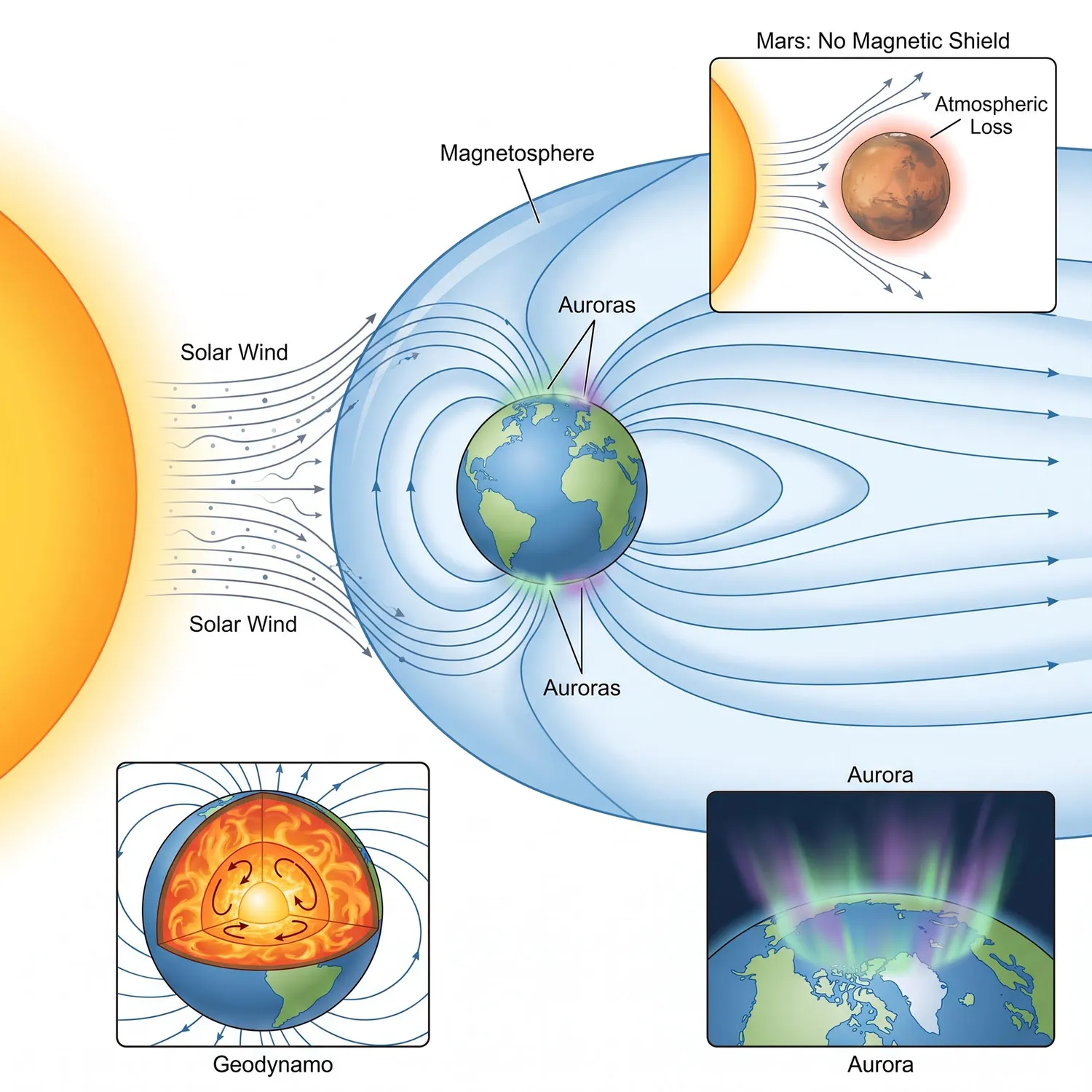
Earth's magnetosphere deflects solar wind and protects the atmosphere from radiation
Earth's magnetic field shields our planet from harmful solar wind particles.

Earth's magnetic field acts as an invisible shield that protects life on our planet. The Sun constantly releases a stream of charged particles called solar wind, along with dangerous radiation. Without protection, this flow of energy and particles could harm living things. Scientists explain that Earth's magnetic field creates a protective bubble around our planet called the magnetosphere. This shield deflects most of the solar wind and radiation away from Earth.

The magnetosphere works like a windshield on a moving car. When you drive, air rushes toward the windshield but flows around the vehicle instead of hitting you directly. Similarly, the magnetosphere steers the solar wind around Earth rather than letting it strike our atmosphere and surface. Evidence shows that charged particles from the Sun follow the magnetic field lines. These lines curve around our planet and guide the dangerous particles safely into space. Some particles do enter near the North and South Poles, creating beautiful displays called auroras. However, most of the harmful flow stays away from Earth's surface.

Without this magnetic protection, Earth could lose its atmosphere over time. The solar wind can slowly strip away atmospheric gases, molecule by molecule. Scientists observe this process happening on Mars today. Mars once had a strong magnetic field, but it disappeared billions of years ago. Research suggests that without its magnetic shield, Mars gradually lost most of its atmosphere to space. Today, Mars has only a thin atmosphere and appears cold and barren. The surface receives much more radiation than Earth does. This makes Mars a challenging environment for any potential life.

Earth's magnetic field remains strong because of activity deep inside our planet. The outer core contains liquid iron that moves and creates electric currents. These currents generate the magnetic field that extends far into space. This process has continued for billions of years, keeping our protective shield active. The magnetosphere not only blocks harmful radiation but also helps preserve the air we breathe. Oxygen, nitrogen, and other atmospheric gases stay bound to Earth instead of escaping into space. This protection matters greatly for all living things on our planet.

Interesting Fact: The magnetosphere extends about 370,000 miles into space on the side facing away from the Sun. This protective bubble is constantly shifting and changing shape as the solar wind pushes against it.

Comprehension quiz (10 questions)

1. What is the magnetosphere?

A type of solar wind that comes from the Sun
A protective bubble created by Earth's magnetic field
The liquid iron in Earth's outer core
A layer of the atmosphere that blocks sunlight

2. How does the magnetosphere protect Earth from solar wind?

It absorbs all the particles and stores them
It reflects the particles back to the Sun
It deflects most particles around the planet
It destroys the particles before they reach Earth

3. What does the word 'radiation' mean in the context of this passage?

Energy that travels through space and can harm living things
The heat produced by Earth's core
Light from the Sun that helps plants grow
Electric currents in the magnetosphere

4. Based on the passage, what can scientists infer happened to Mars after it lost its magnetic field?

Mars developed a thicker atmosphere
Mars became warmer and more suitable for life
Mars gradually lost its atmosphere to the solar wind
Mars created a new type of protective shield

5. What creates Earth's magnetic field?

The Sun's radiation hitting Earth's surface
Electric currents from moving liquid iron in Earth's outer core
The rotation of Earth's atmosphere
Charged particles trapped in the magnetosphere

6. Why does the passage compare the magnetosphere to a car windshield?

To show that both are made of similar materials
To explain how both guide flowing matter around an object
To demonstrate that both can break under pressure
To prove that magnetospheres exist on cars

7. If Earth lost its magnetic field, what would likely happen to our atmosphere over time?

The atmosphere would become thicker and heavier
The atmosphere would stay exactly the same
The solar wind would gradually strip it away
The atmosphere would turn into liquid iron

8. What causes auroras near Earth's North and South Poles?

Sunlight reflecting off ice and snow
Charged particles from the Sun entering the atmosphere
Lightning storms in the upper atmosphere
The magnetic field creating colored lights

9. True or False: The magnetosphere has a fixed shape that never changes.

True
False

10. True or False: Mars currently has a strong magnetic field protecting its surface.

True
False
Who it's for

Perfect for the way you teach

Teachers
  • Build comprehension skills
  • Auto-graded quiz
  • Differentiated reading
Parents
  • Read together at home
  • Improve fluency
  • Quiet reading time
Homeschoolers
  • Reading curriculum support
  • Independent practice
  • Track Lexile growth
Topics

Reviews & Ratings

No reviews yet. Be the first to share your experience!

More reading you might love

20 more
Passage
Frost Wedging: How Ice Splits Rock - reading educational content
Grades 5–8

Frost Wedging: How Ice Splits Rock

earth and space science · MS-ESS2-1

$1.50
Passage
Limestone Caves: Nature’s Underground Wonders - reading educational content
Grades 5–8

Limestone Caves: Nature’s Underground Wonders

science · MS-ESS2-1

Free
Passage
Chemical Weathering: The Breakdown of Rocks Through Chemical Reactions - reading educational content
Grades 5–8

Chemical Weathering: The Breakdown of Rocks Through Chemical Reactions

earth and space science · MS-ESS2-1

Free
Passage
Talus Slopes: Formation and Features - reading educational content
Grades 5–8

Talus Slopes: Formation and Features

science · MS-ESS2-1

Free
Passage
Biological Weathering: Types and Examples - reading educational content
Grades 5–8

Biological Weathering: Types and Examples

science · MS-ESS2-1

Free
Passage
The Coldest City in the World: Yakutsk - reading educational content
Grades 5–8

The Coldest City in the World: Yakutsk

weather and climate · MS-ESS2-1

$1.50
Passage
Igneous Rocks - reading educational content
Grades 5–8

Igneous Rocks

earth and space science · MS-ESS2-1

$1.50
Passage
Sedimentary Rocks - reading educational content
Grades 5–8

Sedimentary Rocks

earth and space science · MS-ESS2-1

$1.50
Passage
Metamorphic Rocks - reading educational content
Grades 5–8

Metamorphic Rocks

earth and space science · MS-ESS2-1

Free
Passage
Scientific Inquiry in Earth Science - reading educational content
Grades 5–8

Scientific Inquiry in Earth Science

earth and space science · MS-ESS1-4

$1.50
Passage
Contour Lines and Elevation - reading educational content
Grades 5–8

Contour Lines and Elevation

earth and space science · MS-ESS2-2

$1.50
Passage
Weathering - reading educational content
Grades 5–8

Weathering

earth and space science · MS-ESS2-1

$1.50
Passage
Erosion - reading educational content
Grades 5–8

Erosion

earth and space science · MS-ESS2-1

$1.50
Passage
Stream Erosion and Deposition - reading educational content
Grades 5–8

Stream Erosion and Deposition

earth and space science · MS-ESS2-1

$1.50
Passage
Wind Erosion and Deposition - reading educational content
Grades 5–8

Wind Erosion and Deposition

earth and space science · MS-ESS2-1

$1.50
Passage
Glacial Erosion and Deposition - reading educational content
Grades 5–8

Glacial Erosion and Deposition

earth and space science · MS-ESS2-1

$1.50
Passage
Mass Movements - reading educational content
Grades 5–8

Mass Movements

science · MS-ESS2-1

$1.50
Passage
Soil Formation and Composition - reading educational content
Grades 5–8

Soil Formation and Composition

earth and space science · MS-ESS2-1

$1.50
Passage
Constructive and Destructive Forces - reading educational content
Grades 5–8

Constructive and Destructive Forces

earth and space science · MS-ESS2-1

Free
Passage
Mountains and Mountain Building - reading educational content
Grades 5–8

Mountains and Mountain Building

earth and space science · MS-ESS2-1

$1.50
Copyright © 2026 Workybooks. Made with ♥ in California.