How Was the Grand Canyon Formed? — Reading Comprehension
Rate this|
1
Premium Resource
Present
Present in classroom. No work saved
Assign
Classroom with student accounts, Track progress
Quick Play
No student accounts, assign with a link
Grades
6
PRINT+DIGITAL RESOURCE
This learning resource is available in interactive and printable formats. The interactive worksheet can be played online and assigned to students. The Printable PDF version can be downloaded and printed for completion by hand.
This educational passage, audio-integrated, delves into the fascinating story of how the Grand Canyon was formed. Students will learn about the powerful forces of erosion and weathering, primarily by the Colorado River, that sculpted this iconic landmark over millions of years. The passage defines key geological terms and explains how geoscience processes have dramatically changed Earth's surface at varying time and spatial scales, directly aligning with NGSS MS-ESS2-2. It's designed for a Grade 6 reading level, making complex geological concepts accessible and engaging, with relevant SEO keywords to enhance discoverability.
CONTENT PREVIEW
Expand content preview
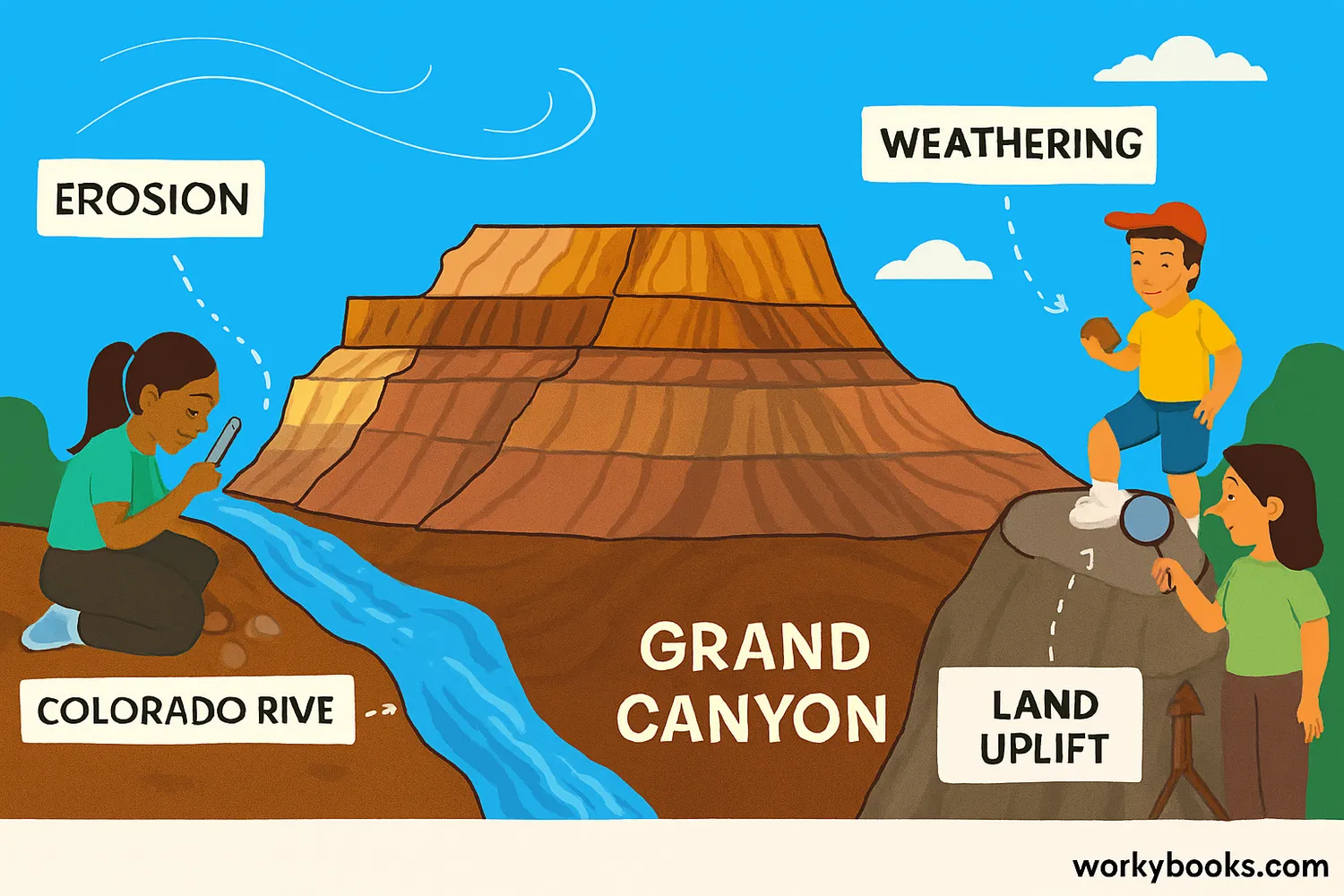
Colorado River erosion, weathering, and uplift shaped the Grand Canyon’s layered landscape.
The Grand Canyon is one of the most amazing natural wonders on Earth. It's a huge, deep ditch in the ground, located in Arizona, USA. But how did it get there? It wasn't formed overnight; it took millions of years for nature to sculpt this incredible landscape. The story of the Grand Canyon's formation is a great example of how geoscience processes have changed Earth's surface.
The main architect of the Grand Canyon is the Colorado River. For a very long time, this powerful river has been flowing across the land. As it flows, it carries tiny bits of rock and sand. This process is called erosion. Think of it like sandpaper rubbing against a piece of wood – slowly, over time, the sandpaper wears away the wood. The Colorado River acted like a giant, powerful sandpaper, constantly grinding away at the rock.
The rocks in the Grand Canyon are also very old, formed by layers of sediment that piled up over millions of years and then hardened into rock. These layers show different colors and textures. As the river carved deeper and deeper, it exposed these ancient layers, telling a story of Earth's past. The river didn't just cut straight down; it also widened the canyon over time. Other natural forces, like weathering, helped with this. Weathering is when rocks break down due to things like wind, rain, and ice. Water seeps into cracks, freezes, expands, and breaks the rock apart. Wind also carries small particles that can slowly wear away the rock.
Another important factor in the Grand Canyon's formation was the uplift of the land. Millions of years ago, the land in this area began to rise. As the land lifted, the Colorado River kept its course and continued to cut downwards, creating an even deeper canyon. It's like cutting a cake while someone else slowly lifts the plate – the knife goes deeper and deeper relative to the surface of the cake.
So, the Grand Canyon is a result of a combination of powerful forces working together over vast stretches of time: the relentless erosion by the Colorado River, the breakdown of rocks by weathering, and the slow uplift of the land. These geological processes continue even today, slowly changing the canyon's appearance. It's a living example of how our planet is always changing.
Interesting Fact: The Grand Canyon is so large that it could hold all the water in the world's rivers!
Which river is the main architect of the Grand Canyon?
Mississippi RiverColorado RiverNile RiverAmazon River
What process involves carrying tiny bits of rock?
WeatheringUpliftErosionSedimentation
The Grand Canyon was formed quickly.
TrueFalse
Which force helps break down rocks?
ErosionWeatheringUpliftSediment
What is 'uplift' in geology?
River flowing fasterLand rising upRocks breaking downSediment hardening
How do you think the canyon's shape might change in another million years?
Become completely flatBecome much deeperFill with waterShrink in size
Why are the rocks in the Grand Canyon colorful?
Painted by peopleDifferent rock layersSunlight causes itFrom river water
What would happen if the Colorado River stopped flowing?
Canyon gets widerErosion would stopLand would sinkMore uplift occurs
Which term describes rocks breaking down?
ErosionUpliftWeatheringSediment
If a new, stronger river formed next to the Grand Canyon, what might happen?
New canyon formsOld canyon fillsBoth stop erodingLand gets flatter
Perfect For:
👩🏫 Teachers
• Reading comprehension practice
• Auto-graded assessments
• Literacy skill development
👨👩👧👦 Parents
• Reading practice at home
• Comprehension improvement
• Educational reading time
🏠 Homeschoolers
• Reading curriculum support
• Independent reading practice
• Progress monitoring
Reading Features:
📖
Reading Passage
Engaging fiction or nonfiction text
❓
Comprehension Quiz
Auto-graded questions
📊
Instant Feedback
Immediate results and scoring
📄
Printable Version
Download for offline reading
🔊
Read Aloud
Voice-over with word highlighting
Reviews & Ratings
No reviews yet. Be the first to share your experience!
Related Content
Tools and Technology in Earth Science
This middle school science reading passage explores the wide range of tools and technologies used in Earth science, from...
MS-ESS2-2MS-ESS3-2MS-ETS1-1MS-PS4-3
Scientific Inquiry in Earth Science
This passage explores scientific inquiry in Earth science for grades 6-8, aligned with NGSS standards MS-ESS1-4, MS-ESS2...
MS-ESS1-4MS-ESS2-1MS-ESS3-5SEP
What Is Earth Science?
This engaging middle school science passage introduces students to the field of Earth science, aligning with NGSS standa...
MS-ESS1MS-ESS2MS-ESS3SEP
Earth: Our Home in Space
This engaging Grade 4-5 science passage, aligned to NGSS, introduces students to Earth's special place in the solar syst...
Earth's Spheres
This middle school science passage introduces students to Earth's four major spheres: the geosphere, hydrosphere, atmosp...
MS-ESS2-4MS-ESS2-6
What Is Space Weather and How Does It Affect the Earth?
This NGSS-aligned science passage for middle school explains what space weather is and how it affects Earth. Students le...
MS-ESS2-2
Earth's Energy Balance
This engaging, NGSS-aligned science passage for grades 6–8 explores Earth's energy balance, a key process that keeps our...
MS-ESS2-6
Earth's Rotation
This middle school science passage, aligned with NGSS standard MS-ESS1-1, focuses on Earth's rotation—how Earth spins on...
MS-ESS1-1
Earth's Interior
This comprehensive passage for grades 6-8 explores Earth's layered interior, including the crust, mantle, outer core, an...
MS-ESS2-1MS-ESS2-2
Facts About Earth
This engaging science reading passage introduces Grade 4 and 5 students to Earth, our home planet. Aligned with NGSS sta...
Meteorite Impacts on Earth
This engaging science reading passage for Grades 4-5 explores meteorite impacts on Earth, aligning with NGSS standards. ...
Venus: Earth's Twin?
This comprehensive science passage for grades 6-8 examines Venus—often called Earth's twin—by exploring its similarities...
MS-ESS1-2MS-ESS1-3
Earth Changes Over Millions of Years
This engaging, audio-integrated science passage for Grade 4-5 students explores how Earth has changed over millions of y...
Earth's Moon Facts
This engaging science passage, 'The Moon: Earth's Companion,' is designed for Grade 4-5 students and aligns with NGSS ge...
Earth's Quick and Slow Changes
In 'Earth's Quick and Slow Changes,' students categorize 12 Earth events by their speed of occurrence, enhancing underst...
Earth: Our Home Planet
This comprehensive science passage for grades 6-8 explores Earth’s unique characteristics and the interconnected systems...
MS-ESS1-2
Earth's Revolution
This middle school science passage explores the science behind Earth's revolution around the Sun, closely aligned with N...
MS-ESS1-1
Earth's Seasons
This comprehensive reading passage for grades 6-8 explains why Earth has seasons, revealing the scientific mechanisms be...
MS-ESS1-1
Earth's Place in the Universe
This reading passage explains Earth's place in the universe, supporting NGSS 1-ESS1-1. It describes how Earth is one of ...
1-ESS1-1
Aphelion and Perihelion
This engaging reading passage, 'Aphelion and Perihelion,' delves into the fascinating aspects of Earth's elliptical orbi...
MS-ESS1-1: DEVELOP AND USE A MODEL OF THE EARTH-SUN-MOON SYSTEM TO DESCRIBE THE CYCLIC PATTERNS OF LUNAR PHASESECLIPSES OF THE SUN AND MOONAND SEASONS.