Human Impact on the Biosphere — Reading Comprehension
Rate this
Premium Resource
Present
Present in classroom. No work saved
Assign
Classroom with student accounts, Track progress
Quick Play
No student accounts, assign with a link
Grades
6
PRINT+DIGITAL RESOURCE
This learning resource is available in interactive and printable formats. The interactive worksheet can be played online and assigned to students. The Printable PDF version can be downloaded and printed for completion by hand.
This educational passage, audio integrated, focuses on 'Human Impact on the Biosphere,' exploring how increases in human population and per-capita consumption of natural resources impact Earth's systems. It directly aligns with NGSS MS-ESS3-4, providing a clear explanation of key concepts like the biosphere, natural resources, pollution, and deforestation. Students will learn about the interconnectedness of human activities and environmental changes, understanding how our actions contribute to issues such as climate change and habitat loss. The passage uses simple language, making complex ideas accessible for a Grade 6 reading level, and includes relevant keywords for better comprehension and SEO.
CONTENT PREVIEW
Expand content preview
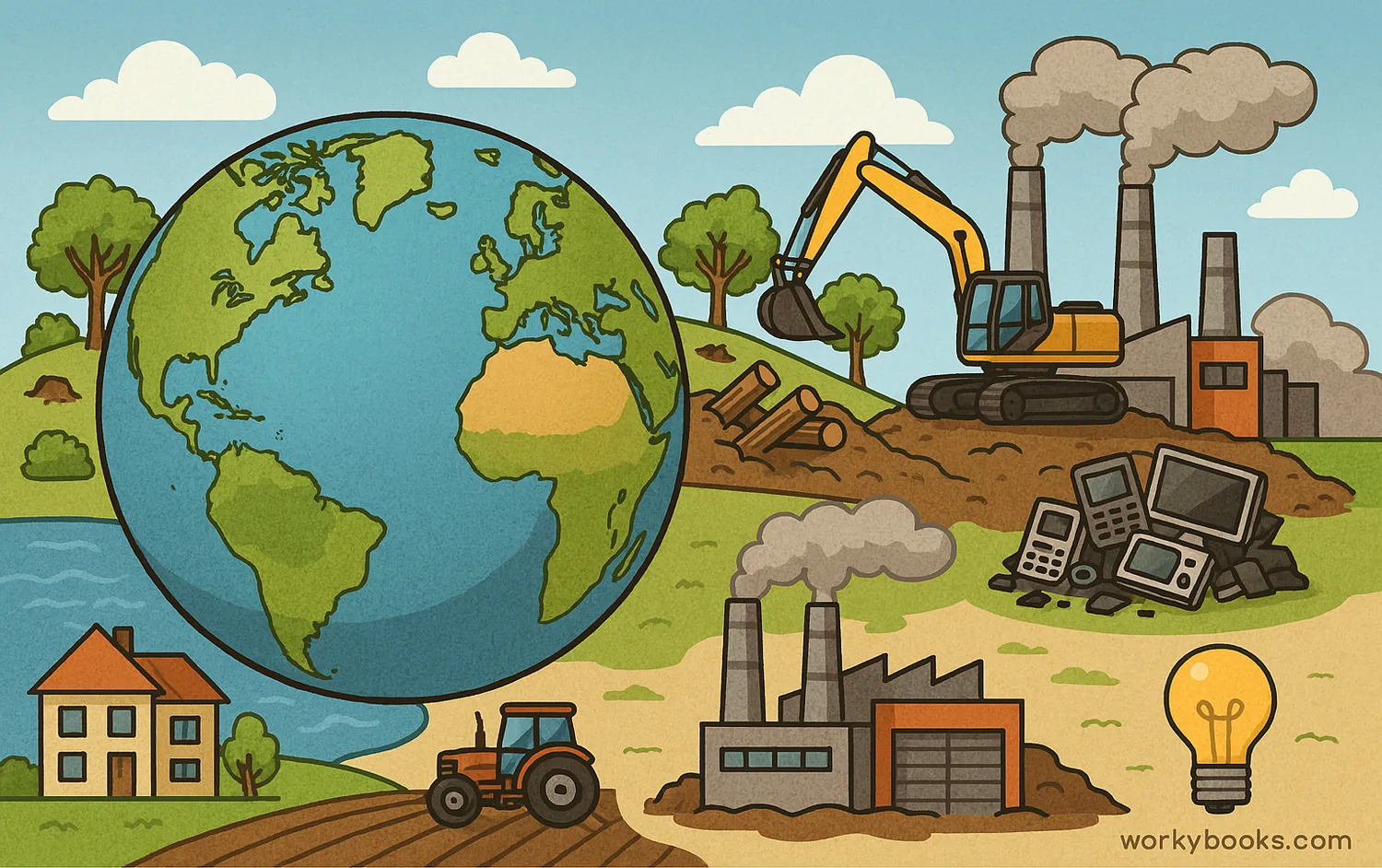
Earth with surrounding images illustrating the human impact on the biosphere.
Our amazing planet Earth is home to countless living things, from tiny bacteria to giant whales. All these living things, including us, live in a part of Earth called the biosphere. The biosphere is like a thin layer around Earth where life exists, including the air, water, and land. For a long time, human actions didn't seem to make a huge difference to the whole planet. But now, with more people living on Earth and each person using more stuff, our impact is much bigger.
One major way humans impact the biosphere is by using natural resources. These are things we get from nature, like trees for wood, water for drinking, and minerals for making electronics. As the human population grows, we need more homes, more food, and more energy. This leads to us using more natural resources. For example, to build houses, we might cut down forests, a process called deforestation. Deforestation removes trees that produce oxygen and provide homes for animals, impacting entire ecosystems.
Another big impact comes from our consumption. Each person consumes, or uses up, resources. The more we consume, the more resources we need. Making and using products often creates pollution, which is harmful substances released into the environment. Pollution can contaminate our air, water, and soil, making it unhealthy for plants, animals, and humans. For instance, burning fossil fuels for energy releases gases that trap heat in the atmosphere, leading to climate change. Climate change causes warmer temperatures, changes in weather patterns, and rising sea levels, threatening many species and their habitats.
When we use up resources faster than Earth can replace them, or create too much pollution, it affects Earth's systems. These systems include the atmosphere (air), hydrosphere (water), geosphere (land), and, of course, the biosphere. Our actions can cause loss of biodiversity, meaning a decrease in the variety of life on Earth. This is a problem because every species plays a role in keeping the biosphere healthy. To help reduce our impact, we can try to use fewer resources, recycle, conserve energy, and support sustainable practices.
Interesting Fact: It is estimated that humans have changed over 75% of the Earth's land surface, mostly for agriculture and urban development.
Which part of Earth is home to all living things?
BiosphereAtmosphereHydrosphereGeosphere
What is the process of cutting down forests called?
ReforestationDeforestationPollutionConsumption
True or False: Human impact on Earth's systems has always been this significant.
TrueFalse
Which of these is NOT a natural resource mentioned?
TreesWaterPlasticMinerals
How does burning fossil fuels contribute to climate change?
Causes deforestationTraps heatCleans airIncreases water
What is biodiversity?
Variety of lifeAmount of waterTypes of rocksAir quality
What is an ecosystem?
A type of treeLiving things and environmentA science toolA kind of pollution
Why is the loss of biodiversity a problem?
Makes Earth colorfulIncreases pollutionHarms biosphere healthSpeeds up deforestation
Which action helps reduce human impact?
More consumptionLess recyclingConserve energyIncrease pollution
If a city replaced all its gas cars with electric cars, which impact would be most reduced?
DeforestationWater pollutionAir pollutionBiodiversity loss
Perfect For:
👩🏫 Teachers
• Reading comprehension practice
• Auto-graded assessments
• Literacy skill development
👨👩👧👦 Parents
• Reading practice at home
• Comprehension improvement
• Educational reading time
🏠 Homeschoolers
• Reading curriculum support
• Independent reading practice
• Progress monitoring
Reading Features:
📖
Reading Passage
Engaging fiction or nonfiction text
❓
Comprehension Quiz
Auto-graded questions
📊
Instant Feedback
Immediate results and scoring
📄
Printable Version
Download for offline reading
🔊
Read Aloud
Voice-over with word highlighting
Reviews & Ratings
No reviews yet. Be the first to share your experience!
Related Content
Earth: Our Home in Space
This engaging Grade 4-5 science passage, aligned to NGSS, introduces students to Earth's special place in the solar syst...
Tools and Technology in Earth Science
This middle school science reading passage explores the wide range of tools and technologies used in Earth science, from...
MS-ESS2-2MS-ESS3-2MS-ETS1-1MS-PS4-3
Earth's Place in the Universe
This reading passage explains Earth's place in the universe, supporting NGSS 1-ESS1-1. It describes how Earth is one of ...
1-ESS1-1
Scientific Inquiry in Earth Science
This passage explores scientific inquiry in Earth science for grades 6-8, aligned with NGSS standards MS-ESS1-4, MS-ESS2...
MS-ESS1-4MS-ESS2-1MS-ESS3-5SEP
What Is Space Weather and How Does It Affect the Earth?
This NGSS-aligned science passage for middle school explains what space weather is and how it affects Earth. Students le...
MS-ESS2-2
Escape Velocity and Space Travel
This middle school science passage introduces students to the concept of escape velocity—the minimum speed required to b...
MS-ESS1-2MS-PS2-4
Space Stations
This informational science reading passage for grades 6-8 explores the complex systems and technology behind space stati...
MS-ESS1-3MS-ETS1-1
What Is Earth Science?
This engaging middle school science passage introduces students to the field of Earth science, aligning with NGSS standa...
MS-ESS1MS-ESS2MS-ESS3SEP
The Space Garden
This innovative passage combines plant science with space exploration, aligning with NGSS standards for life sciences an...
RL.3.1RL.2.1RL.4.9
Measuring Distances in Space
This middle school science passage explores how astronomers measure the vast distances in space, aligning with NGSS stan...
MS-ESS1-3
Earth: Our Home Planet
This comprehensive science passage for grades 6-8 explores Earth’s unique characteristics and the interconnected systems...
MS-ESS1-2
Meteorite Impacts on Earth
This engaging science reading passage for Grades 4-5 explores meteorite impacts on Earth, aligning with NGSS standards. ...
Earth's Rotation
This middle school science passage, aligned with NGSS standard MS-ESS1-1, focuses on Earth's rotation—how Earth spins on...
MS-ESS1-1
Exploring Space: Rockets and Spacecraft
Space exploration has been one of humanity's greatest achievements, made possible by rockets and spacecraft. Rockets act...
RI.4.4RI.4.2
Facts About Earth
This engaging science reading passage introduces Grade 4 and 5 students to Earth, our home planet. Aligned with NGSS sta...
Earth's Moon Facts
This engaging science passage, 'The Moon: Earth's Companion,' is designed for Grade 4-5 students and aligns with NGSS ge...
International Space Station
Discover the wonders of the International Space Station with this informative coloring page showcasing the orbiting outpost where astronauts live and work in space. As children color the complex modul...
Venus: Earth's Twin?
This comprehensive science passage for grades 6-8 examines Venus—often called Earth's twin—by exploring its similarities...
MS-ESS1-2MS-ESS1-3
Earth's Seasons
This comprehensive reading passage for grades 6-8 explains why Earth has seasons, revealing the scientific mechanisms be...
MS-ESS1-1
What Makes Earth Perfect for Life?
This Grade 4-5 science passage, aligned with NGSS standards, explores the essential features that make Earth the perfect...