Hydrogen and Alkali Metals
Interactive passage with audio narration, comprehension questions, and printable PDF.
By completing this purchase you agree to our Terms of Use and Privacy Policy. Your subscription renews automatically until you cancel. You can cancel anytime from your account settings. All sales are final and non-refundable. Digital content is available for download in your account immediately upon purchase.
What's included
Hydrogen and Alkali Metals preview and details
About this printable Hydrogen and Alkali Metals science reading passage, NGSS-aligned (Grades 5-8)
Sample passage and quiz from Hydrogen and Alkali Metals
Reading passage and comprehension quiz preview
Hydrogen and Alkali Metals
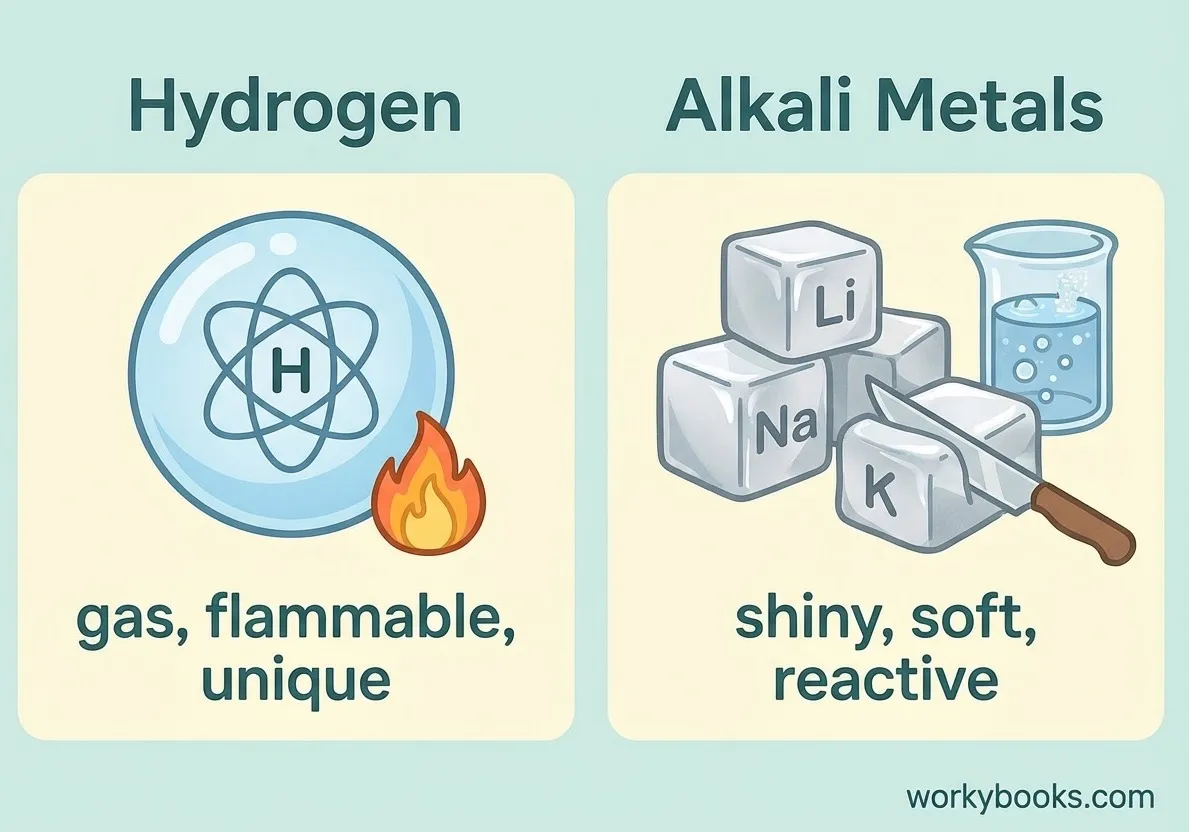
Hydrogen is the simplest and most abundant element in the universe. It appears in the first column of the periodic table, the chart scientists use to organize all known elements based on their atomic structure. However, even though hydrogen sits above the alkali metals, it behaves very differently. Understanding why these elements are placed together—and how they interact—reveals the fascinating relationship between atomic structure and chemical properties.
Atomic Structure and Reactivity
All atoms are made up of protons, neutrons, and electrons. Hydrogen contains only one proton and one electron, making it the lightest element. Alkali metals, such as lithium, sodium, and potassium, also have a single electron in their outermost shell, called the valence electron. This similarity in electron configuration places them in Group 1. However, alkali metals have more protons, neutrons, and electrons, making them heavier and giving them a solid form at room temperature—unlike hydrogen, which is a gas. The presence of one valence electron means alkali metals lose this electron easily during chemical reactions, making them extremely reactive. For example, when sodium contacts water, it reacts rapidly, producing hydrogen gas and heat, which may cause an explosion. The chemical equation for this reaction is: 2Na + 2H2O → 2NaOH + H2↑.
Physical Properties and Real-World Applications
Alkali metals share several physical properties. They are soft—sodium can be cut with a butter knife—and have low density. In fact, lithium, sodium, and potassium are less dense than water, so they float. Their softness and low density relate to the weak attraction between atoms in their structure. In industry, sodium is used in streetlights, while lithium powers rechargeable batteries found in phones and laptops. Potassium is vital for plant growth and is a main ingredient in fertilizers. Hydrogen, though not an alkali metal, is crucial for making ammonia (NH3) for fertilizers, and is also studied as a clean fuel source for the future.
Safety and Scientific Significance
Due to their high reactivity, alkali metals must be stored under oil to prevent contact with air or moisture. Even small pieces of sodium or potassium can cause dangerous reactions if exposed to water. Scientists have learned about their properties through careful experiments, observing patterns in reactivity and atomic structure. This understanding helps chemists predict how elements will behave in new situations and design safer processes for industries. The placement of hydrogen with alkali metals in the periodic table highlights the importance of electron arrangement over other properties, showing how scientific classification evolves as we learn more.
In summary, hydrogen and the alkali metals illustrate how atomic structure determines an element’s properties and reactivity. Their similarities and differences have shaped important discoveries in chemistry and have significant impacts on technology, industry, and safety practices around the world.
Interesting Fact:
Potassium is so reactive that it can ignite instantly when it touches water, releasing enough energy to spark a purple flame!
Comprehension quiz (10 questions)
1. Which element is the simplest and most abundant in the universe?
2. Why are alkali metals placed in Group 1 of the periodic table?
3. What is produced when sodium reacts with water?
4. Which property do hydrogen and alkali metals share?
5. What does the term 'density' mean as used in the passage?
6. In the passage, what is the main reason alkali metals are extremely reactive?
7. How have scientists learned about the properties of alkali metals?
8. Which is a real-world use of lithium mentioned in the passage?
9. Alkali metals must be stored under oil to prevent dangerous reactions. (True/False)
10. Hydrogen is always a solid at room temperature. (True/False)
Perfect for the way you teach
- Build comprehension skills
- Auto-graded quiz
- Differentiated reading
- Read together at home
- Improve fluency
- Quiet reading time
- Reading curriculum support
- Independent practice
- Track Lexile growth