This learning resource is available in interactive and printable formats. The interactive worksheet can be played online and assigned to students. The Printable PDF version can be downloaded and printed for completion by hand.
This middle school science passage introduces students to the concept of hydrogen bonds, an essential intermolecular force responsible for many important properties in nature. Aligned to NGSS standard MS-PS1-1, the text explains how hydrogen bonds form between hydrogen and highly electronegative atoms like oxygen, nitrogen, or fluorine. Students will learn how hydrogen bonds give water its high boiling point, create surface tension, and enable ice to float. The passage also covers how hydrogen bonding maintains DNA’s double helix structure through base pairing. Clear distinctions are made between hydrogen bonds and covalent bonds, supporting conceptual understanding. The passage includes a glossary, differentiated and Spanish versions, and interactive activities such as quizzes, writing prompts, and graphic organizers. Audio integration supports diverse learners. This resource helps students understand the role of hydrogen bonds in both living and nonliving systems and connects to broader chemistry and biology concepts.
CONTENT PREVIEW
Expand content preview
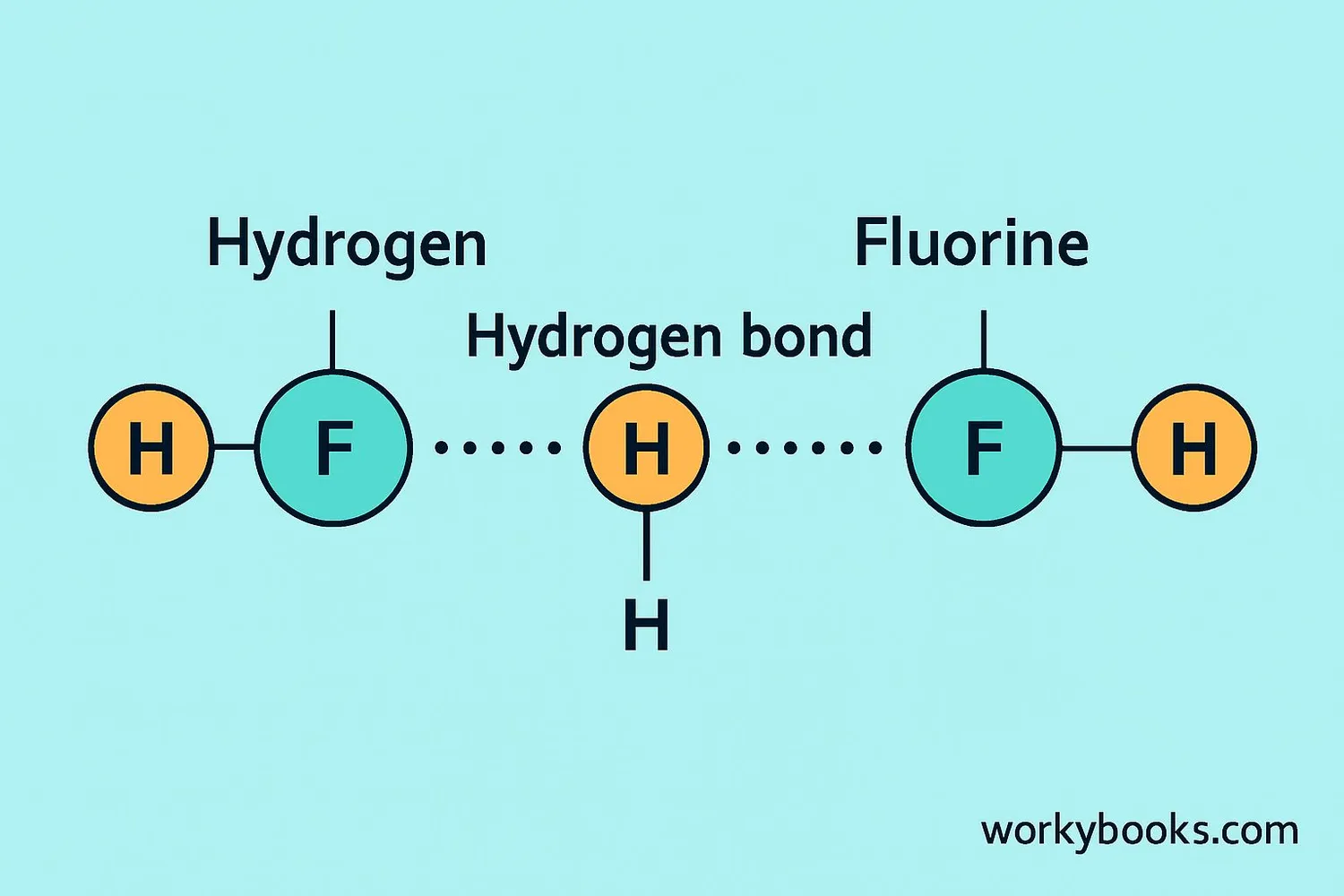
Hydrogen bonding in hydrogen fluoride molecules
Hydrogen bonds play a vital role in shaping the world around us. For example, water’s unusually high boiling point, its ability to form droplets, and the way ice floats are all explained by hydrogen bonds. Scientists have discovered that these strong attractions between molecules are essential to many chemical and biological processes. Unlike covalent bonds, which involve the sharing of electrons within a molecule, hydrogen bonds are not true chemical bonds, but rather powerful forces that act between molecules.
How Hydrogen Bonds Form Hydrogen bonds occur when a hydrogen atom attached to a highly electronegative atom—such as oxygen, nitrogen, or fluorine—attracts another electronegative atom in a different molecule. In a water molecule (H₂O), the oxygen atom pulls electrons closer, giving it a slight negative charge, while the hydrogen atoms become slightly positive. This charge difference creates an intermolecular force, known as a hydrogen bond, between the hydrogen of one molecule and the oxygen of another. These bonds are much weaker than covalent bonds, but stronger than most other intermolecular forces. In liquid water, each molecule can form up to four hydrogen bonds at a time, creating a dynamic, interconnected network. This network is responsible for water’s high surface tension, its ability to dissolve many substances, and its high boiling point (100°C), which is much higher than similar-sized molecules.
Hydrogen Bonds in Water and DNA The effects of hydrogen bonding are seen in both living and nonliving systems. In water, hydrogen bonds cause molecules to stick together, supporting insects that walk on water and causing water to bead on surfaces. When water freezes, the hydrogen bonds arrange molecules in an open, hexagonal pattern. This makes ice less dense than liquid water, so it floats—an unusual property that helps aquatic life survive cold winters. In living systems, hydrogen bonds hold together the two strands of the DNA double helix. Each base pair in DNA is connected by specific hydrogen bonds: adenine pairs with thymine using two hydrogen bonds, while cytosine pairs with guanine using three. These bonds are strong enough to keep the DNA strands together but weak enough to allow them to separate during cell division and replication.
Broader Importance and Misconceptions Hydrogen bonds are not the same as covalent bonds. While covalent bonds involve the sharing of electrons between atoms in a single molecule, hydrogen bonds are attractions between different molecules or parts of large molecules. This distinction is important for understanding chemical reactions, physical properties, and biological functions. Hydrogen bonds also play a role in the structure of proteins, the behavior of ammonia and hydrogen fluoride, and in many industrial and technological applications. Understanding hydrogen bonds helps scientists develop new materials, medicines, and environmental solutions.
Hydrogen bonds are a key example of how invisible forces at the molecular level shape the properties of substances and the processes of life. They connect to broader scientific ideas about matter, energy, and interactions between particles.
Interesting Fact: Without hydrogen bonds, all water on Earth would be a gas at room temperature, making life as we know it impossible!
What is a hydrogen bond?
A strong attraction between molecules involving hydrogen and an electronegative atomA chemical bond where atoms share electronsA force that only exists in metalsA type of covalent bond between two hydrogens
Which property of water is explained by hydrogen bonds?
High boiling pointWater's colorWater's smellWater's taste
What happens to water molecules when ice forms?
They form an open, hexagonal pattern due to hydrogen bondsThey get closer together and become denser than liquid waterThey lose all hydrogen bondsThey combine with air molecules
In DNA, what do hydrogen bonds do?
Hold the two strands of DNA togetherHelp DNA dissolve in waterBreak apart DNA during cell divisionCreate the color of DNA
What does 'electronegative' mean in the context of hydrogen bonds?
An atom's ability to attract electronsAn atom's colorA molecule's boiling pointA type of metal
Which of the following best describes a covalent bond?
A bond where two atoms share electrons within a moleculeA force between moleculesAn attraction between hydrogen and oxygenA bond found only in water
Hydrogen bonds are responsible for which of the following effects? (Choose all that apply)
Surface tension in waterWater beading on leavesDNA double helix stabilityAll of the above
If hydrogen bonds did not exist, what would happen to water at room temperature?
All water would be a gasWater would freeze instantlyWater would turn into a solidWater would not exist
True or False: Hydrogen bonds are stronger than covalent bonds.
TrueFalse
True or False: Hydrogen bonds only occur in water.
TrueFalse
Perfect For:
👩🏫 Teachers
• Reading comprehension practice
• Auto-graded assessments
• Literacy skill development
👨👩👧👦 Parents
• Reading practice at home
• Comprehension improvement
• Educational reading time
🏠 Homeschoolers
• Reading curriculum support
• Independent reading practice
• Progress monitoring
Reading Features:
📖
Reading Passage
Engaging fiction or nonfiction text
❓
Comprehension Quiz
Auto-graded questions
📊
Instant Feedback
Immediate results and scoring
📄
Printable Version
Download for offline reading
🔊
Read Aloud
Voice-over with word highlighting
Reviews & Ratings
No reviews yet. Be the first to share your experience!
Related Content
Atomic Structure
This reading passage on Atomic Structure provides middle school students with an accessible explanation of the fundament...
MS-PS1-1RI.6.3RI.7.1
Parts of an Atom
This reading passage on Parts of an Atom provides middle school students with a structured and accessible explanation of...
MS-PS1-1RI.6.3RI.7.1
Chemical Bonds
This reading passage on Chemical Bonds provides middle school students with a clear explanation of how and why atoms con...
MS-PS1-1RI.6.3RI.7.1
The Freezing Point of Water
This science reading passage, titled 'The Freezing Point of Water', introduces students to a key physical science concep...
MS-PS1-1RI.6.3RI.7.1
Physical Properties of Matter
This comprehensive reading passage introduces grades 6-8 students to the concept of physical properties of matter, perfe...
MS-PS1-1
Mixtures and Pure Substances
This middle school science passage provides an in-depth exploration of mixtures and pure substances, directly aligned to...
MS-PS1-1
Types of Mixtures
This comprehensive science passage for grades 6-8 introduces students to the concept of mixtures, focusing on distinguis...
MS-PS1-1
Solutions, Suspensions, and Colloids
This comprehensive science passage explores the differences between solutions, suspensions, and colloids, focusing on ho...
MS-PS1-1
The Nature of Science
This passage explores the nature of science for middle school students, aligning with NGSS standards MS-ETS1-4, MS-PS1-1...
MS-ETS1-4MS-PS1-1MS-LS1-1
Scientific Theories
This reading passage for grades 6-8 introduces students to the concept of scientific theories, emphasizing that these ar...
MS-PS1-1MS-PS1-4MS-PS3-4SCIENCE AND ENGINEERING PRACTICES
Particle Model of Matter
This comprehensive science reading passage for grades 6-8 explores the particle model of matter, aligning with NGSS stan...
MS-PS1-1MS-PS1-4
Valence Electrons
This middle school science passage introduces students to the concept of valence electrons, the outermost electrons that...
MS-PS1-1
The Idea of the Atom
This informational science passage introduces middle school students (grades 6-8) to the concept that all matter is made...
MS-PS1-1
Protons, Neutrons, and Electrons
This comprehensive middle school science passage explores the roles of protons, neutrons, and electrons, the three main ...
MS-PS1-1
What are Ions
This passage introduces middle school students to the concept of ions, explaining the processes by which atoms gain or l...
MS-PS1-1
Nucleus of the Atom
This comprehensive passage for grades 6-8 introduces students to the nucleus of the atom, the dense center that contains...
MS-PS1-1
How Atoms Differ
This middle school science reading passage, aligned with NGSS standard MS-PS1-1, explores the fundamental differences am...
MS-PS1-1
Isotopes
This middle school science passage explores the concept of isotopes, which are atoms of the same element with different ...
MS-PS1-1
Compounds vs. Mixtures
This educational passage for grades 6-8 explores the fundamental differences between compounds and mixtures, aligning wi...
MS-PS1-1
Organizing the Elements
This passage for middle school science explores how scientists organized the elements as more were discovered, leading t...