This learning resource is available in interactive and printable formats. The interactive worksheet can be played online and assigned to students. The Printable PDF version can be downloaded and printed for completion by hand.
This detailed passage explores the concept of ionic bonds for middle school students, aligning with NGSS standard MS-PS1-1. Students will learn how ionic bonds form through the transfer of electrons between metals and nonmetals, resulting in the creation of cations and anions held together by electrostatic forces. With familiar examples like sodium chloride (table salt), magnesium oxide, and calcium fluoride, the passage guides readers through the mechanistic steps of electron transfer, ion formation, and crystal lattice organization. Key vocabulary is embedded and explained, supporting deep understanding of chemical bonding and its importance in everyday life. The passage also connects to broader scientific ideas about matter, structure, and properties. Activities include a glossary, differentiated and Spanish versions, quizzes, writing prompts, and graphic organizers, with integrated audio support for accessibility.
CONTENT PREVIEW
Expand content preview
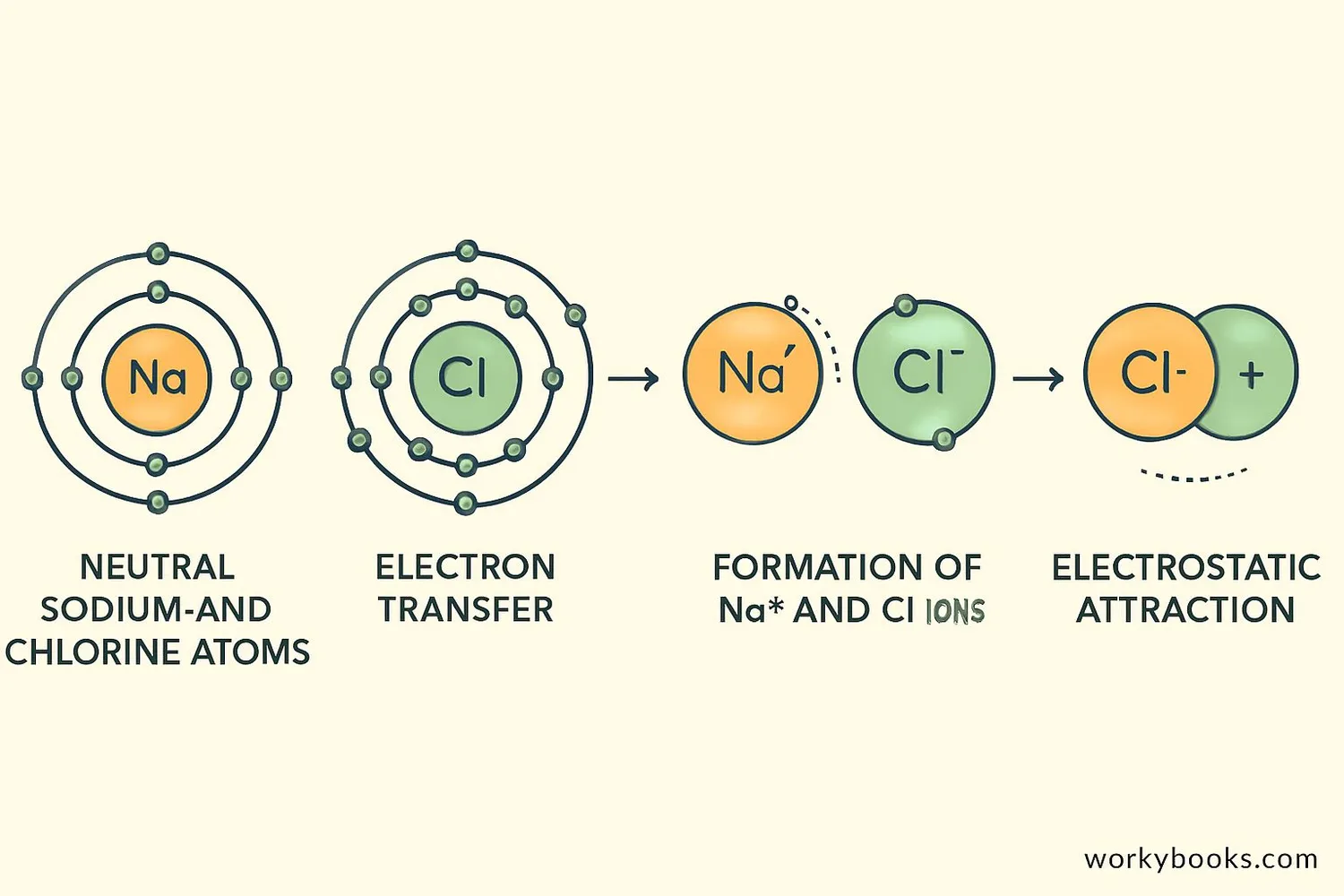
Diagram of ionic bond formation process
Ionic bonds are responsible for holding together many of the solid compounds we see in everyday life, such as table salt. These bonds form when atoms interact in a way that involves the complete transfer of valence electrons. Understanding how and why these bonds occur explains why certain materials have high melting points and conduct electricity when dissolved in water. The process of ionic bonding is a key part of how matter is structured at the atomic level.
How Ionic Bonds Form: The Role of Electron Transfer
Atoms are made up of protons, neutrons, and electrons. The electrons in the outermost shell are called valence electrons. Metals, like sodium (Na) and magnesium (Mg), tend to lose these valence electrons easily. Nonmetals, such as chlorine (Cl) and fluorine (F), tend to gain electrons. When a sodium atom meets a chlorine atom, sodium transfers one electron to chlorine. After this transfer, sodium becomes a positively charged cation (Na+), and chlorine becomes a negatively charged anion (Cl-). This electron transfer creates two ions with opposite charges.
These opposite charges result in a strong electrostatic attraction between the ions, which is the force that holds them together in an ionic compound. For example, in sodium chloride (NaCl), each sodium cation is surrounded by chloride anions, and vice versa, forming a stable structure.
Crystal Lattice and Properties of Ionic Compounds
The repeating pattern of ions in an ionic compound forms a crystal lattice. In this arrangement, each ion is attracted to its oppositely charged neighbors in a three-dimensional grid. This regular pattern makes ionic compounds strong and gives them high melting points. For example, table salt melts at about 800°C (1,472°F). The crystal lattice also explains why these compounds are brittle: when a force shifts the lattice, like charges can line up, causing the crystal to shatter.
Ionic compounds like magnesium oxide (MgO) and calcium fluoride (CaF2) show similar structures. Magnesium loses two electrons to become Mg2+, while oxygen gains two electrons to become O2-. This balancing of charges ensures the compound is neutral overall.
Applications and Broader Connections
Ionic bonds are not just found in the lab. They play a critical role in our bodies and the environment. For example, sodium and potassium ions are essential for nerve impulses. The ability of ionic compounds to dissolve in water and conduct electricity is used in batteries and water treatment. The formation of these bonds connects directly to the concept of valence electrons—a topic studied in previous lessons—showing how atomic structure determines chemical properties.
Understanding ionic bonding is fundamental for recognizing how atoms achieve stability by filling their outer electron shells. This concept is central to chemistry and helps explain the diversity and behavior of substances around us.
Interesting Fact: The largest known natural crystal of table salt (sodium chloride) was found in Poland and measured over 2 meters long!
What is the main process that creates ionic bonds?
The transfer of electrons from one atom to anotherThe sharing of electrons between atomsThe splitting of an atom's nucleusThe movement of protons between atoms
Which of the following is an example of an ionic compound?
Table salt (NaCl)Water (H2O)Carbon dioxide (CO2)Hydrogen gas (H2)
What happens to a sodium atom when it forms an ionic bond with chlorine?
It loses one electron and becomes a cationIt gains one electron and becomes an anionIt loses one proton and becomes neutralIt shares electrons with chlorine
What is the main force that holds the ions together in an ionic bond?
Electrostatic attractionGravityMagnetismNuclear force
What does the word 'cation' mean as used in the passage?
A positively charged ionA negatively charged ionA neutral atomA type of molecule
Based on the passage, what is a 'crystal lattice'?
A repeating 3D arrangement of ions in an ionic compoundA group of water moleculesA bond between two metalsA layer of atoms in a metal
Why do ionic compounds have high melting points?
Because the crystal lattice structure is very strongBecause they contain waterBecause they are made of gasesBecause they have weak bonds
Apply: Potassium (K) is a metal and fluorine (F) is a nonmetal. What type of bond would they form?
Ionic bondCovalent bondMetallic bondNo bond at all
True or False: In an ionic bond, metals usually gain electrons.
FalseTrue
True or False: The ability of table salt to dissolve in water and conduct electricity is related to its ionic bonds.
TrueFalse
Perfect For:
👩🏫 Teachers
• Reading comprehension practice
• Auto-graded assessments
• Literacy skill development
👨👩👧👦 Parents
• Reading practice at home
• Comprehension improvement
• Educational reading time
🏠 Homeschoolers
• Reading curriculum support
• Independent reading practice
• Progress monitoring
Reading Features:
📖
Reading Passage
Engaging fiction or nonfiction text
❓
Comprehension Quiz
Auto-graded questions
📊
Instant Feedback
Immediate results and scoring
📄
Printable Version
Download for offline reading
🔊
Read Aloud
Voice-over with word highlighting
Reviews & Ratings
No reviews yet. Be the first to share your experience!
Related Content
Atomic Structure
This reading passage on Atomic Structure provides middle school students with an accessible explanation of the fundament...
MS-PS1-1RI.6.3RI.7.1
Parts of an Atom
This reading passage on Parts of an Atom provides middle school students with a structured and accessible explanation of...
MS-PS1-1RI.6.3RI.7.1
Chemical Bonds
This reading passage on Chemical Bonds provides middle school students with a clear explanation of how and why atoms con...
MS-PS1-1RI.6.3RI.7.1
The Freezing Point of Water
This science reading passage, titled 'The Freezing Point of Water', introduces students to a key physical science concep...
MS-PS1-1RI.6.3RI.7.1
Physical Properties of Matter
This comprehensive reading passage introduces grades 6-8 students to the concept of physical properties of matter, perfe...
MS-PS1-1
Mixtures and Pure Substances
This middle school science passage provides an in-depth exploration of mixtures and pure substances, directly aligned to...
MS-PS1-1
Types of Mixtures
This comprehensive science passage for grades 6-8 introduces students to the concept of mixtures, focusing on distinguis...
MS-PS1-1
Solutions, Suspensions, and Colloids
This comprehensive science passage explores the differences between solutions, suspensions, and colloids, focusing on ho...
MS-PS1-1
The Nature of Science
This passage explores the nature of science for middle school students, aligning with NGSS standards MS-ETS1-4, MS-PS1-1...
MS-ETS1-4MS-PS1-1MS-LS1-1
Scientific Theories
This reading passage for grades 6-8 introduces students to the concept of scientific theories, emphasizing that these ar...
MS-PS1-1MS-PS1-4MS-PS3-4SCIENCE AND ENGINEERING PRACTICES
Particle Model of Matter
This comprehensive science reading passage for grades 6-8 explores the particle model of matter, aligning with NGSS stan...
MS-PS1-1MS-PS1-4
Valence Electrons
This middle school science passage introduces students to the concept of valence electrons, the outermost electrons that...
MS-PS1-1
The Idea of the Atom
This informational science passage introduces middle school students (grades 6-8) to the concept that all matter is made...
MS-PS1-1
Protons, Neutrons, and Electrons
This comprehensive middle school science passage explores the roles of protons, neutrons, and electrons, the three main ...
MS-PS1-1
What are Ions
This passage introduces middle school students to the concept of ions, explaining the processes by which atoms gain or l...
MS-PS1-1
Nucleus of the Atom
This comprehensive passage for grades 6-8 introduces students to the nucleus of the atom, the dense center that contains...
MS-PS1-1
How Atoms Differ
This middle school science reading passage, aligned with NGSS standard MS-PS1-1, explores the fundamental differences am...
MS-PS1-1
Isotopes
This middle school science passage explores the concept of isotopes, which are atoms of the same element with different ...
MS-PS1-1
Compounds vs. Mixtures
This educational passage for grades 6-8 explores the fundamental differences between compounds and mixtures, aligning wi...
MS-PS1-1
Organizing the Elements
This passage for middle school science explores how scientists organized the elements as more were discovered, leading t...