Is the Sun Really Moving
Interactive passage with audio narration, comprehension questions, and printable PDF.
By completing this purchase you agree to our Terms of Use and Privacy Policy. Your subscription renews automatically until you cancel. You can cancel anytime from your account settings. All sales are final and non-refundable. Digital content is available for download in your account immediately upon purchase.
What's included
Is the Sun Really Moving preview and details
About this printable Is the Sun Really Moving science reading passage, NGSS-aligned (Grades 5-8)
Sample passage and quiz from Is the Sun Really Moving
Reading passage and comprehension quiz preview
Is the Sun Moving Across the Sky

"Beautiful sunset over Lake Michigan, capturing serene waters and a colorful sky." by Hao Chen / Pexels.
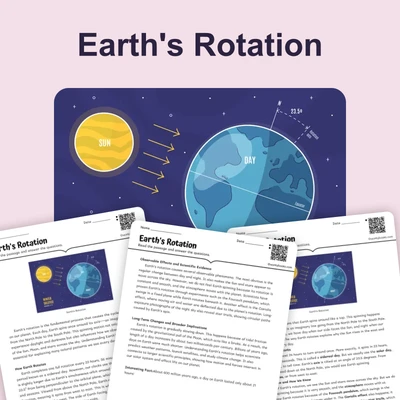
The Sun does not actually move across the sky during the day. This may seem surprising because we watch it rise in the east each morning. We see it climb higher at noon. We observe it set in the west each evening. However, the Sun remains nearly stationary in space. Earth's rotation creates this illusion of movement.
Our planet spins on its axis once every 24 hours. This spinning motion is called rotation. As Earth rotates from west to east, we move past the Sun. From our perspective on Earth's surface, the Sun appears to move in the opposite direction. Scientists call this apparent motion. Evidence shows that Earth's rotation causes day and night, not the Sun traveling around our planet.
Ancient cultures naturally believed the Sun moved because that is what their eyes told them. They lacked tools to measure Earth's rotation. Without telescopes or satellites, they could only observe from Earth's surface. Their observations were accurate, but their explanations were incorrect. The Sun looked like it moved, so they assumed it did. This demonstrates an important difference between what we observe and how scientists explain those observations.
Consider riding in a car on the highway. Trees and buildings appear to rush past your window. You know the trees are not actually moving. Your motion through space creates this effect. The same principle applies to our view of the Sun. We are passengers on a rotating planet. The Sun's position in our sky changes because we are moving, not because the Sun is traveling around Earth.
In 1851, French physicist Léon Foucault demonstrated Earth's rotation using a large pendulum. The pendulum's swing direction slowly changed over time. This change occurred because Earth rotated beneath the swinging pendulum. The pendulum itself maintained a constant direction in space. Foucault's experiment provided direct evidence that Earth rotates. Scientists today use even more precise instruments to measure our planet's rotation.
Understanding Earth's rotation matters for navigation, timekeeping, and space exploration. Pilots and ship captains must account for Earth's rotation when planning long routes. Satellites orbit a rotating planet, which affects their paths. Even our system of time zones exists because Earth rotates through sunlight. Recognizing that Earth moves rather than the Sun helps us understand our place in the solar system.
Interesting Fact: Earth rotates at approximately 1,000 miles per hour at the equator, yet we do not feel this motion because everything around us moves at the same speed.
Comprehension quiz (10 questions)
1. According to the passage, what causes the Sun to appear to move across the sky?
2. How long does it take Earth to complete one full rotation on its axis?
3. What does the term 'apparent motion' mean in the context of the passage?
4. Why did ancient cultures believe the Sun moved around Earth?
5. In the car analogy, what do the trees represent?
6. What did Léon Foucault's pendulum experiment demonstrate?
7. According to the passage, understanding Earth's rotation is important for which of the following?
8. What is the main difference between observations and scientific explanations mentioned in the passage?
9. True or False: The Sun actually travels around Earth each day.
10. True or False: We can feel Earth's rotation because it spins at approximately 1,000 miles per hour at the equator.
Perfect for the way you teach
- Build comprehension skills
- Auto-graded quiz
- Differentiated reading
- Read together at home
- Improve fluency
- Quiet reading time
- Reading curriculum support
- Independent practice
- Track Lexile growth