This learning resource is available in interactive and printable formats. The interactive worksheet can be played online and assigned to students. The Printable PDF version can be downloaded and printed for completion by hand.
This engaging reading passage explores President James Madison’s 1812 war message to Congress, which played a pivotal role in the events leading to the War of 1812. The text details the major grievances Madison cited, such as British interference with American trade and the impressment of U.S. sailors, providing students with a nuanced understanding of the causes and consequences of the war. Designed for middle school learners, the passage incorporates academic vocabulary, encourages historical reasoning, and models the use of evidence in analyzing primary sources. This resource aligns with HSS 8.5.1 and CCSS.RI.6-8.1, RI.6-8.2, supporting both history and ELA standards. The set includes a Spanish translation, differentiated versions for accessibility, a glossary, timeline, comprehension questions, writing prompts, and graphic organizers. Read aloud audio is available, making this a comprehensive tool for history classrooms.
CONTENT PREVIEW
Expand content preview
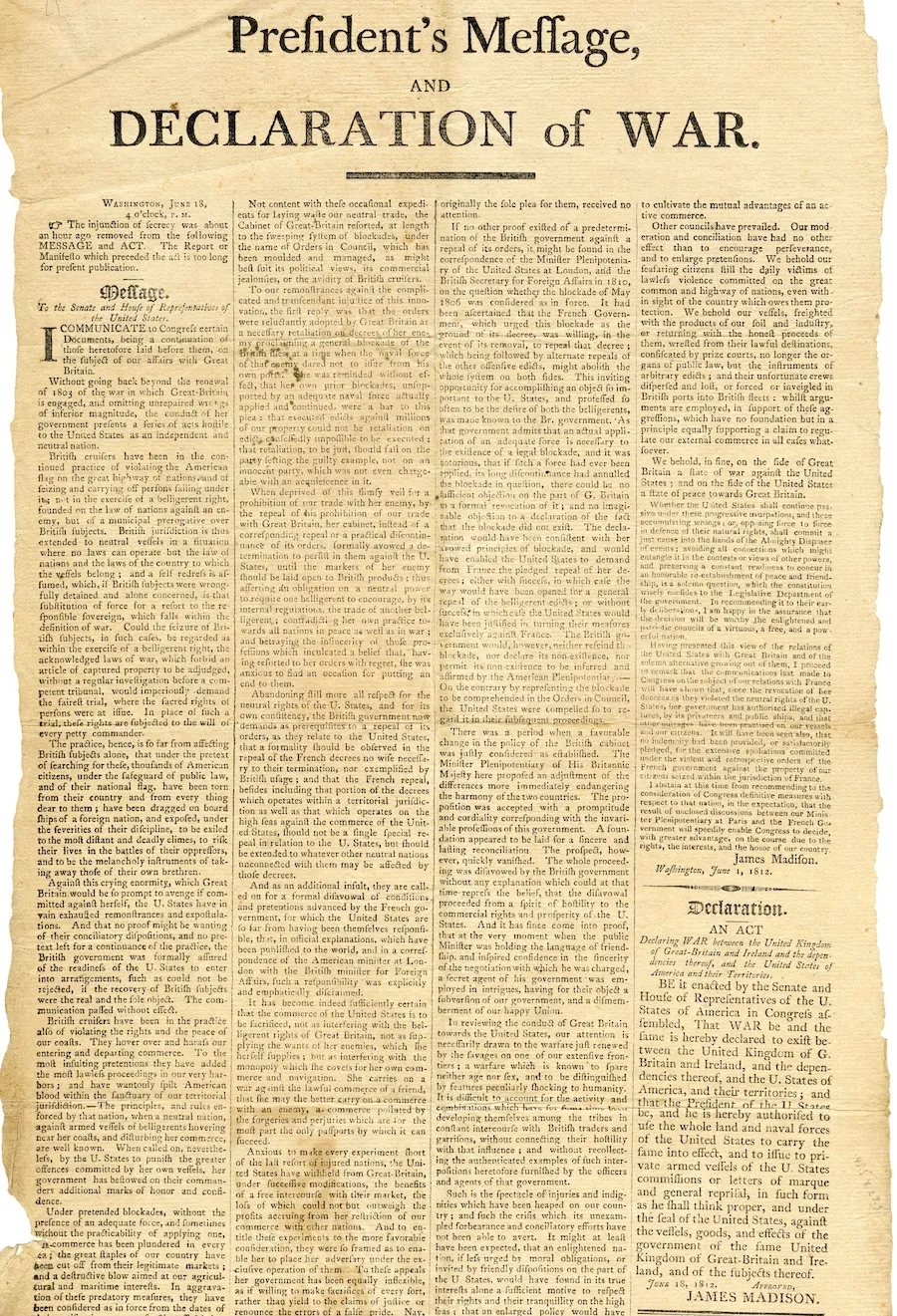
On June 18, 1812, Congress declared war on Great Britain.
On June 1, 1812, President James Madison delivered a formal war message to the United States Congress, asking for a declaration of war against Great Britain. This marked a turning point in American history, as it was the first time Congress was asked to declare war on another nation. Madison's message was not simply a call to arms; it was a carefully constructed document that justified war by listing the American grievances against Britain.
One of the main complaints in Madison's message was British interference with American trade. Great Britain and France were at war in Europe, and both countries had tried to prevent the United States from trading with the other. However, Madison argued that Britain was especially aggressive, using its powerful navy to block American ships and seize their cargoes. This interference with neutral trade hurt American merchants and the young nation's economy.
Another serious issue was the British practice of impressment. The British navy forcibly took sailors from American ships, claiming these men were British subjects who had deserted. However, many of those taken were actually American citizens. Madison called impressment a violation of American sovereignty—the right of a nation to control its own affairs. He argued that this practice not only endangered the lives of American sailors but also humiliated the United States on the world stage.
Madison also pointed to British support for Native American resistance in the Northwest Territory. He believed that British agents supplied weapons to Native groups who attacked American settlers. This added to the sense of insecurity and was considered an indirect attack on U.S. expansion and national security.
In his message, Madison made the case that all diplomatic efforts to solve these problems had failed. He wrote that the United States had tried negotiations and peaceful diplomacy, but Britain refused to change its policies. Therefore, Madison argued, war was the only way to defend the nation’s rights and honor. By presenting evidence of repeated violations, he persuaded Congress and the American public that war was justified.
On June 18, 1812, after debate, Congress responded to Madison’s message by issuing an official declaration of war against Great Britain. This event began the War of 1812, a conflict that would test the young nation’s strength and unity.
Although the war was controversial—some Americans opposed it, fearing economic hardship or military defeat—Madison’s message shaped public opinion and set out clear reasons for the conflict. It also established a precedent for how presidents could use evidence and argument to request military action from Congress, balancing executive and legislative powers as defined in the Constitution.
Interesting Fact: During the War of 1812, the British burned the White House and the Capitol, forcing President Madison and other leaders to flee Washington, D.C.
Who delivered the 1812 war message?
James MadisonThomas JeffersonAndrew JacksonGeorge Washington
What did Madison ask Congress for?
Declaration of warNew lawsPeace treatyTrade agreement
Which country was the U.S. declaring war on?
FranceSpainBritainMexico
Why did Britain take American sailors?
They needed more workersTo punish the U.S.They claimed sailors were BritishFor trade reasons
What was one result of British interference?
American trade sufferedBritain lost shipsFrance gained powerAmericans helped Britain
How did Madison justify war?
He listed grievancesHe ignored CongressHe promised landHe supported Britain
The War of 1812 began after Congress declared war. True or false?
TrueFalse
What is 'impressment'?
Seizing cargoForcing sailors into serviceSigning a treatyMaking speeches
Perfect For:
👩🏫 Teachers
• Reading comprehension practice
• Auto-graded assessments
• Literacy skill development
👨👩👧👦 Parents
• Reading practice at home
• Comprehension improvement
• Educational reading time
🏠 Homeschoolers
• Reading curriculum support
• Independent reading practice
• Progress monitoring
Reading Features:
📖
Reading Passage
Engaging fiction or nonfiction text
❓
Comprehension Quiz
Auto-graded questions
📊
Instant Feedback
Immediate results and scoring
📄
Printable Version
Download for offline reading
🔊
Read Aloud
Voice-over with word highlighting
Reviews & Ratings
No reviews yet. Be the first to share your experience!
Related Content
Presidential Precedents George Washington
This comprehensive history reading passage examines George Washington’s presidency and how his leadership set key nation...
New Nation America
This history reading passage, 'New Nation America,' covers how the United States struggled to become a united country af...
HSS 5.6.1RI.4.2
George Washington First President
This passage explores how George Washington became the first President of the United States in 1789 and the crucial prec...
The Cherokee Nation: History and Culture
This reading passage explores the rich history and culture of the Cherokee Nation, one of the largest Native American tr...
D2.HIS.2.3-5D2.HIS.14.3-5RI.4.3RI.4.4RI.4.10
American Indians and U.S. Citizenship
This reading passage explores the complex history of American Indians and U.S. citizenship, focusing on the period after...
John Adams: Second President
This engaging U.S. history reading passage introduces students to John Adams, the second President of the United States....
D2.HIS.2.3-5D2.HIS.14.3-5RI.4.3RI.4.4
George Washington: Our First President
This engaging U.S. history reading passage introduces students to George Washington, America’s first president, through ...
D2.HIS.2.3-5D2.HIS.3.3-5RI.4.3RI.4.4
James Madison Early Life
This passage explores the formative years of James Madison—his upbringing in Virginia, his education, and his early expe...
George Washington Early Life
This reading passage explores George Washington’s remarkable journey from Virginia plantation farmer to the first presid...
New Orleans: An Important Port
This engaging U.S. history reading passage explores the crucial role of New Orleans and the Louisiana Purchase in shapin...
D2.HIS.3.3-5D2.HIS.14.3-5RI.4.3RI.4.4
John Adams Presidency
This passage explores the complex presidency of John Adams, the second president of the United States, focusing on the p...
D2.HIS.2.3-5D2.HIS.3.3-5RI.4.3RI.4.4
George Washington Whiskey Rebellion
This engaging U.S. History reading passage examines George Washington and the Whiskey Rebellion, a crucial moment that t...
Modern American Presidents
This engaging reading passage introduces students to Modern American Presidents, focusing on the leadership, challenges,...
D2.HIS.1-4.3-5RI.4.3RI.4.4
Hamilton vs Jefferson
This engaging U.S. history reading passage explores the contrasting visions of Alexander Hamilton and Thomas Jefferson, ...
Leaders Call for a New Constitution
This reading passage explores the pivotal moment in U.S. history when American leaders recognized the weaknesses of the ...
James Madison: Father of the Constitution
This passage provides a detailed exploration of James Madison’s pivotal role in creating the U.S. Constitution, earning ...
Battle of New Orleans 1815
This passage explores the pivotal Battle of New Orleans in 1815, focusing on Andrew Jackson’s leadership and the complex...
D2.HIS.2.3-5D2.HIS.3.3-5RI.4.3RI.4.4
James Monroe and the Monroe Doctrine
This engaging U.S. history reading passage introduces students to President James Monroe and the Monroe Doctrine, a key ...
D2.HIS.1-4.3-5RI.4.1RI.4.2RI.4.3
Madison First Congress
This passage explores the critical period of the First Congress in 1789, focusing on James Madison's leadership and the ...