Presidential Precedents George Washington — Reading Comprehension
Rate this
Premium Resource
Present
Present in classroom. No work saved
Assign
Classroom with student accounts, Track progress
Quick Play
No student accounts, assign with a link
Grades
6
7
8
PRINT+DIGITAL RESOURCE
This learning resource is available in interactive and printable formats. The interactive worksheet can be played online and assigned to students. The Printable PDF version can be downloaded and printed for completion by hand.
This comprehensive history reading passage examines George Washington’s presidency and how his leadership set key national precedents for the United States. Students will explore the creation of the first presidential cabinet, the establishment of the two-term tradition, and the challenges Washington faced in defining executive power. The passage analyzes causes, motivations, and effects, and uses a compare/contrast structure to highlight multiple perspectives. Primary source evidence and academic vocabulary are integrated throughout. Activities include a glossary, multiple-choice quiz, explanatory writing prompts, graphic organizers, and a timeline. The resource is aligned with CA HSS 8.2 and common core standards RI.6.3, RI.6.4, W.6.2, making it ideal for middle school U.S. History classes. Spanish translations and differentiated versions support diverse learners. Read aloud audio is available for accessibility.
CONTENT PREVIEW
Expand content preview
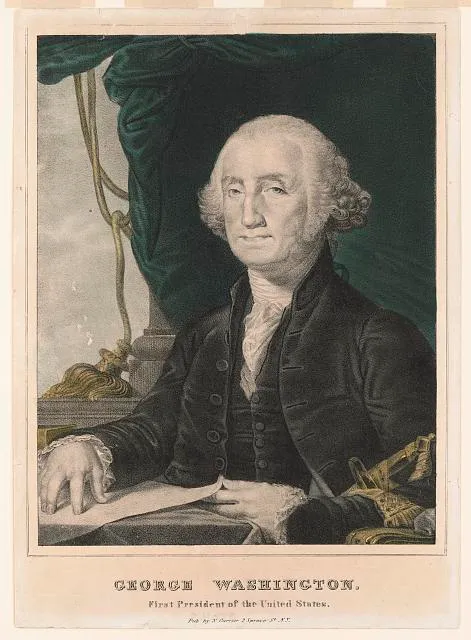
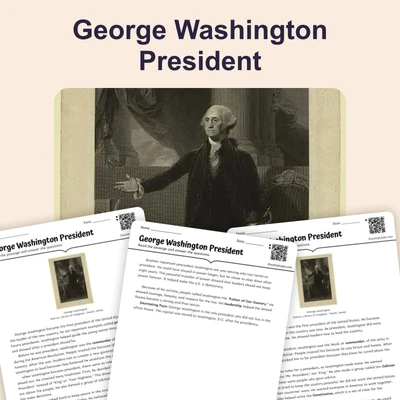
"George Washington: first president of the United States" by N. Currier (Firm) / Source: Library of Congress.
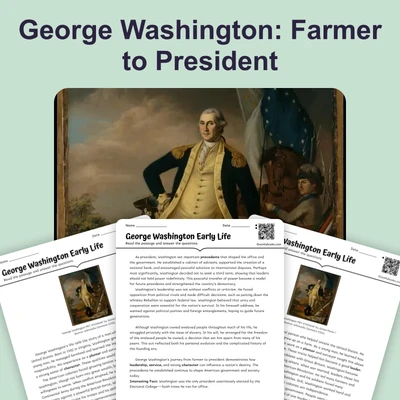
George Washington was the first president of the United States, serving from 1789 to 1797. Washington’s presidency was a time of great responsibility and uncertainty, as the new nation faced many decisions about how to govern itself. Since there had never been a U.S. president before, Washington’s actions helped create precedents, or examples for others to follow. These early decisions shaped the role of the president and influenced future leaders.
One major challenge Washington faced was defining the powers and limits of the presidency. The U.S. Constitution provided a broad outline for the executive branch, but many details were left unclear. Washington worked closely with Congress to interpret the Constitution and establish the traditions of the office. For example, he chose to be called "Mr. President" instead of a royal-sounding title like "Your Excellency." This decision reflected a commitment to a republic, where leaders were not kings but public servants.
Another important tradition set by Washington was the use of a group of advisors, known as the Cabinet. He selected experienced individuals—including Thomas Jefferson as Secretary of State and Alexander Hamilton as Secretary of the Treasury—to help him make important decisions. The Cabinet became a model for future presidents, who also relied on trusted advisors to guide national policy.
Washington also established the tradition of serving only two terms as president. After his second term, he chose not to run again, even though many people wanted him to stay in office. His voluntary departure set an example of peaceful transfer of power, which later became law with the 22nd Amendment. This action helped prevent the rise of a lifelong ruler and protected democratic principles.
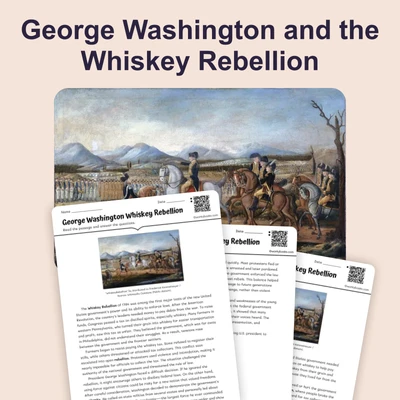
During his presidency, Washington dealt with conflicts such as the Whiskey Rebellion, where farmers protested a tax on whiskey. He responded by sending troops to enforce the law, showing that the new government could maintain order. Washington also kept the United States neutral in foreign wars, believing this would help the young country grow stronger and avoid unnecessary conflict. These decisions demonstrated careful leadership and a respect for the rule of law.
Not everyone agreed with Washington’s choices. Political parties began to form, with leaders like Thomas Jefferson and Alexander Hamilton disagreeing about the direction of the country. Washington warned against the dangers of political parties and foreign alliances in his Farewell Address. His advice reflected his desire for national unity and independence, even though the nation would continue to debate these issues for many years.
In summary, George Washington’s presidency set key precedents that have shaped the office and American government. His decisions about titles, advisors, and term limits continue to influence presidents today. Washington’s example of strong but limited leadership remains an important part of U.S. history.
Interesting Fact: Washington is the only president to have received 100% of the electoral votes—twice!
Who was the first U.S. president?
George WashingtonThomas JeffersonAlexander HamiltonJohn Adams
What year did Washington become president?
1789177617971800
Who was NOT in Washington’s Cabinet?
John AdamsThomas JeffersonAlexander HamiltonHenry Knox
Why did Washington choose 'Mr. President'?
To avoid royal titlesTo sound more importantAs a British traditionBecause Congress required it
What was a key effect of Washington’s two-term decision?
Prevented lifelong rulersCreated political partiesStarted foreign warsEnded the Cabinet
How did Washington deal with the Whiskey Rebellion?
Sent troops to enforce lawIgnored the rebellionReduced the taxAsked for British help
Washington served three terms as president. True or false?
TrueFalse
What is a precedent?
An example for othersA law passed by CongressA group of advisorsA political party
Perfect For:
👩🏫 Teachers
• Reading comprehension practice
• Auto-graded assessments
• Literacy skill development
👨👩👧👦 Parents
• Reading practice at home
• Comprehension improvement
• Educational reading time
🏠 Homeschoolers
• Reading curriculum support
• Independent reading practice
• Progress monitoring
Reading Features:
📖
Reading Passage
Engaging fiction or nonfiction text
❓
Comprehension Quiz
Auto-graded questions
📊
Instant Feedback
Immediate results and scoring
📄
Printable Version
Download for offline reading
🔊
Read Aloud
Voice-over with word highlighting
Reviews & Ratings
No reviews yet. Be the first to share your experience!
Related Content
New Nation America
This history reading passage, 'New Nation America,' covers how the United States struggled to become a united country af...
HSS 5.6.1RI.4.2
George Washington First President
This passage explores how George Washington became the first President of the United States in 1789 and the crucial prec...
The Cherokee Nation: History and Culture
This reading passage explores the rich history and culture of the Cherokee Nation, one of the largest Native American tr...
D2.HIS.2.3-5D2.HIS.14.3-5RI.4.3RI.4.4RI.4.10
American Indians and U.S. Citizenship
This reading passage explores the complex history of American Indians and U.S. citizenship, focusing on the period after...
John Adams: Second President
This engaging U.S. history reading passage introduces students to John Adams, the second President of the United States....
D2.HIS.2.3-5D2.HIS.14.3-5RI.4.3RI.4.4
George Washington: Our First President
This engaging U.S. history reading passage introduces students to George Washington, America’s first president, through ...
D2.HIS.2.3-5D2.HIS.3.3-5RI.4.3RI.4.4
James Madison Early Life
This passage explores the formative years of James Madison—his upbringing in Virginia, his education, and his early expe...
George Washington Early Life
This reading passage explores George Washington’s remarkable journey from Virginia plantation farmer to the first presid...
New Orleans: An Important Port
This engaging U.S. history reading passage explores the crucial role of New Orleans and the Louisiana Purchase in shapin...
D2.HIS.3.3-5D2.HIS.14.3-5RI.4.3RI.4.4
John Adams Presidency
This passage explores the complex presidency of John Adams, the second president of the United States, focusing on the p...
D2.HIS.2.3-5D2.HIS.3.3-5RI.4.3RI.4.4
George Washington Whiskey Rebellion
This engaging U.S. History reading passage examines George Washington and the Whiskey Rebellion, a crucial moment that t...
Modern American Presidents
This engaging reading passage introduces students to Modern American Presidents, focusing on the leadership, challenges,...
D2.HIS.1-4.3-5RI.4.3RI.4.4
Hamilton vs Jefferson
This engaging U.S. history reading passage explores the contrasting visions of Alexander Hamilton and Thomas Jefferson, ...
Leaders Call for a New Constitution
This reading passage explores the pivotal moment in U.S. history when American leaders recognized the weaknesses of the ...
Madison War of 1812
This engaging reading passage explores President James Madison’s 1812 war message to Congress, which played a pivotal ro...
James Madison: Father of the Constitution
This passage provides a detailed exploration of James Madison’s pivotal role in creating the U.S. Constitution, earning ...
Battle of New Orleans 1815
This passage explores the pivotal Battle of New Orleans in 1815, focusing on Andrew Jackson’s leadership and the complex...
D2.HIS.2.3-5D2.HIS.3.3-5RI.4.3RI.4.4
James Monroe and the Monroe Doctrine
This engaging U.S. history reading passage introduces students to President James Monroe and the Monroe Doctrine, a key ...
D2.HIS.1-4.3-5RI.4.1RI.4.2RI.4.3
Madison First Congress
This passage explores the critical period of the First Congress in 1789, focusing on James Madison's leadership and the ...