This learning resource is available in interactive and printable formats. The interactive worksheet can be played online and assigned to students. The Printable PDF version can be downloaded and printed for completion by hand.
This history reading passage explores the harsh realities of life in the ghettos during the Holocaust. Students will examine how Nazi Germany forced Jewish communities into isolated sections of cities, known as ghettos, across Eastern Europe. The passage covers daily life, social hierarchy, and the impact of starvation, disease, and violence. It integrates primary source evidence, such as diaries and photographs, and aligns with HSS 7.11 and RH.6-8.2 standards. Students will analyze causes and effects, use evidence, and build vocabulary while making connections to broader themes of human rights, discrimination, and resilience. Activities include a multiple-choice quiz, writing prompts, graphic organizers, and a timeline, with both English and Spanish versions and read aloud audio. This resource supports critical thinking and historical understanding of the Holocaust for world history students.
CONTENT PREVIEW
Expand content preview
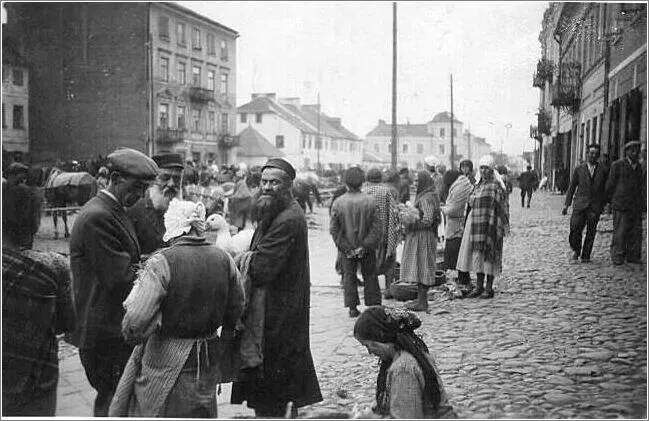
"Jewish street in newly established ghetto in Radom in occupied Poland. Circa 1940" / Wikimedia Commons (Public domain).
During World War II, Nazi Germany established ghettos as part of its plan to control, isolate, and persecute Jewish communities in Europe. These ghettos, or tightly restricted city sections, were created mainly in Nazi-occupied Poland and other parts of Eastern Europe between 1939 and 1945. The largest ghetto was in Warsaw, Poland, where over 400,000 Jews were forced to live in an area of just 1.3 square miles. Life in the ghettos was marked by extreme hardship, violence, and a struggle for survival.
Conditions in the ghettos were overcrowded and unsanitary. The Nazis used barriers such as brick walls and barbed wire to physically separate Jewish people from the rest of the city. Food was strictly rationed, leading to malnutrition and starvation among residents. Primary sources like the diary of Dawid Sierakowiak from the Łódź Ghetto describe people waiting in long lines for bread and soup, with many not receiving enough to live. Disease outbreaks, especially typhus, spread rapidly due to poor hygiene and lack of medical supplies. According to Nazi records, over 100,000 people died in the Warsaw Ghetto before 1943, mostly from hunger and sickness.
Despite these conditions, daily life continued with some sense of community and resilience. People organized secret schools, cultural events, and religious ceremonies to keep hope alive. The social structure within the ghettos included the Judenrat, or Jewish councils, appointed by the Nazis to manage daily affairs such as food distribution and housing. Members of the Judenrat faced difficult choices, often under threat of violence. Some residents attempted to smuggle food or medicine from outside the ghetto, risking severe punishment. For example, photographs from the Warsaw Ghetto show children crawling under fences to bring in bread for their families.
Over time, the Nazis intensified their persecution, leading to mass deportations to concentration and extermination camps. In 1942, the "Grossaktion Warschau" resulted in nearly 300,000 Jews being sent from the Warsaw Ghetto to the Treblinka death camp. Resistance also grew, with the Warsaw Ghetto Uprising of 1943 showing the determination of some to fight back, even in desperate circumstances. Although most ghettos were eventually liquidated, the experiences of those who lived and died there are crucial for understanding the human impact of the Holocaust.
The story of the ghettos is a powerful reminder of the dangers of discrimination, dehumanization, and unchecked government power. It connects to broader themes in world history, such as human rights, social justice, and the consequences of prejudice.
Interesting Fact: Between 1939 and 1945, over 1,000 ghettos were created in Nazi-occupied Europe, each with different rules, sizes, and survival rates.
Where was the largest ghetto?
Warsaw, PolandBerlin, GermanyParis, FranceVienna, Austria
What did the Nazis use to separate ghettos?
Barriers and wallsRiversMountainsFences with flowers