This learning resource is available in interactive and printable formats. The interactive worksheet can be played online and assigned to students. The Printable PDF version can be downloaded and printed for completion by hand.
This passage explores the pivotal event of John Brown's 1859 raid on the federal arsenal at Harpers Ferry, Virginia. Students will learn about the background of Brown as an abolitionist, his plan to incite a slave uprising, and the broader impact of his actions on the growing tensions between the North and South. The text encourages students to analyze historical events through a problem/solution lens and includes academic vocabulary such as 'arsenal,' 'abolitionist,' and 'symbol.' The passage is aligned to HSS 8.10.2 and CCSS.RI.6-8.1, RI.6-8.3, and is designed to foster historical reasoning and critical thinking. It includes read aloud audio, a Spanish translation, and a differentiated version for accessibility. Activities such as quizzes, writing prompts, and graphic organizers help students engage deeply with the material. This resource is ideal for U.S. history instruction and supports English Language Arts standards.
CONTENT PREVIEW
Expand content preview
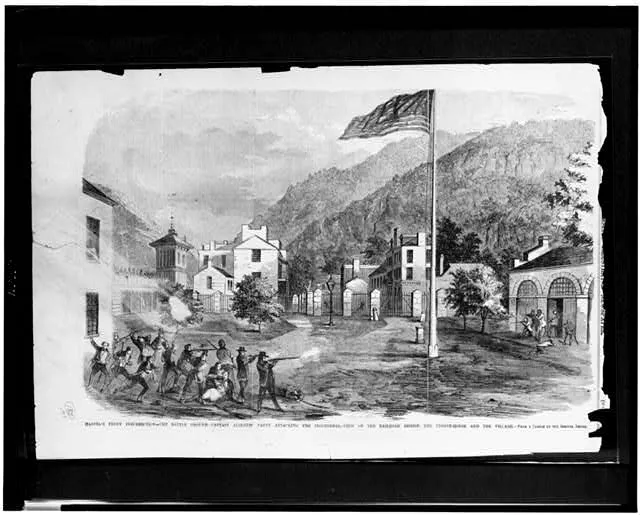
"Harper's Ferry insurrection - the battle ground - Captain Alberts' party attacking the insurgents - view of the railroad bridge, the engine-house, and the village" / Library of Congress.
In October 1859, John Brown, a determined abolitionist, led a group of followers in a bold attack on the federal armory at Harpers Ferry, Virginia. Brown hoped to start an armed insurrection to end slavery in the United States. This event, known as John Brown’s Raid, became a turning point that deepened the country’s divisions over slavery.
John Brown believed that slavery was a moral evil that needed urgent action, not just words. He had previously fought against pro-slavery forces in Kansas, earning a reputation for using violence to achieve his goals. Brown’s plan was to seize weapons from the armory, arm enslaved people, and spark a larger rebellion across the South. His motivations stemmed from religious beliefs and a sense of justice, but his methods were considered extreme and controversial by many.
Not everyone agreed with Brown’s approach. Some Northern supporters admired his courage and commitment to ending slavery, but others worried that violence would only make things worse. Many Southerners saw Brown as a dangerous criminal, believing his raid threatened their way of life and security. The raid highlighted the fierce conflict between those who wanted to preserve slavery and those determined to abolish it.
The attack began on the night of October 16, 1859. Brown and his group captured the armory and took several hostages. However, things did not go as planned. Local townspeople fought back, and soon, the United States militia and U.S. Marines, led by Colonel Robert E. Lee, arrived to end the rebellion. After a two-day standoff, Brown was captured. Most of his men were killed or wounded.
During his trial, Brown made a powerful statement: "I am quite certain that the crimes of this guilty land will never be purged away but with blood." This quote, taken from his speech before sentencing, shows how Brown saw slavery as an unforgivable wrong that would lead the country to war. His words convinced some people that peaceful solutions to slavery were no longer possible.
John Brown was found guilty of treason and sentenced to death. He was executed on December 2, 1859. His actions and death caused strong reactions across the country. In the North, Brown became a martyr to the abolitionist cause, while many in the South became even more fearful of slave revolts and Northern interference. The raid increased tensions between North and South and pushed the nation closer to the Civil War.
Historians continue to debate Brown’s legacy. Was he a hero fighting for freedom or a fanatic whose violence made the situation worse? The raid at Harpers Ferry forces us to consider the limits of protest and the consequences of using violence for justice. It is a reminder of how deeply divided the United States was over slavery, and how one dramatic event can spark major change.
Interesting Fact: John Brown’s tiny fort at Harpers Ferry became a famous landmark and a symbol of the struggle over slavery in America.
When did John Brown's Raid occur?
October 1859July 1776March 1865April 1861
Where did the raid take place?
GettysburgHarpers FerryRichmondBoston
Who led the U.S. Marines against Brown?
Ulysses S. GrantAbraham LincolnRobert E. LeeFrederick Douglass
Why did John Brown attack Harpers Ferry?
To start an insurrectionTo protect the SouthTo win an electionTo build a fort
What was one result of the raid?
It ended slavery immediatelyIt increased tensionsIt united the countryIt freed all hostages
What did Brown say about 'purging with blood'?
Slavery would end peacefullyOnly war could end slaveryHe wanted to surrenderHe supported the South
John Brown's raid succeeded. True or false?
TrueFalse
What is an abolitionist?
A person who ends slaveryA person who starts warsA soldier in the militiaA person who makes laws
Perfect For:
👩🏫 Teachers
• Reading comprehension practice
• Auto-graded assessments
• Literacy skill development
👨👩👧👦 Parents
• Reading practice at home
• Comprehension improvement
• Educational reading time
🏠 Homeschoolers
• Reading curriculum support
• Independent reading practice
• Progress monitoring
Reading Features:
📖
Reading Passage
Engaging fiction or nonfiction text
❓
Comprehension Quiz
Auto-graded questions
📊
Instant Feedback
Immediate results and scoring
📄
Printable Version
Download for offline reading
🔊
Read Aloud
Voice-over with word highlighting
Reviews & Ratings
No reviews yet. Be the first to share your experience!
Related Content
Pocahontas: Myth vs. Historical Reality
This passage explores the nuanced history of Pocahontas, moving beyond the myth made popular by movies and stories. Stud...
HSS 5.3.1RI.6-8.1RI.6-8.8
Roger Williams Religious Freedom
This passage explores the life and legacy of Roger Williams, a key figure in Colonial America who was banished from Mass...
HSS 5.4.38.2.2RI.6-8.1RI.6-8.6
Benjamin Franklin in Colonial America
This U.S. History reading passage explores the life and influence of Benjamin Franklin, a key colonial leader whose idea...
HSS 5.58.1RI.6-8.1RI.6-8.3
Colonial Apprenticeship System
This comprehensive passage explores the Colonial Apprenticeship System and its role in education during Colonial America...
HSS 5.4.6RI.6-8.1RI.6-8.2
Colonial Printing Press
This passage explores the revolutionary impact of the colonial printing press in America, examining how it enabled the s...
HSS 5.58.1RI.6-8.1RI.6-8.2
Cities in Colonial America
This engaging U.S. history reading passage explores the rise of colonial American cities such as Boston, Philadelphia, a...
HSS 5.4.68.1RI.6-8.1RI.6-8.7
Frontier Life in Colonial America
This passage examines the realities of frontier life in colonial America, highlighting both the promise and peril faced ...
HSS 5.4.68.1RI.6-8.1RI.6-8.2
Declaration of Independence
This engaging reading passage examines the Declaration of Independence, highlighting its adoption on July 4, 1776, and t...
HSS 5.6.18.2.3RI.6-8.1RI.6-8.8
Mercy Otis Warren: Political Writer
This passage explores the life and impact of Mercy Otis Warren, a significant political writer during the American Revol...
HSS 5.6.38.1RI.6-8.1RI.6-8.6
Crispus Attucks
This comprehensive U.S. History reading passage examines the life and legacy of Crispus Attucks, the first person killed...
HSS 5.5.38.1RI.6-8.1RI.6-8.3
French Alliance and American Revolution
This history reading passage explores the significant role of the French alliance in the American Revolution, aligning w...
HSS 5.6.48.1RI.6-8.1RI.6-8.3
Lewis and Clark Expedition
This comprehensive U.S. History reading passage explores the Lewis and Clark Expedition (1804-1806), a pivotal journey l...
HSS 8.4.18.8.2RI.6-8.1RI.6-8.3
Exodusters
This passage explores the migration of Exodusters—African Americans who left the South in the 1870s to escape discrimina...
HSS 8.12.1RI.6-8.1RI.6-8.2
Uncle Tom's Cabin
This passage explores the impact of Harriet Beecher Stowe’s Uncle Tom’s Cabin on American society in the 1850s. It exami...
HSS 8.9.48.10.2RI.6-8.1RI.6-8.6
Dred Scott Decision
This rigorous history reading passage delves into the 1857 Dred Scott Decision, a pivotal moment in the lead-up to the C...
HSS 8.9.48.10.3RI.6-8.1RI.6-8.8
Election of 1860
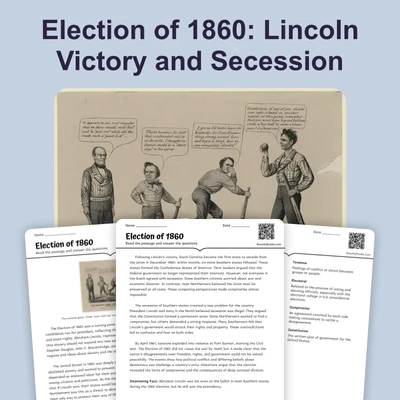
This passage explores Abraham Lincoln’s election in 1860 and the critical reactions from Southern states, which set the ...
HSS 8.10.4RI.6-8.1RI.6-8.6
Southern Secession
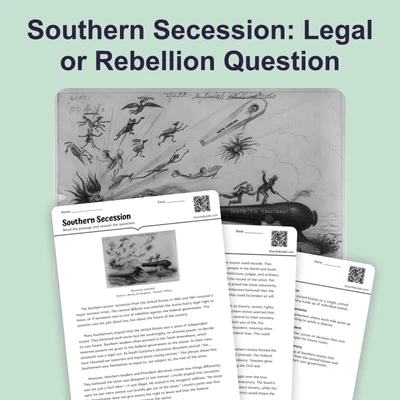
This passage explores the significant moment in U.S. history when seven Southern states seceded from the Union after Abr...
HSS 8.10.4RI.6-8.1RI.6-8.2
Advantages and Disadvantages: North vs. South
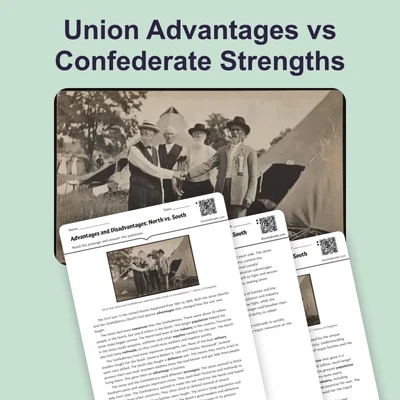
This history reading passage examines the contrasting strengths of the Union and Confederacy during the U.S. Civil War. ...
HSS 8.10.5RI.6-8.1RI.6-8.3
Emancipation Proclamation
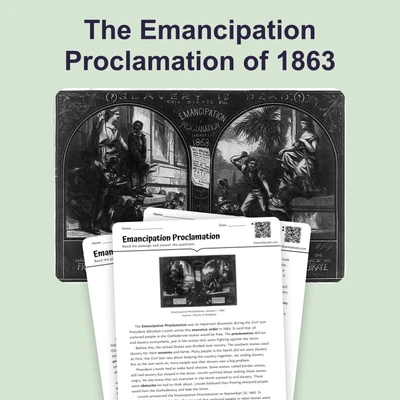
This U.S. history passage explores the Emancipation Proclamation of 1863, an executive order issued by President Abraham...