Marble Collision Experiment
Interactive passage with audio narration, comprehension questions, and printable PDF.
By completing this purchase you agree to our Terms of Use and Privacy Policy. Your subscription renews automatically until you cancel. You can cancel anytime from your account settings. All sales are final and non-refundable. Digital content is available for download in your account immediately upon purchase.
What's included
Marble Collision Experiment preview and details
About this printable Marble Collision Experiment science reading passage, NGSS-aligned (Grades 3-6)
Sample passage and quiz from Marble Collision Experiment
Reading passage and comprehension quiz preview
Marble Collision Experiment
Exploring Collisions with Marbles
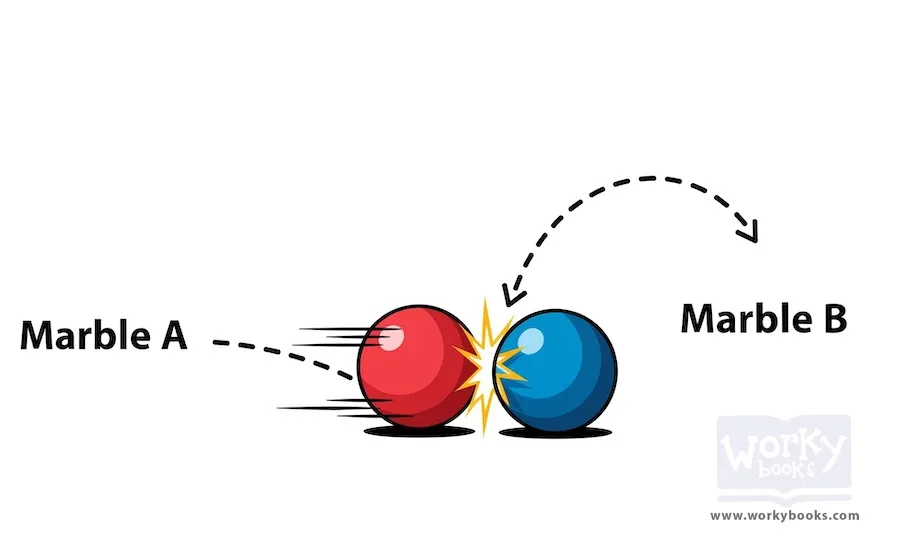
The marble collision experiment is a fun way to learn about how energy and momentum move from one object to another. In this experiment, you roll a marble down a ramp or across a smooth floor so it hits another marble that is not moving. Watch closely as the moving marble slows down or stops, and the still marble starts rolling in the same direction. This shows how energy and momentum are transferred during a collision.
The Science Behind It
When the first marble is rolling, it has kinetic energy. Kinetic energy means the energy something has because it is moving. The marble also has momentum, which scientists describe as its mass (how heavy it is) times its speed. When the rolling marble hits the still one, it passes its energy and momentum to the other marble. The first marble slows or stops, and the second one starts moving, just like runners passing a baton in a relay race. Energy cannot disappear; it must go somewhere, so it transfers from one marble to the next.
Changing Variables
There are many ways to change this experiment. What happens if you use marbles of different sizes? What if one marble is rolled faster? You can also try having several marbles in a line, like a Newton's Cradle. You can test if the collision is elastic (the marbles bounce off each other) or inelastic (they stick together). Measuring how far the marbles roll after a collision can help you see how much energy was transferred. Try using a ruler for measuring and a straight track made with rulers to keep the marbles on course.
Real-Life Connections
The same science happens in real life! Car crashes, pool balls, bowling, and bumper cars all show energy and momentum transfer during collisions. Anytime objects bump into each other, energy moves from one to the other.
Interesting Fact: Scientists use marble collision experiments to help understand car safety and design safer vehicles for everyone.
Comprehension quiz (8 questions)
1. What is transferred in a marble collision?
2. What is kinetic energy?
3. What tool helps measure marble distance?
4. Changing marble size changes what?
5. What happens to the first marble after the collision?
6. Why do scientists study marble collisions?
7. Energy disappears after a collision. True or false?
8. What is a collision?
Perfect for the way you teach
- Build comprehension skills
- Auto-graded quiz
- Differentiated reading
- Read together at home
- Improve fluency
- Quiet reading time
- Reading curriculum support
- Independent practice
- Track Lexile growth