Mendeleev's Periodic Table
Interactive passage with audio narration, comprehension questions, and printable PDF.
By completing this purchase you agree to our Terms of Use and Privacy Policy. Your subscription renews automatically until you cancel. You can cancel anytime from your account settings. All sales are final and non-refundable. Digital content is available for download in your account immediately upon purchase.
What's included
Mendeleev's Periodic Table preview and details
About this printable Mendeleev's Periodic Table science reading passage, NGSS-aligned (Grades 5-8)
Sample passage and quiz from Mendeleev's Periodic Table
Reading passage and comprehension quiz preview
Mendeleev's Periodic Table
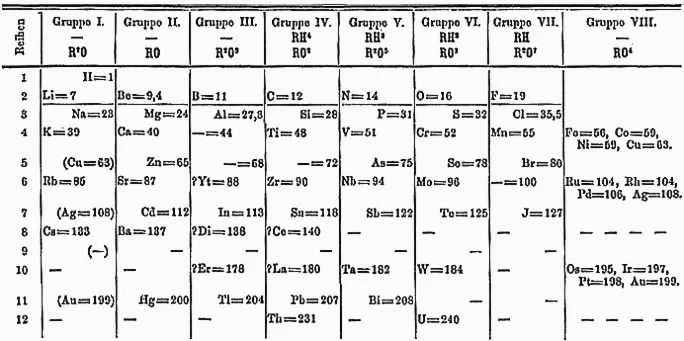
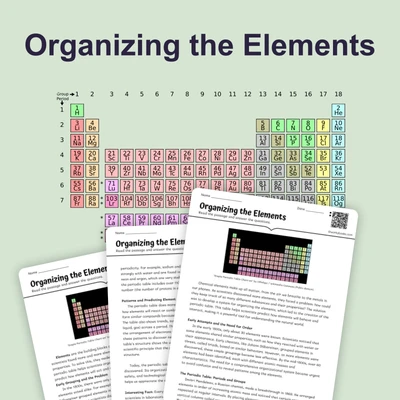
"Mendeleev's periodic table 1871" by The original uploader was Den fjättrade ankan at Swedish Wikipedia. / Wikimedia Commons (Public domain).
Chemical elements are the basic building blocks of all matter. In the mid-1800s, scientists struggled to organize the growing list of known elements in a meaningful way. The challenge was to find a system that grouped elements with similar properties together and revealed patterns in their behavior. The solution to this problem changed the study of chemistry forever.
In 1869, Russian chemist Dmitri Mendeleev created the first widely recognized periodic table. Mendeleev arranged the elements in order of increasing atomic mass, which is the total mass of protons and neutrons in an atom's nucleus. He noticed that elements with similar properties appeared at regular intervals, or periods. By placing elements into rows and columns, Mendeleev revealed a repeating pattern known as periodicity. This pattern showed that certain chemical and physical properties, such as reactivity or melting point, recurred in predictable ways.
Leaving Gaps and Making Predictions
Mendeleev's genius was not just in organizing known elements, but in leaving empty spaces where he believed undiscovered elements should fit. For example, he left a gap below aluminum and predicted the existence and properties of an element he called "eka-aluminum." Years later, the element gallium was discovered, matching Mendeleev's predictions almost exactly. He also predicted the element germanium, which was found about 15 years later. These successful predictions provided strong evidence that the periodic table was more than just a chart—it was a powerful scientific model. The accuracy of his forecasts convinced other scientists of the value of his system and encouraged further searches for unknown elements.
Scientific Principles and Impact
Mendeleev’s periodic table demonstrated the importance of organizing data to uncover patterns and make predictions. His work introduced the concept of periodic law, which states that the properties of elements are a periodic function of their atomic masses (today we use atomic numbers). This idea showed that the structure of matter is not random, but follows natural laws. The periodic table became a key tool for scientists, helping them understand chemical reactivity, make new materials, and develop technologies like batteries and medicines. Mendeleev’s approach of using patterns to predict the unknown is a central part of scientific thinking and discovery.
Continuing Developments
Although Mendeleev organized his table by atomic mass, we now arrange elements by atomic number, which is the number of protons in an atom. This change, made in the early 1900s, fixed some issues with the original table and made the pattern even clearer. Today, the periodic table includes over 100 elements and continues to grow as new elements are synthesized. Mendeleev’s method of predicting and testing ideas based on observed patterns still guides scientific research. The periodic table remains a symbol of how organizing information can reveal the hidden order of the natural world.
Interesting Fact: Element 101 was named mendelevium in honor of Dmitri Mendeleev’s contributions to science.
Comprehension quiz (10 questions)
1. What was Mendeleev’s main achievement in 1869?
2. How did Mendeleev arrange the elements in his periodic table?
3. Which of the following is an example of a property mentioned in the passage?
4. What does the term 'periodicity' mean in the context of the periodic table?
5. What is the significance of the gaps Mendeleev left in his periodic table?
6. What scientific principle did Mendeleev’s periodic table help demonstrate?
7. Why was the discovery of gallium and germanium important for Mendeleev’s table?
8. How is the modern periodic table different from Mendeleev’s original version?
9. True or False: Mendeleev’s periodic table helped scientists predict the properties of undiscovered elements.
10. True or False: The periodic table is no longer useful for scientists today.
Perfect for the way you teach
- Build comprehension skills
- Auto-graded quiz
- Differentiated reading
- Read together at home
- Improve fluency
- Quiet reading time
- Reading curriculum support
- Independent practice
- Track Lexile growth