Metallic Bonds
Interactive passage with audio narration, comprehension questions, and printable PDF.
By completing this purchase you agree to our Terms of Use and Privacy Policy. Your subscription renews automatically until you cancel. You can cancel anytime from your account settings. All sales are final and non-refundable. Digital content is available for download in your account immediately upon purchase.
What's included
Metallic Bonds preview and details
About this printable Metallic Bonds science reading passage, NGSS-aligned (Grades 5-8)
Sample passage and quiz from Metallic Bonds
Reading passage and comprehension quiz preview
Metallic Bonds
Metallic bonds are the fundamental force that holds together the atoms in metals. In daily life, people use metals like copper wiring for electricity, aluminum foil for cooking, and gold jewelry for decoration. The unique properties of these metals—such as conductivity, luster, and the ability to bend—arise from the way metal atoms bond with each other. Understanding metallic bonding reveals the reasons why metals behave differently from other materials and are so valuable in technology and industry.
How Metallic Bonds Work
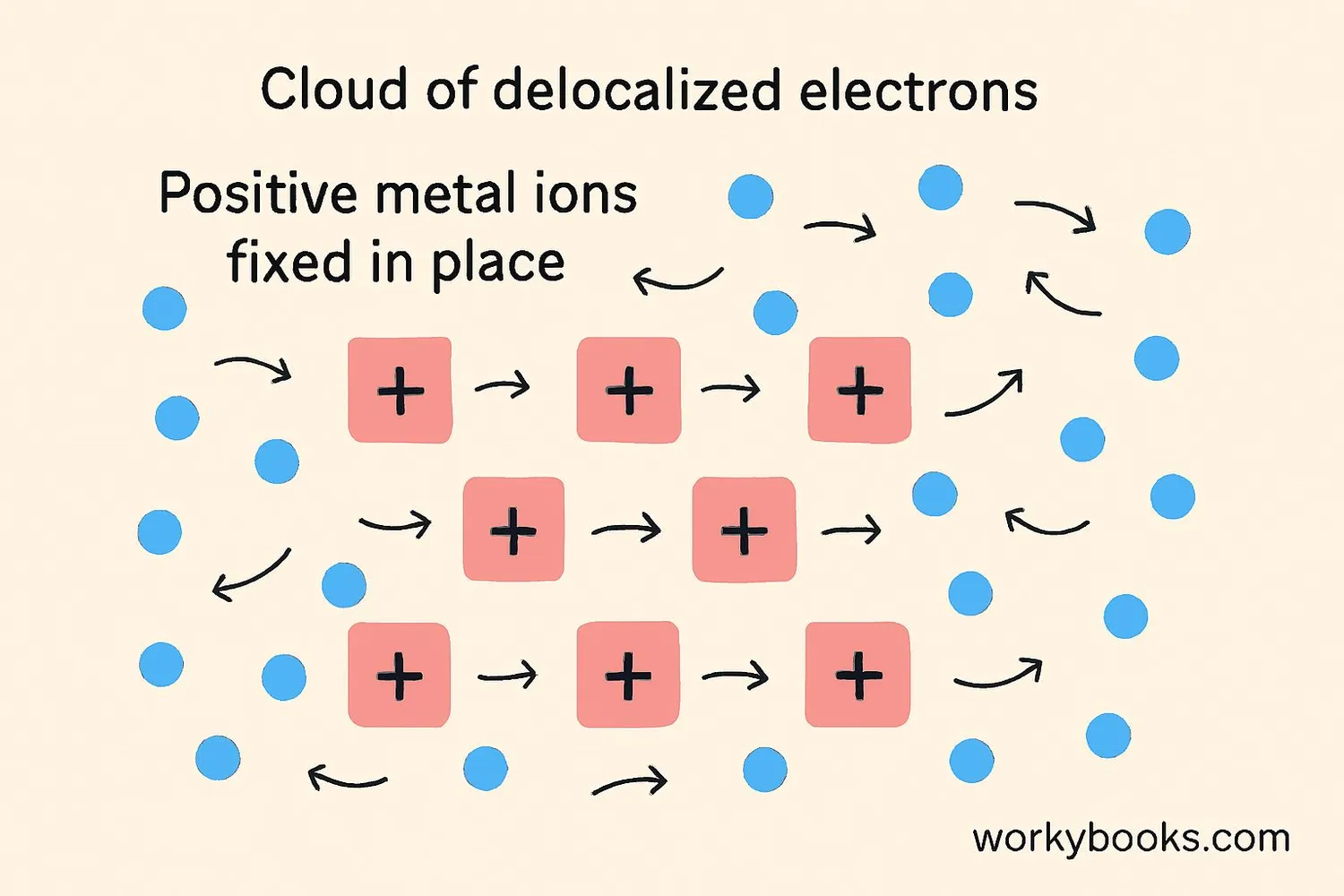
In a metallic bond, metal atoms lose some of their outer electrons. These electrons do not stay attached to any single atom. Instead, they move freely throughout the entire metal structure, forming what is called a sea of electrons. The positive metal ions are arranged in a regular pattern, while the negative electrons flow around them. This sharing of electrons creates a strong attraction, holding the atoms together tightly. The freely moving electrons explain why metals conduct electricity so well. For example, copper wire can carry electric current because the sea of electrons lets charges move easily. Quantitatively, copper has an electrical conductivity of about 5.96 × 10⁷ siemens per meter—much higher than most materials.
Properties of Metals Explained by Metallic Bonds
The sea of electrons in metallic bonds also gives metals their malleability and ductility. Malleability means metals can be hammered into thin sheets, like aluminum foil, without breaking. Ductility means they can be drawn into wires, such as in electrical cables. These properties occur because the metal atoms can slide past each other when force is applied, but the sea of electrons keeps them bonded. This is different from ionic or covalent bonds, where shifting the atoms would break the material. Additionally, the sea of electrons reflects light, giving metals their shiny luster. For instance, gold jewelry is prized for its bright, reflective surface, which comes from metallic bonding.
Applications and Broader Importance
Metallic bonds are essential in technologies that rely on metals’ properties. Electrical grids depend on copper and aluminum wires for reliable power transmission. Buildings use steel, an alloy with metallic bonds, for strength and flexibility. The ability of metals to bend without breaking is crucial when making tools, bridges, and vehicles. Scientists study metallic bonding to develop new alloys with improved properties, like lightweight yet strong airplane parts. Understanding metallic bonds also connects to larger scientific principles; it illustrates how atomic structure determines the properties and uses of materials in our world.
In summary, metallic bonds hold metal atoms together through a sea of shared electrons. This mechanism gives metals their conductivity, malleability, ductility, and luster, making them indispensable in everyday life and technology. The study of metallic bonds demonstrates the connection between atomic-scale interactions and the macroscopic properties of materials.
Interesting Fact: The world’s longest single electrical cable, made from copper, stretches over 1,500 miles, demonstrating the importance of metallic bonds in transmitting energy over great distances.
Comprehension quiz (10 questions)
1. What is the 'sea of electrons' in a metallic bond?
2. Which property allows metals to be hammered into thin sheets?
3. Why can copper wire carry electricity so well?
4. In the passage, what does ductility mean?
5. What does the term 'luster' refer to in metals?
6. Which of the following is NOT a property explained by metallic bonds?
7. What is the main difference between metallic and ionic bonds according to the passage?
8. If a material can be drawn into a wire, what property does it have?
9. True or False: The sea of electrons in metals allows them to conduct electricity.
10. True or False: Metallic bonds make metals break easily when hammered.
Perfect for the way you teach
- Build comprehension skills
- Auto-graded quiz
- Differentiated reading
- Read together at home
- Improve fluency
- Quiet reading time
- Reading curriculum support
- Independent practice
- Track Lexile growth