Reading PassagePremium

Metalloids

Interactive passage with audio narration, comprehension questions, and printable PDF.

No ratings yet
Grades 5–8ScienceReadingElaEnglish · SpanishInteractive · Printable
Aligned toMS-PS1-1
Just this resource
$1.50
One-time purchase
Best value
Unlock everything
$49.99$29.99/yr
40% off until Aug 1 — 10,000+ resources
Renews at $49.99/year.
Unlock above to use these actions

What's included

Reading passage
Audio narration
Comprehension quiz
Writing activity
Glossary & flashcards
Differentiated version
Spanish translation

Metalloids preview and details

About this printable Metalloids science reading passage, NGSS-aligned (Grades 5-8)

This passage for grades 6-8 explores the fascinating world of metalloids, elements that display properties between metals and nonmetals. Aligned with NGSS MS-PS1-1, it explains how metalloids function as semiconductors and why they are crucial in today’s electronic devices. Students will learn where metalloids are located on the periodic table (along the 'staircase' line), the mechanisms behind their unique characteristics, and real-world applications, especially in technology. The passage includes a glossary, comprehension questions, writing prompts, and graphic organizers to support different learning styles. Audio integration supports accessibility. This resource helps students connect elemental properties to scientific principles and real-world innovations, making abstract concepts tangible and relevant.
Written by Workybooks TeamPublished by Workybooks
Preview

Sample passage and quiz from Metalloids

Reading passage and comprehension quiz preview

Metalloids Periodic Table
metalloids-3
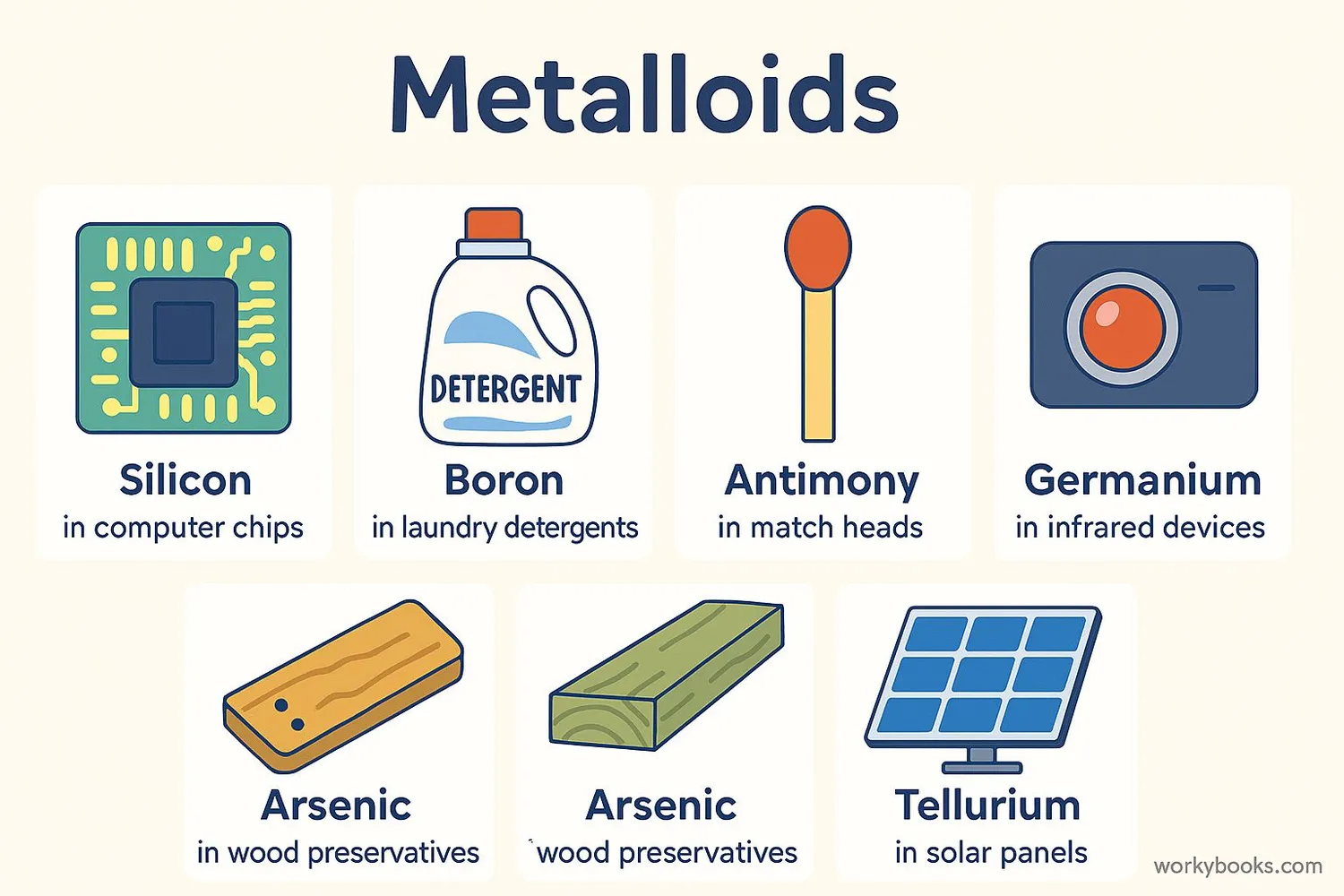
Common metalloids and where we find them in everyday life  

Metalloids are essential elements found along a special dividing line on the periodic table of elements. These elements are not purely metals or nonmetals, but instead possess a unique combination of properties from both categories. The study of metalloids helps scientists understand how elements’ atomic structures influence their behavior. For example, the use of semiconductors in electronics is only possible because of the special way metalloids conduct electricity. Devices like smartphones, computers, and solar panels all depend on these remarkable elements.

Properties and Placement on the Periodic Table

Metalloids are located along a zig-zag or 'staircase' line that runs diagonally from boron (B) to polonium (Po) on the periodic table. This position reflects their intermediate properties. For example, metals are usually shiny, good conductors of electricity, and can be shaped without breaking, while nonmetals are typically dull, brittle, and poor conductors. Metalloids like silicon and germanium are somewhat shiny and can conduct electricity, but only under certain conditions. This ability to control the flow of electricity makes them ideal semiconductors. In fact, silicon is the second most abundant element in Earth's crust and is vital to the technology industry.

How Metalloids Function in Technology

The unique atomic structure of metalloids allows them to act as switches or gates for electric current. In a pure state, metalloids do not conduct electricity as well as metals. However, by adding small amounts of other elements—a process called doping—scientists can change how easily metalloids allow electrons to move. This tunable conductivity is what makes them perfect for building microchips and transistors. For example, silicon microchips contain millions of tiny electrical switches that store and process data at incredible speeds. Germanium was the first metalloid used in early transistors, and boron is needed in solar cells to help capture sunlight efficiently.

Broader Implications and Scientific Significance

Metalloids connect the metallic and nonmetallic worlds, demonstrating how small changes at the atomic level can produce dramatic effects in the real world. Their ability to function as semiconductors has led to the Information Age, transforming communication, medicine, and energy. As research continues, scientists are discovering new ways to use metalloids: from improving solar panel efficiency to developing flexible electronics and medical sensors. This highlights the relationship between atomic structure, material properties, and technology—a key principle in physical science.

Interesting Fact:
Silicon Valley, the global center of technology innovation, is named after silicon, the most famous metalloid used in computer chips!

Comprehension quiz (10 questions)

1. Where are metalloids found on the periodic table?

Along a zig-zag or 'staircase' line
In the far left column
At the bottom of the table
In the center block only

2. Which of the following is a property of metalloids?

They always conduct electricity like metals.
They are always dull and brittle.
They have properties between metals and nonmetals.
They are gases at room temperature.

3. Why is silicon important in technology?

It is used to make microchips and semiconductors.
It is used to make fuel for cars.
It is a liquid metal.
It is the rarest element on Earth.

4. What does 'doping' mean in the context of metalloids?

Adding small amounts of other elements to change conductivity
Melting metalloids at high temperatures
Mixing metalloids with water
Removing electrons from metalloids

5. What is a 'semiconductor'?

A material that is always a good conductor
A material that never conducts electricity
A material that sometimes conducts electricity
A material that only exists as a gas

6. How did metalloids change the world?

They helped create the Information Age through electronics.
They are used as building materials for houses.
They are only important in ancient history.
They are only used in jewelry.

7. What is the primary cause for metalloids being used in electronics?

They can act as semiconductors, controlling electric current.
They are colorful and pretty.
They are easy to melt.
They react with water.

8. True or False: All metalloids are excellent conductors of electricity in all conditions.

True
False

9. True or False: Boron is used in solar cells to help capture sunlight efficiently.

True
False

10. Which of the following best describes the role of atomic structure in metalloids?

It determines their ability to act as semiconductors.
It makes them dissolve in water.
It prevents them from being used in technology.
It causes them to be magnetic.
Who it's for

Perfect for the way you teach

Teachers
  • Build comprehension skills
  • Auto-graded quiz
  • Differentiated reading
Parents
  • Read together at home
  • Improve fluency
  • Quiet reading time
Homeschoolers
  • Reading curriculum support
  • Independent practice
  • Track Lexile growth
Topics

Reviews & Ratings

No reviews yet. Be the first to share your experience!

More reading you might love

20 more
Passage
Atomic Structure - reading educational content
Grades 5–8

Atomic Structure

science · MS-PS1-1

Free
Passage
Parts of an Atom - reading educational content
Grades 5–8

Parts of an Atom

science · MS-PS1-1

Free
Passage
Chemical Bonds - reading educational content
Grades 5–8

Chemical Bonds

science · MS-PS1-1

$1.50
Passage
The Freezing Point of Water - reading educational content
Grades 5–8

The Freezing Point of Water

physical science · MS-PS1-1

Free
Passage
Physical Properties of Matter - reading educational content
Grades 5–8

Physical Properties of Matter

physical science · MS-PS1-1

$1.50
Passage
Mixtures and Pure Substances - reading educational content
Grades 5–8

Mixtures and Pure Substances

physical science · MS-PS1-1

$1.50
Passage
Types of Mixtures - reading educational content
Grades 5–8

Types of Mixtures

physical science · MS-PS1-1

$1.50
Passage
Solutions, Suspensions, and Colloids - reading educational content
Grades 5–8

Solutions, Suspensions, and Colloids

physical science · MS-PS1-1

$1.50
Passage
The Nature of Science - reading educational content
Grades 5–8

The Nature of Science

science · MS-ETS1-4

$1.50
Passage
Scientific Theories - reading educational content
Grades 5–8

Scientific Theories

science · MS-PS1-1

$1.50
Passage
Particle Model of Matter - reading educational content
Grades 5–8

Particle Model of Matter

physical science · MS-PS1-1

$1.50
Passage
Valence Electrons - reading educational content
Grades 5–8

Valence Electrons

physical science · MS-PS1-1

Free
Passage
The Idea of the Atom - reading educational content
Grades 5–8

The Idea of the Atom

physical science · MS-PS1-1

$1.50
Passage
Protons, Neutrons, and Electrons - reading educational content
Grades 5–8

Protons, Neutrons, and Electrons

physical science · MS-PS1-1

$1.50
Passage
What are Ions - reading educational content
Grades 5–8

What are Ions

physical science · MS-PS1-1

$1.50
Passage
Nucleus of the Atom - reading educational content
Grades 5–8

Nucleus of the Atom

physical science · MS-PS1-1

$1.50
Passage
How Atoms Differ - reading educational content
Grades 5–8

How Atoms Differ

physical science · MS-PS1-1

$1.50
Passage
Isotopes - reading educational content
Grades 5–8

Isotopes

physical science · MS-PS1-1

$1.50
Passage
Compounds vs. Mixtures - reading educational content
Grades 5–8

Compounds vs. Mixtures

physical science · MS-PS1-1

$1.50
Passage
Organizing the Elements - reading educational content
Grades 5–8

Organizing the Elements

physical science · MS-PS1-1

$1.50
Copyright © 2026 Workybooks. Made with ♥ in California.