This learning resource is available in interactive and printable formats. The interactive worksheet can be played online and assigned to students. The Printable PDF version can be downloaded and printed for completion by hand.
This middle school science passage, aligned to NGSS standard MS-PS1-1, introduces students to the properties and mechanisms behind metals. Students learn how metals' unique characteristics—such as luster, conductivity, malleability, and ductility—arise from their atomic structure. The passage explains how these physical properties are connected to the arrangement of metals on the periodic table and highlights technology and real-world applications, from electrical wiring to coins. With clear explanations, embedded academic vocabulary, and relatable examples, the passage supports scientific thinking and systems understanding. Spanish translations and differentiated versions make it accessible for all learners. Includes glossary, comprehension questions, writing prompts, and graphic organizers. This resource is audio-integrated, making it suitable for diverse classrooms and reinforcing key science concepts for grades 6-8.
CONTENT PREVIEW
Expand content preview
Metals are a group of elements that make up the majority of the periodic table. Their importance in daily life is evident in everything from coins and cooking pans to skyscrapers and smartphones. The unique properties of metals, such as luster, conductivity, malleability, and ductility, have shaped technology and society. Scientists have worked to understand why metals behave differently from other elements and how their structure leads to these remarkable traits.
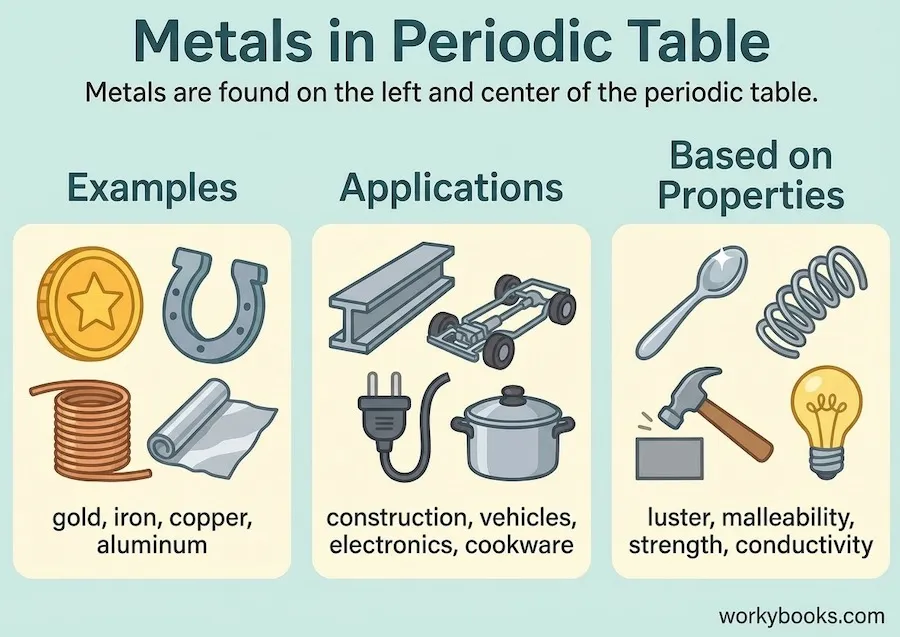
Atomic Structure and Physical Properties Metals are found on the left and center of the periodic table. They are typically solid at room temperature, except for mercury, which is a liquid. At the atomic level, metals have a structure called a metallic bond. In this bond, atoms share a 'sea' of electrons that move freely between them. This movement of electrons explains why metals conduct electricity and heat so well. For example, copper wires are used in electrical circuits because their free electrons allow electric current to flow efficiently. The same structure gives metals their shiny appearance, or luster, because light bounces off the closely packed atoms. The ability to bend and shape metals without breaking—called malleability—and to stretch them into wires—called ductility—are also results of this flexible atomic arrangement.
Examples and Applications Different metals are chosen for specific uses based on their properties. Iron is strong and forms the backbone of buildings and bridges. Aluminum is lightweight and resists rust, making it perfect for airplane bodies and soda cans. Gold and copper are excellent conductors and are used in electronics and jewelry. Quantitatively, about 75% of the elements in the periodic table are classified as metals. This abundance allows for a wide range of alloys—mixtures of metals with other elements—to further enhance their properties. For instance, adding carbon to iron creates steel, which is even stronger and more durable.
Metals in Society and Science The interactions between metals and their surroundings have broad implications. Conductive metals have enabled the development of power grids and advanced electronics, which are essential for modern society. However, not all metals are equally reactive. Some, like gold, resist corrosion, while others, like iron, rust easily when exposed to air and water. Understanding these differences helps engineers select the right material for specific environments, whether building a bridge or designing a smartphone.
Metals illustrate how atomic-level structures influence the observable world. Their physical properties arise from the interactions of electrons and atoms, demonstrating key principles of chemistry and physics. As new alloys and materials are developed, the study of metals continues to drive technological innovation and scientific discovery.
Interesting Fact: Mercury is the only metal that is liquid at room temperature, making it unique among all metals on the periodic table.
Where are metals located on the periodic table?
On the left and centerOnly on the rightOnly at the bottomIn a separate group at the top
What is the only metal that is liquid at room temperature?
IronMercuryGoldCopper
Which property allows metals to be hammered into sheets without breaking?
LusterConductivityMalleabilityDuctility
What does conductivity mean in relation to metals?
The ability to reflect lightThe ability to let heat and electricity pass throughThe ability to be mixed with waterThe ability to rust quickly
What is a metallic bond?
A bond where atoms share a fixed pair of electronsA bond with a sea of free-moving electronsA bond only found in gasesA bond that makes metals break easily
Based on the passage, why are copper wires used in electrical circuits?
Copper is lightweight and rusts easilyCopper is colorful and softCopper conducts electricity very wellCopper is the only metal that is magnetic
Why do scientists mix metals with other elements to create alloys?
To make them weakerTo improve or change their propertiesTo make them melt fasterTo make them more expensive
If a material can be drawn into wires, it is described as:
MagneticLustrousDuctileConductive
True or False: All metals are solid at room temperature.
TrueFalse
True or False: Gold resists corrosion better than iron.
TrueFalse
Perfect For:
👩🏫 Teachers
• Reading comprehension practice
• Auto-graded assessments
• Literacy skill development
👨👩👧👦 Parents
• Reading practice at home
• Comprehension improvement
• Educational reading time
🏠 Homeschoolers
• Reading curriculum support
• Independent reading practice
• Progress monitoring
Reading Features:
📖
Reading Passage
Engaging fiction or nonfiction text
❓
Comprehension Quiz
Auto-graded questions
📊
Instant Feedback
Immediate results and scoring
📄
Printable Version
Download for offline reading
🔊
Read Aloud
Voice-over with word highlighting
Reviews & Ratings
No reviews yet. Be the first to share your experience!
Related Content
Atomic Structure
This reading passage on Atomic Structure provides middle school students with an accessible explanation of the fundament...
MS-PS1-1RI.6.3RI.7.1
Parts of an Atom
This reading passage on Parts of an Atom provides middle school students with a structured and accessible explanation of...
MS-PS1-1RI.6.3RI.7.1
Chemical Bonds
This reading passage on Chemical Bonds provides middle school students with a clear explanation of how and why atoms con...
MS-PS1-1RI.6.3RI.7.1
The Freezing Point of Water
This science reading passage, titled 'The Freezing Point of Water', introduces students to a key physical science concep...
MS-PS1-1RI.6.3RI.7.1
Physical Properties of Matter
This comprehensive reading passage introduces grades 6-8 students to the concept of physical properties of matter, perfe...
MS-PS1-1
Mixtures and Pure Substances
This middle school science passage provides an in-depth exploration of mixtures and pure substances, directly aligned to...
MS-PS1-1
Types of Mixtures
This comprehensive science passage for grades 6-8 introduces students to the concept of mixtures, focusing on distinguis...
MS-PS1-1
Solutions, Suspensions, and Colloids
This comprehensive science passage explores the differences between solutions, suspensions, and colloids, focusing on ho...
MS-PS1-1
The Nature of Science
This passage explores the nature of science for middle school students, aligning with NGSS standards MS-ETS1-4, MS-PS1-1...
MS-ETS1-4MS-PS1-1MS-LS1-1
Scientific Theories
This reading passage for grades 6-8 introduces students to the concept of scientific theories, emphasizing that these ar...
MS-PS1-1MS-PS1-4MS-PS3-4SCIENCE AND ENGINEERING PRACTICES
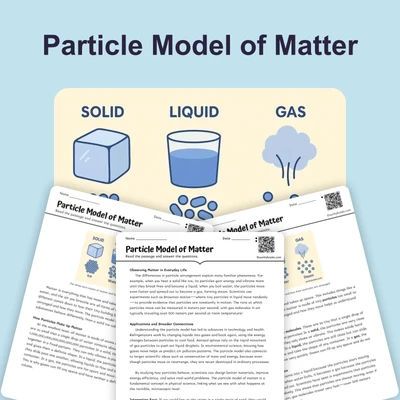
Particle Model of Matter
This comprehensive science reading passage for grades 6-8 explores the particle model of matter, aligning with NGSS stan...
MS-PS1-1MS-PS1-4
Valence Electrons
This middle school science passage introduces students to the concept of valence electrons, the outermost electrons that...
MS-PS1-1
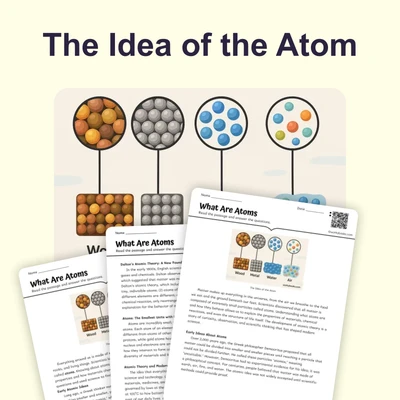
The Idea of the Atom
This informational science passage introduces middle school students (grades 6-8) to the concept that all matter is made...
MS-PS1-1
Protons, Neutrons, and Electrons
This comprehensive middle school science passage explores the roles of protons, neutrons, and electrons, the three main ...
MS-PS1-1
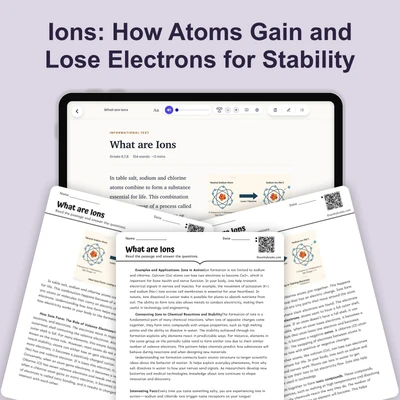
What are Ions
This passage introduces middle school students to the concept of ions, explaining the processes by which atoms gain or l...
MS-PS1-1
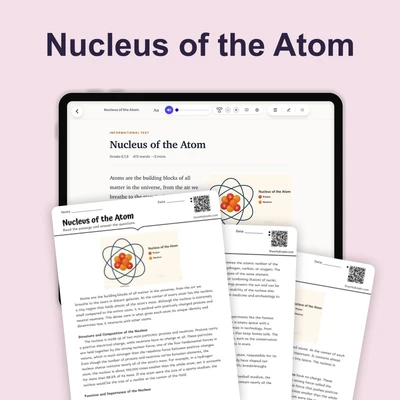
Nucleus of the Atom
This comprehensive passage for grades 6-8 introduces students to the nucleus of the atom, the dense center that contains...
MS-PS1-1
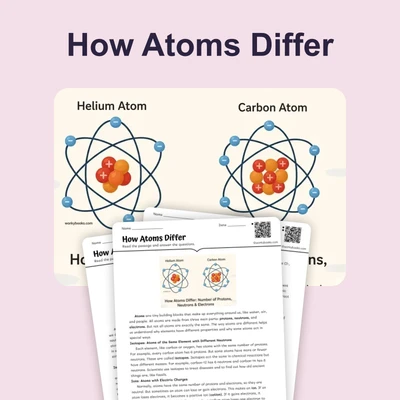
How Atoms Differ
This middle school science reading passage, aligned with NGSS standard MS-PS1-1, explores the fundamental differences am...
MS-PS1-1
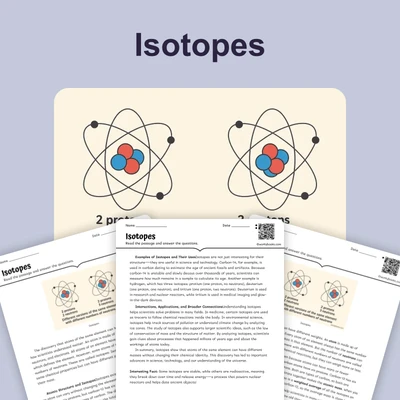
Isotopes
This middle school science passage explores the concept of isotopes, which are atoms of the same element with different ...
MS-PS1-1
Compounds vs. Mixtures
This educational passage for grades 6-8 explores the fundamental differences between compounds and mixtures, aligning wi...
MS-PS1-1
Organizing the Elements
This passage for middle school science explores how scientists organized the elements as more were discovered, leading t...