Mutations and Genetic Variation
Interactive passage with audio narration, comprehension questions, and printable PDF.
What's included
Mutations and Genetic Variation preview and details
About this printable Mutations and Genetic Variation science reading passage, NGSS-aligned (Grades 5-8)
Sample passage and quiz from Mutations and Genetic Variation
Reading passage and comprehension quiz preview
Mutations and Genetic Variation
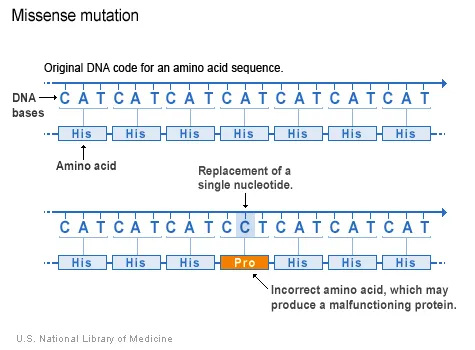
"Missense Mutation Example" by U.S. National Library of Medicine / Wikimedia Commons (Public domain).
Mutations are a key force in shaping the diversity of life on Earth. In every generation, some organisms are born with small changes in their DNA—the chemical code that carries genetic information. These changes, known as mutations, provide the raw material for evolution and adaptation. Scientists study how and why mutations occur to understand the patterns of inherited diseases, the rise of antibiotic resistance, and the way species evolve.
How Mutations Happen in DNA
DNA is made up of four chemical bases arranged in a specific sequence. A mutation is any change in this sequence. There are different types: a substitution replaces one base with another; an insertion adds an extra base; a deletion removes a base from the sequence. Mutations often occur during DNA replication, when cells copy their DNA before dividing. Even though cells have proofreading systems, mistakes can slip through. Environmental factors such as radiation (like UV rays from the sun) or harmful chemicals (such as those in cigarette smoke) can also damage DNA and cause mutations.
Effects of Mutations: Harmful, Neutral, and Beneficial
Not all mutations have the same impact. Some are harmful, leading to diseases like cancer or genetic disorders. For example, a single base substitution in the gene for hemoglobin causes sickle cell anemia, a disorder that affects red blood cells. Other mutations are neutral, causing no noticeable change in the organism. Some are beneficial and help organisms survive in changing environments. In bacteria, mutations can produce antibiotic resistance, allowing them to survive medicines that would normally kill them. Mutations in body cells (like skin or lung cells) usually affect only the individual. However, mutations in gametes—the reproductive cells—can be passed on to offspring, creating new genetic variation in populations.
Mutations as the Source of Genetic Variation
Genetic variation is essential for evolution and the survival of species. Without mutations, all organisms would be genetically identical, and populations could not adapt to new challenges. Over long periods, mutations accumulate, leading to differences between individuals, species, and even entire ecosystems. Scientists have measured that, on average, about 1 in every 100 million DNA bases is changed by mutation each generation. This tiny rate, multiplied across billions of organisms, drives the diversity we see in nature today.
In summary, mutations are random changes in DNA that can have harmful, neutral, or beneficial effects. They are the ultimate source of genetic variation, enabling populations to adapt and evolve over time. By studying mutations, scientists gain insight into health, disease, and the processes that shape life on Earth.
Interesting Fact: Some mutations in bacteria can make them resistant to antibiotics within just a few generations, challenging doctors to find new ways to fight infections.
Comprehension quiz (10 questions)
1. What is a mutation?
2. Which of the following can cause mutations?
3. A substitution mutation is when:
4. What happens to mutations that occur in gametes?
5. In the passage, what is one example of a harmful mutation?
6. What effect can mutations have on organisms?
7. Based on the passage, why is genetic variation important?
8. Which statement best explains why mutations are the source of genetic variation?
9. True or False: All mutations are harmful and cause diseases.
10. True or False: Environmental factors like radiation can cause mutations in DNA.
Perfect for the way you teach
- Build comprehension skills
- Auto-graded quiz
- Differentiated reading
- Read together at home
- Improve fluency
- Quiet reading time
- Reading curriculum support
- Independent practice
- Track Lexile growth