This learning resource is available in interactive and printable formats. The interactive worksheet can be played online and assigned to students. The Printable PDF version can be downloaded and printed for completion by hand.
This comprehensive passage for grades 6-8 explains the science behind noble gases, as outlined in the NGSS standard MS-PS1-1. Readers learn why noble gases like helium, neon, and argon are extremely stable and unreactive due to their full valence electron shells. The passage details the mechanism of chemical inertness, provides real-world examples of noble gas applications (such as in balloons, neon signs, and light bulbs), and connects these properties to broader scientific principles. Activities include differentiated reading, a glossary, a quiz, writing prompts, and graphic organizers to support understanding. Keywords include noble gases, valence electrons, periodic table, and inertness. All resources are audio integrated for accessibility.
CONTENT PREVIEW
Expand content preview
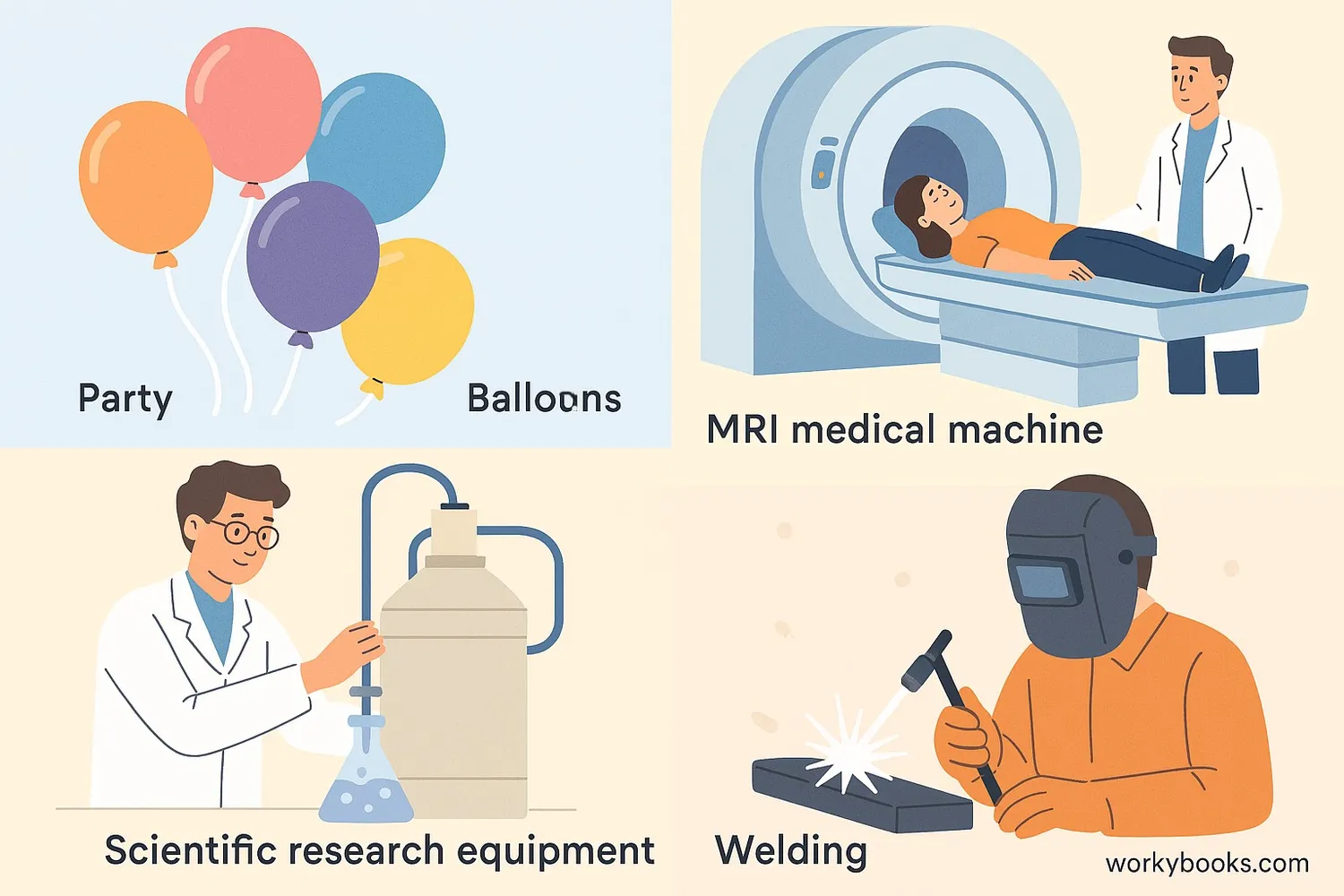
Helium has many important uses beyond party balloons
Noble gases are a special group of elements in the periodic table, found in Group 18. These elements, including helium, neon, argon, krypton, xenon, and radon, are known for being extremely stable and unreactive. Scientists noticed that, unlike most elements, noble gases rarely form compounds or participate in chemical reactions. Their unique stability makes them valuable in many everyday and technological applications.
Full Valence Shells: The Key to Stability
The main reason for the stability of noble gases lies in their electron arrangement. Atoms have electrons organized in energy levels, also called shells. The outermost shell, or valence shell, determines how atoms interact with others. Most atoms are reactive because they want to achieve a full valence shell, usually with eight electrons — a state called the octet rule. Noble gases already have full valence shells: helium has two electrons (full for its first shell), while neon, argon, krypton, xenon, and radon each have eight electrons in their outer shell. This full shell means they do not need to gain, lose, or share electrons, making them inert and chemically nonreactive.
Real-World Applications of Noble Gases
The inertness of noble gases makes them ideal for many uses. Helium, for example, is lighter than air and non-flammable, so it is used to fill balloons and airships (blimps), replacing dangerous hydrogen gas. Neon produces a bright red-orange glow when electricity passes through it, which is why it is used in colorful neon signs. Argon is used inside light bulbs to prevent the hot tungsten filament from reacting with oxygen, which would cause the bulb to burn out quickly. Krypton and xenon are used in specialized lighting, such as high-intensity lamps and some types of lasers. Because noble gases do not react easily, they are safe and reliable in situations where chemical reactions could be dangerous or damaging.
Broader Scientific Principles and Impact
The discovery and understanding of noble gases changed how scientists view chemical stability. By studying why noble gases are so unreactive, chemists developed the octet rule and deepened our understanding of atomic structure and chemical bonding. This knowledge helps explain why other elements react the way they do, and it guides the design of new materials. In industry, noble gases are used in welding, preserving historical documents, and creating safe environments for delicate experiments. Their properties are an example of how atomic structure controls the behavior of matter at a large scale.
Noble gases continue to be important in science and technology. As researchers seek new ways to use their unique properties, noble gases remind us that even the most 'inactive' elements can have a big impact on our world.
Interesting Fact: Helium is the only element that cannot be solidified just by lowering the temperature; it needs high pressure to become a solid!
What is the main reason noble gases are stable?
They have full valence electron shells.They are found in Group 1 of the periodic table.They are heavier than other elements.They are metals.
Which noble gas is commonly used to fill balloons?
HeliumNeonArgonXenon
What feature makes neon useful in signs?
It glows red-orange when electric current passes through.It is heavier than air.It reacts with oxygen.It is flammable.
According to the passage, which of the following is NOT a use for noble gases?
Making fireworksFilling light bulbsWeldingNeon signs
What does the term 'inert' mean as used in the passage?
Not reactive with other substancesVery heavyGlowing in the darkRadioactive
Which statement is supported by the passage?
Noble gases do not need to gain, lose, or share electrons.Noble gases are highly reactive with other elements.Noble gases are only found in laboratories.Noble gases have empty outer shells.
Why is argon used inside light bulbs?
It prevents the filament from reacting with oxygen.It is cheaper than air.It makes the bulb glow blue.It is magnetic.
If a new element is discovered with a full valence shell, what property might it share with noble gases?
It would likely be chemically inert.It would be a metal.It would be highly reactive.It would conduct electricity like copper.
True or False: Noble gases are often used in situations where chemical reactions would be dangerous.
TrueFalse
True or False: Helium is the only noble gas with a full valence shell of eight electrons.
TrueFalse
Perfect For:
👩🏫 Teachers
• Reading comprehension practice
• Auto-graded assessments
• Literacy skill development
👨👩👧👦 Parents
• Reading practice at home
• Comprehension improvement
• Educational reading time
🏠 Homeschoolers
• Reading curriculum support
• Independent reading practice
• Progress monitoring
Reading Features:
📖
Reading Passage
Engaging fiction or nonfiction text
❓
Comprehension Quiz
Auto-graded questions
📊
Instant Feedback
Immediate results and scoring
📄
Printable Version
Download for offline reading
🔊
Read Aloud
Voice-over with word highlighting
Reviews & Ratings
No reviews yet. Be the first to share your experience!
Related Content
Atomic Structure
This reading passage on Atomic Structure provides middle school students with an accessible explanation of the fundament...
MS-PS1-1RI.6.3RI.7.1
Parts of an Atom
This reading passage on Parts of an Atom provides middle school students with a structured and accessible explanation of...
MS-PS1-1RI.6.3RI.7.1
Chemical Bonds
This reading passage on Chemical Bonds provides middle school students with a clear explanation of how and why atoms con...
MS-PS1-1RI.6.3RI.7.1
The Freezing Point of Water
This science reading passage, titled 'The Freezing Point of Water', introduces students to a key physical science concep...
MS-PS1-1RI.6.3RI.7.1
Physical Properties of Matter
This comprehensive reading passage introduces grades 6-8 students to the concept of physical properties of matter, perfe...
MS-PS1-1
Mixtures and Pure Substances
This middle school science passage provides an in-depth exploration of mixtures and pure substances, directly aligned to...
MS-PS1-1
Types of Mixtures
This comprehensive science passage for grades 6-8 introduces students to the concept of mixtures, focusing on distinguis...
MS-PS1-1
Solutions, Suspensions, and Colloids
This comprehensive science passage explores the differences between solutions, suspensions, and colloids, focusing on ho...
MS-PS1-1
The Nature of Science
This passage explores the nature of science for middle school students, aligning with NGSS standards MS-ETS1-4, MS-PS1-1...
MS-ETS1-4MS-PS1-1MS-LS1-1
Scientific Theories
This reading passage for grades 6-8 introduces students to the concept of scientific theories, emphasizing that these ar...
MS-PS1-1MS-PS1-4MS-PS3-4SCIENCE AND ENGINEERING PRACTICES
Particle Model of Matter
This comprehensive science reading passage for grades 6-8 explores the particle model of matter, aligning with NGSS stan...
MS-PS1-1MS-PS1-4
Valence Electrons
This middle school science passage introduces students to the concept of valence electrons, the outermost electrons that...
MS-PS1-1
The Idea of the Atom
This informational science passage introduces middle school students (grades 6-8) to the concept that all matter is made...
MS-PS1-1
Protons, Neutrons, and Electrons
This comprehensive middle school science passage explores the roles of protons, neutrons, and electrons, the three main ...
MS-PS1-1
What are Ions
This passage introduces middle school students to the concept of ions, explaining the processes by which atoms gain or l...
MS-PS1-1
Nucleus of the Atom
This comprehensive passage for grades 6-8 introduces students to the nucleus of the atom, the dense center that contains...
MS-PS1-1
How Atoms Differ
This middle school science reading passage, aligned with NGSS standard MS-PS1-1, explores the fundamental differences am...
MS-PS1-1
Isotopes
This middle school science passage explores the concept of isotopes, which are atoms of the same element with different ...
MS-PS1-1
Compounds vs. Mixtures
This educational passage for grades 6-8 explores the fundamental differences between compounds and mixtures, aligning wi...
MS-PS1-1
Organizing the Elements
This passage for middle school science explores how scientists organized the elements as more were discovered, leading t...