Nonmetals on Periodic Table — Reading Comprehension
Rate this
Present
Present in classroom. No work saved
Assign
Classroom with student accounts, Track progress
Quick Play
No student accounts, assign with a link
Grades
5
6
7
8
Standards
MS-PS1-1
PRINT+DIGITAL RESOURCE
This learning resource is available in interactive and printable formats. The interactive worksheet can be played online and assigned to students. The Printable PDF version can be downloaded and printed for completion by hand.
This NGSS-aligned passage for grades 6-8 introduces students to the fascinating world of nonmetals, a crucial category of elements found on the right side of the periodic table. The passage explores the unique properties of nonmetals, such as being dull, brittle, and poor conductors of electricity and heat. It uses real-world examples like oxygen, nitrogen, carbon, and sulfur to illustrate how nonmetals are essential for life, from the air we breathe to the structure of living things. Students will learn how nonmetals interact with other elements in systems and why their properties matter for biological, environmental, and technological processes. The activities include a glossary, differentiated readings, Spanish translations, quizzes, writing prompts, and graphic organizers, all designed for accessibility and deep understanding. The content is audio integrated, supporting diverse learning needs and making the passage ideal for classroom or independent study.
CONTENT PREVIEW
Expand content preview
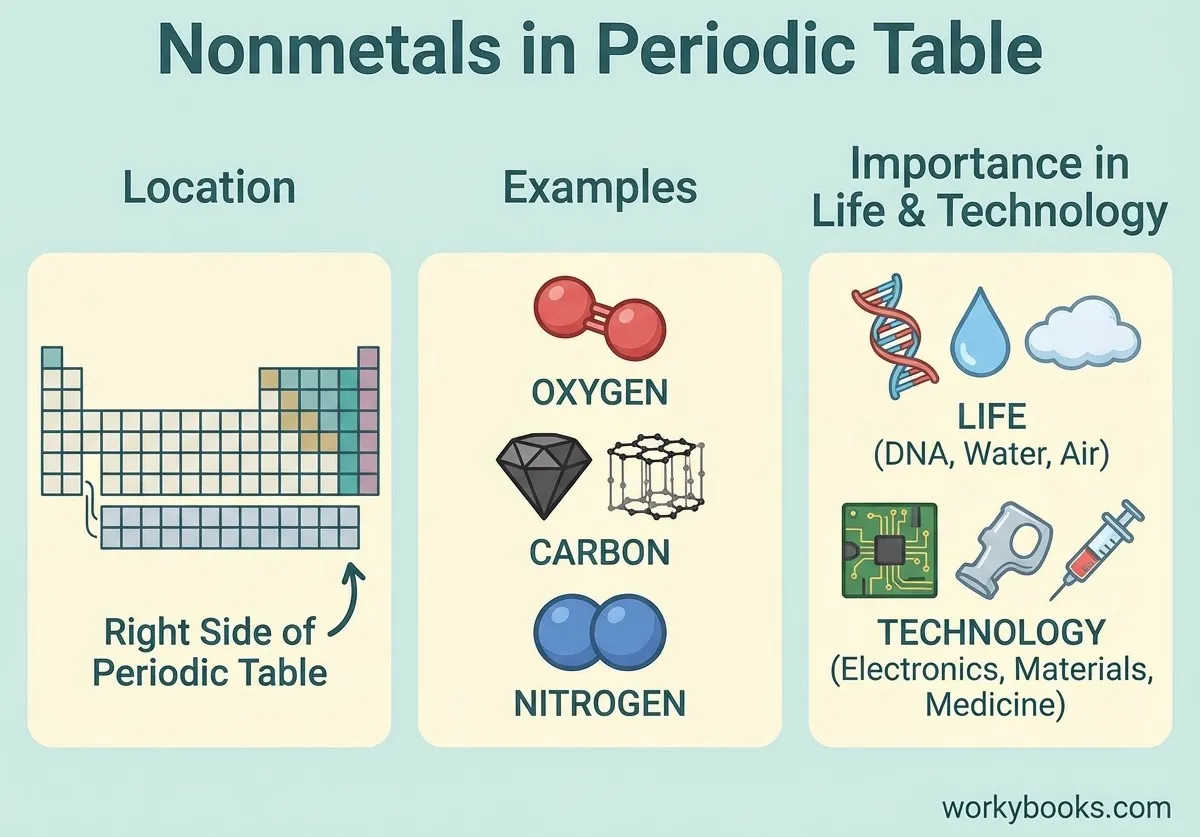
Nonmetals make up a unique and important category of elements on the periodic table. Unlike metals, nonmetals tend to be dull, poor conductors of heat and electricity, and often brittle when solid. Many nonmetals are gases at room temperature. These properties affect how nonmetals interact with other elements and why they are essential in nature and technology.
Where Nonmetals Are Found and Their Key Properties
Nonmetals are located on the right side of the periodic table. Out of more than 100 known elements, about 20% are classified as nonmetals. Their atomic structure—specifically, having more electrons in their outer energy level—makes them less likely to give up electrons, which is why they don't conduct electricity well. For example, oxygen and nitrogen are nonmetals that make up about 99% of Earth's atmosphere. Solid nonmetals, like sulfur and carbon, are brittle and break easily instead of bending. The dull appearance of nonmetals, compared to the shiny luster of metals, results from the way their atoms reflect light. These differences are not just observations; they result from deep atomic differences that determine how nonmetals behave in chemical reactions.
Examples and Importance of Nonmetals in Life and Technology
Nonmetals play vital roles in biological and environmental systems. Oxygen is essential for respiration, the process by which living things release energy from food. Nitrogen is necessary for building proteins in all living organisms. Carbon, another nonmetal, forms the backbone of all organic molecules, including DNA and proteins. Sulfur is needed for some vitamins and amino acids. In technology, nonmetals are used for their special properties: for instance, graphite (a form of carbon) is used in pencils and as a lubricant because it is soft and slippery. The chemical reactivity of nonmetals also means they combine with metals to form important compounds, like sodium chloride (table salt).
Interactions, Systems, and Broader Implications
Nonmetals do not exist in isolation—they are part of complex systems. For example, oxygen and carbon dioxide cycle through the atmosphere, plants, and animals in processes like photosynthesis and respiration. These cycles are essential for life on Earth. The poor conductivity of nonmetals can also be useful: plastic coatings (which contain nonmetals) protect electrical wires from short-circuiting. Understanding the properties of nonmetals helps scientists develop new materials for safer, more efficient technologies. The study of nonmetals also connects to larger scientific principles, such as the conservation of mass and how matter cycles through ecosystems.
Nonmetals may not shine or bend like metals, but their unique properties make them crucial for life, industry, and the environment. By studying their structure and behavior, scientists can answer questions about everything from how our bodies work to how we can build better batteries or cleaner air.
Interesting Fact: Diamond, one of the hardest materials on Earth, is actually a form of the nonmetal carbon arranged in a special structure!
Where are nonmetals found on the periodic table?
On the right sideOn the left sideIn the centerScattered throughout
Which of the following is a property of nonmetals?
Dull appearanceGood conductor of electricityFlexible and shinyAlways solid at room temperature
Oxygen and nitrogen together make up about what percentage of Earth's atmosphere?
99%50%10%1%
What is the main reason nonmetals are poor conductors of electricity?
They have more electrons in their outer energy level.They are always gases.They are shiny.They are metals.
What does the word "brittle" mean as used in the passage?
Easily broken without bendingShiny and smoothGood at conducting electricityHeavy and dense
What is a "compound" according to the passage?
A substance formed when two or more elements join chemicallyA pure elementA type of metalA gas at room temperature
Why are nonmetals important in biological systems?
They are needed for processes like respiration and building proteins.They are used only in technology.They make up most rocks.They are always metals.
How does the property of poor conductivity in nonmetals benefit technology?
It allows plastics to insulate electrical wires safely.It makes them shiny.It helps metals conduct electricity.It makes them flexible.
True or False: All nonmetals are gases at room temperature.
FalseTrue
True or False: The study of nonmetals helps scientists develop new materials and understand life processes.
TrueFalse
Perfect For:
👩🏫 Teachers
• Reading comprehension practice
• Auto-graded assessments
• Literacy skill development
👨👩👧👦 Parents
• Reading practice at home
• Comprehension improvement
• Educational reading time
🏠 Homeschoolers
• Reading curriculum support
• Independent reading practice
• Progress monitoring
Reading Features:
📖
Reading Passage
Engaging fiction or nonfiction text
❓
Comprehension Quiz
Auto-graded questions
📊
Instant Feedback
Immediate results and scoring
📄
Printable Version
Download for offline reading
🔊
Read Aloud
Voice-over with word highlighting
Reviews & Ratings
No reviews yet. Be the first to share your experience!
Related Content
Atomic Structure
This reading passage on Atomic Structure provides middle school students with an accessible explanation of the fundament...
MS-PS1-1RI.6.3RI.7.1
Parts of an Atom
This reading passage on Parts of an Atom provides middle school students with a structured and accessible explanation of...
MS-PS1-1RI.6.3RI.7.1
Chemical Bonds
This reading passage on Chemical Bonds provides middle school students with a clear explanation of how and why atoms con...
MS-PS1-1RI.6.3RI.7.1
The Freezing Point of Water
This science reading passage, titled 'The Freezing Point of Water', introduces students to a key physical science concep...
MS-PS1-1RI.6.3RI.7.1
Physical Properties of Matter
This comprehensive reading passage introduces grades 6-8 students to the concept of physical properties of matter, perfe...
MS-PS1-1
Mixtures and Pure Substances
This middle school science passage provides an in-depth exploration of mixtures and pure substances, directly aligned to...
MS-PS1-1
Types of Mixtures
This comprehensive science passage for grades 6-8 introduces students to the concept of mixtures, focusing on distinguis...
MS-PS1-1
Solutions, Suspensions, and Colloids
This comprehensive science passage explores the differences between solutions, suspensions, and colloids, focusing on ho...
MS-PS1-1
The Nature of Science
This passage explores the nature of science for middle school students, aligning with NGSS standards MS-ETS1-4, MS-PS1-1...
MS-ETS1-4MS-PS1-1MS-LS1-1
Scientific Theories
This reading passage for grades 6-8 introduces students to the concept of scientific theories, emphasizing that these ar...
MS-PS1-1MS-PS1-4MS-PS3-4SCIENCE AND ENGINEERING PRACTICES
Particle Model of Matter
This comprehensive science reading passage for grades 6-8 explores the particle model of matter, aligning with NGSS stan...
MS-PS1-1MS-PS1-4
Valence Electrons
This middle school science passage introduces students to the concept of valence electrons, the outermost electrons that...
MS-PS1-1
The Idea of the Atom
This informational science passage introduces middle school students (grades 6-8) to the concept that all matter is made...
MS-PS1-1
Protons, Neutrons, and Electrons
This comprehensive middle school science passage explores the roles of protons, neutrons, and electrons, the three main ...
MS-PS1-1
What are Ions
This passage introduces middle school students to the concept of ions, explaining the processes by which atoms gain or l...
MS-PS1-1
Nucleus of the Atom
This comprehensive passage for grades 6-8 introduces students to the nucleus of the atom, the dense center that contains...
MS-PS1-1
How Atoms Differ
This middle school science reading passage, aligned with NGSS standard MS-PS1-1, explores the fundamental differences am...
MS-PS1-1
Isotopes
This middle school science passage explores the concept of isotopes, which are atoms of the same element with different ...
MS-PS1-1
Compounds vs. Mixtures
This educational passage for grades 6-8 explores the fundamental differences between compounds and mixtures, aligning wi...
MS-PS1-1
Organizing the Elements
This passage for middle school science explores how scientists organized the elements as more were discovered, leading t...