This learning resource is available in interactive and printable formats. The interactive worksheet can be played online and assigned to students. The Printable PDF version can be downloaded and printed for completion by hand.
This comprehensive passage for grades 6-8 introduces students to the concept of nuclear fission, aligning with NGSS standards MS-PS1-1 and MS-PS3-4. Students will learn how the splitting of a heavy atomic nucleus releases enormous energy, the role of chain reactions and critical mass, and specific examples like uranium-235 and plutonium-239. The passage connects fission to real-world applications such as nuclear power plants and atomic bombs, while conceptually introducing Einstein’s equation E=mc². Glossary terms, multiple-choice questions, writing prompts, and graphic organizers support a range of learners. Spanish translations and simplified versions ensure accessibility. This resource is ideal for middle school science classes and is fully audio integrated, making it perfect for diverse classrooms. Key concepts are reinforced through vocabulary, conceptual explanations, and real-world connections, providing a deep understanding of how nuclear fission shapes technology and society today.
CONTENT PREVIEW
Expand content preview
Nuclear Fission
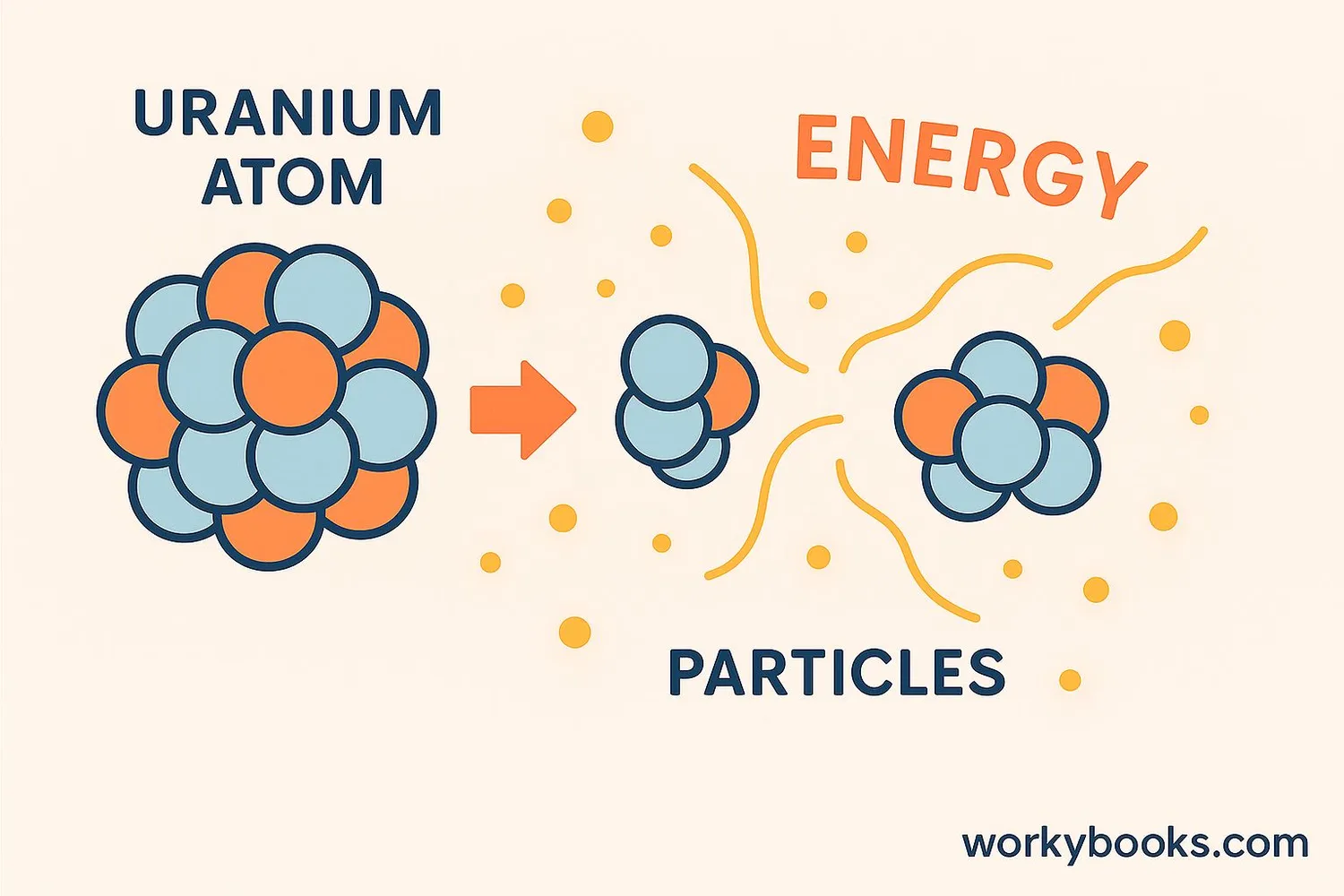
Nuclear fission is a process that has changed how people produce energy and understand matter. In nuclear fission, a heavy atomic nucleus, such as uranium-235 or plutonium-239, splits into two smaller nuclei. This process releases an enormous amount of energy and forms the basis for both nuclear power plants and atomic bombs. Understanding the mechanism behind fission helps scientists and engineers control and apply this energy in different ways.
How Nuclear Fission Works
Nuclear fission begins when a neutron strikes the nucleus of a heavy atom like uranium-235. The nucleus absorbs the neutron, becomes unstable, and splits into two smaller nuclei. This splitting releases additional neutrons and a large amount of energy, mostly as heat and radiation. The released neutrons can strike nearby uranium nuclei, causing them to split as well. This creates a chain reaction, where one fission event leads to many others. If enough material is present, known as the critical mass, the chain reaction can sustain itself.
For example, in a nuclear power plant, uranium-235 fuel rods are arranged to control the speed of the chain reaction. Control rods absorb excess neutrons and prevent the reaction from becoming too fast. The heat produced from fission turns water into steam, which drives turbines to generate electricity. In contrast, an atomic bomb is designed to achieve an uncontrolled chain reaction, releasing energy explosively in less than a second.
Energy, Mass, and Real-World Applications
The energy released in nuclear fission comes from a tiny loss of mass, explained by Einstein’s famous equation, E=mc². Even a small amount of mass can be converted into a huge amount of energy because the speed of light squared (c²) is a very large number. This principle helps explain why nuclear reactions produce much more energy than chemical reactions, such as burning coal or gasoline.
Nuclear fission has both positive and negative impacts on society. Power plants offer a low-carbon way to generate electricity, but they produce radioactive waste that must be stored safely. Atomic bombs, first used in World War II, showed the destructive power of uncontrolled fission. Scientists continue to research safer ways to use nuclear energy and to limit nuclear weapons. The study of nuclear fission also deepens our understanding of atomic structure and the forces that hold matter together.
Beyond the Basics: Variations and Challenges
Not all elements can undergo fission. Only certain heavy isotopes, like uranium-235 and plutonium-239, are suitable because their nuclei are large and unstable. The process must be carefully controlled to avoid accidents and to maximize energy output. Advances in nuclear engineering have improved reactor safety and waste management. Researchers are also exploring nuclear fusion, a different process that could one day provide even more energy with less radioactive waste.
In summary, nuclear fission is a powerful process that transforms matter and energy. It has changed electricity production, medical treatments, and international politics. By understanding how fission works and its effects, people can make informed decisions about using nuclear technology in the future.
Interesting Fact: The Hiroshima atomic bomb released energy equal to about 15,000 tons of TNT, all from less than one gram of matter converted to energy through nuclear fission.
What is nuclear fission?
The splitting of a heavy atomic nucleus into smaller nuclei, releasing energy.The process of combining two light nuclei to form a heavier nucleus.The movement of electrons around the nucleus.The burning of fossil fuels to produce energy.
Which elements are commonly used as fuel in nuclear fission reactors?
Uranium-235 and plutonium-239Hydrogen and heliumCarbon and oxygenGold and silver
What is a chain reaction in nuclear fission?
A reaction where neutrons released from one fission cause more nuclei to split.The process of splitting water molecules.A reaction that only occurs once and then stops.The movement of electrons between atoms.
Why are control rods important in nuclear power plants?
They absorb neutrons to regulate the chain reaction.They speed up the reaction to make more energy.They provide fuel for the reaction.They cool down the reactor core.
What does Einstein’s equation E=mc² explain in the context of nuclear fission?
How a small amount of mass can be turned into a large amount of energy.How electricity can be produced from water.How neutrons are formed.How atoms combine to make molecules.
What is 'critical mass'?
The minimum amount of fissile material needed for a self-sustaining chain reaction.The maximum energy a nuclear plant can produce.The weight of all atoms in the reactor.The mass of neutrons in the reaction.
Why must radioactive waste from nuclear fission be stored safely?
Because it remains hazardous and can harm living things.Because it can be used as fertilizer.Because it is valuable for jewelry.Because it is used in solar panels.
True or False: Only certain heavy elements like uranium-235 and plutonium-239 can undergo nuclear fission.
TrueFalse
True or False: Nuclear fission in power plants produces more energy than burning the same amount of coal.
TrueFalse
Which of the following is NOT an application of nuclear fission?
Solar panels generating electricityNuclear power plants producing electricityAtomic bombsMedical treatments using radiation
Perfect For:
👩🏫 Teachers
• Reading comprehension practice
• Auto-graded assessments
• Literacy skill development
👨👩👧👦 Parents
• Reading practice at home
• Comprehension improvement
• Educational reading time
🏠 Homeschoolers
• Reading curriculum support
• Independent reading practice
• Progress monitoring
Reading Features:
📖
Reading Passage
Engaging fiction or nonfiction text
❓
Comprehension Quiz
Auto-graded questions
📊
Instant Feedback
Immediate results and scoring
📄
Printable Version
Download for offline reading
🔊
Read Aloud
Voice-over with word highlighting
Reviews & Ratings
No reviews yet. Be the first to share your experience!
Related Content
Atomic Structure
This reading passage on Atomic Structure provides middle school students with an accessible explanation of the fundament...
MS-PS1-1RI.6.3RI.7.1
Parts of an Atom
This reading passage on Parts of an Atom provides middle school students with a structured and accessible explanation of...
MS-PS1-1RI.6.3RI.7.1
Chemical Bonds
This reading passage on Chemical Bonds provides middle school students with a clear explanation of how and why atoms con...
MS-PS1-1RI.6.3RI.7.1
The Freezing Point of Water
This science reading passage, titled 'The Freezing Point of Water', introduces students to a key physical science concep...
MS-PS1-1RI.6.3RI.7.1
Physical Properties of Matter
This comprehensive reading passage introduces grades 6-8 students to the concept of physical properties of matter, perfe...
MS-PS1-1
Mixtures and Pure Substances
This middle school science passage provides an in-depth exploration of mixtures and pure substances, directly aligned to...
MS-PS1-1
Types of Mixtures
This comprehensive science passage for grades 6-8 introduces students to the concept of mixtures, focusing on distinguis...
MS-PS1-1
Solutions, Suspensions, and Colloids
This comprehensive science passage explores the differences between solutions, suspensions, and colloids, focusing on ho...
MS-PS1-1
The Nature of Science
This passage explores the nature of science for middle school students, aligning with NGSS standards MS-ETS1-4, MS-PS1-1...
MS-ETS1-4MS-PS1-1MS-LS1-1
Scientific Theories
This reading passage for grades 6-8 introduces students to the concept of scientific theories, emphasizing that these ar...
MS-PS1-1MS-PS1-4MS-PS3-4SCIENCE AND ENGINEERING PRACTICES
Particle Model of Matter
This comprehensive science reading passage for grades 6-8 explores the particle model of matter, aligning with NGSS stan...
MS-PS1-1MS-PS1-4
Valence Electrons
This middle school science passage introduces students to the concept of valence electrons, the outermost electrons that...
MS-PS1-1
The Idea of the Atom
This informational science passage introduces middle school students (grades 6-8) to the concept that all matter is made...
MS-PS1-1
Protons, Neutrons, and Electrons
This comprehensive middle school science passage explores the roles of protons, neutrons, and electrons, the three main ...
MS-PS1-1
What are Ions
This passage introduces middle school students to the concept of ions, explaining the processes by which atoms gain or l...
MS-PS1-1
Nucleus of the Atom
This comprehensive passage for grades 6-8 introduces students to the nucleus of the atom, the dense center that contains...
MS-PS1-1
How Atoms Differ
This middle school science reading passage, aligned with NGSS standard MS-PS1-1, explores the fundamental differences am...
MS-PS1-1
Isotopes
This middle school science passage explores the concept of isotopes, which are atoms of the same element with different ...
MS-PS1-1
Compounds vs. Mixtures
This educational passage for grades 6-8 explores the fundamental differences between compounds and mixtures, aligning wi...
MS-PS1-1
Organizing the Elements
This passage for middle school science explores how scientists organized the elements as more were discovered, leading t...