This learning resource is available in interactive and printable formats. The interactive worksheet can be played online and assigned to students. The Printable PDF version can be downloaded and printed for completion by hand.
This middle school science passage introduces students to the concept of nuclear fusion, the process that powers the Sun and stars. Aligned with NGSS standards MS-PS1-1 and MS-PS3-4, the passage explains how fusion combines light atomic nuclei, like hydrogen, into heavier nuclei, like helium, releasing vast amounts of energy. Students will learn about the mechanisms of fusion, why it requires extreme temperature and pressure, and how it differs from nuclear fission, which is currently used in nuclear power plants. The reading also explores the difficulties of achieving nuclear fusion on Earth and its potential as a future clean energy source that produces less radioactive waste than fission. Activities include a reading comprehension quiz, writing prompts, and graphic organizers to deepen understanding. The passage is available in both English and Spanish, with differentiated versions for various reading levels. This resource also includes audio integration for enhanced accessibility and is ideal for grades 6-8 science classrooms.
CONTENT PREVIEW
Expand content preview
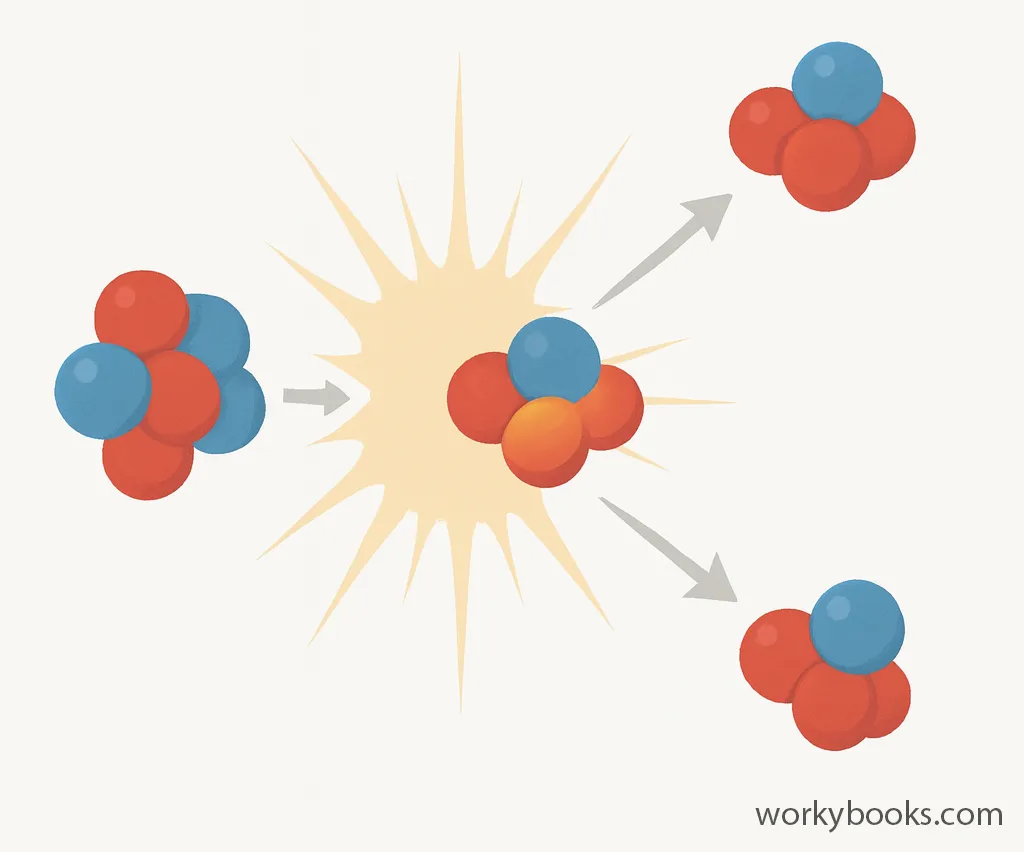
Nuclear fusion: energy released as atomic nuclei combine.
Nuclear fusion is the process that allows our Sun and other stars to shine brilliantly for billions of years. This powerful reaction occurs when two or more light atomic nuclei join together to form a heavier nucleus, releasing tremendous amounts of energy in the process. Nuclear fusion is not only the source of solar energy that warms Earth, but it also represents a potential solution for our future energy needs.
The Mechanism of Fusion
Fusion happens when light atomic nuclei, such as hydrogen, are forced close enough together that the strong nuclear force binds them into a single, heavier nucleus. This process requires extremely high temperatures (over 15 million degrees Celsius in the Sun) and immense pressure to overcome the natural repulsion between positively charged nuclei. In the Sun, hydrogen nuclei fuse to form helium, releasing energy according to Einstein’s equation, E=mc2, which shows that a small amount of lost mass becomes a large amount of energy. More than 99% of the Sun’s energy comes from fusion reactions.
Fusion on Earth and Its Challenges
Scientists have long seen fusion as a potential clean energy source, since it uses abundant fuels like hydrogen and produces much less radioactive waste than nuclear fission. Fission, used in today’s nuclear power plants, splits heavy nuclei like uranium to release energy, but it generates hazardous waste and relies on rare elements. Fusion, by contrast, uses lighter elements and offers the promise of nearly limitless, safe energy. However, reproducing the necessary temperatures and pressures for fusion on Earth is extremely difficult. Devices called tokamaks and lasers are being developed to contain and heat fuel for fusion, but so far, no reactor has produced more energy than it consumes.
Fusion vs. Fission: A Comparison
Fusion and fission both release energy from atomic nuclei, but they do so in opposite ways. Fusion combines light nuclei, usually isotopes of hydrogen, while fission splits heavy nuclei like uranium. Fusion produces less long-lived radioactive waste and does not create the risk of a nuclear meltdown. However, fission is easier to achieve with current technology, which is why it is used in all nuclear power plants today. If scientists can solve the technical problems of fusion, it could become a key part of clean energy systems for the planet’s future.
Fusion demonstrates how understanding the interactions of matter and energy can lead to transformative technologies. The pursuit of fusion energy highlights the need for scientific research and innovation in addressing global challenges.
Interesting Fact: Just one gram of fusion fuel can release as much energy as burning about eight tons of coal!
What is nuclear fusion?
The process where light atomic nuclei combine to form a heavier nucleus, releasing energy.The splitting of heavy nuclei into lighter nuclei.The process that creates radioactive waste.A reaction that only occurs on Earth.
What powers the Sun and most stars?
Nuclear fissionChemical combustionNuclear fusionWind energy
Which element is most commonly used as fuel in fusion reactions in the Sun?
UraniumHeliumHydrogenCarbon
Why is nuclear fusion considered a clean energy source?
It uses rare and expensive fuels.It produces less radioactive waste than fission.It is easier to achieve than fission.It creates more pollution than coal plants.
What is a tokamak?
A special machine designed to contain and heat fuel for nuclear fusion.A type of radioactive waste.A heavy atomic nucleus.A chemical used in fission reactors.
What does the term 'strong nuclear force' mean in the passage?
The force that pushes atoms apart.The force that holds nuclei together.A type of radioactive waste.The heat from the Sun.
Why is it difficult to achieve nuclear fusion on Earth?
It requires extremely high temperatures and pressures.It uses rare elements.It creates too much radioactive waste.It is illegal in most countries.
Which statement best describes the difference between fusion and fission?
Fusion splits heavy nuclei, while fission combines light nuclei.Fusion produces more radioactive waste than fission.Fusion combines light nuclei, while fission splits heavy nuclei.They are the same process.
True or False: Nuclear fusion currently produces more energy than it uses in Earth’s reactors.
TrueFalse
True or False: Fusion reactions in the Sun convert hydrogen into helium.
TrueFalse
Perfect For:
👩🏫 Teachers
• Reading comprehension practice
• Auto-graded assessments
• Literacy skill development
👨👩👧👦 Parents
• Reading practice at home
• Comprehension improvement
• Educational reading time
🏠 Homeschoolers
• Reading curriculum support
• Independent reading practice
• Progress monitoring
Reading Features:
📖
Reading Passage
Engaging fiction or nonfiction text
❓
Comprehension Quiz
Auto-graded questions
📊
Instant Feedback
Immediate results and scoring
📄
Printable Version
Download for offline reading
🔊
Read Aloud
Voice-over with word highlighting
Reviews & Ratings
No reviews yet. Be the first to share your experience!
Related Content
Atomic Structure
This reading passage on Atomic Structure provides middle school students with an accessible explanation of the fundament...
MS-PS1-1RI.6.3RI.7.1
Parts of an Atom
This reading passage on Parts of an Atom provides middle school students with a structured and accessible explanation of...
MS-PS1-1RI.6.3RI.7.1
Chemical Bonds
This reading passage on Chemical Bonds provides middle school students with a clear explanation of how and why atoms con...
MS-PS1-1RI.6.3RI.7.1
The Freezing Point of Water
This science reading passage, titled 'The Freezing Point of Water', introduces students to a key physical science concep...
MS-PS1-1RI.6.3RI.7.1
Physical Properties of Matter
This comprehensive reading passage introduces grades 6-8 students to the concept of physical properties of matter, perfe...
MS-PS1-1
Mixtures and Pure Substances
This middle school science passage provides an in-depth exploration of mixtures and pure substances, directly aligned to...
MS-PS1-1
Types of Mixtures
This comprehensive science passage for grades 6-8 introduces students to the concept of mixtures, focusing on distinguis...
MS-PS1-1
Solutions, Suspensions, and Colloids
This comprehensive science passage explores the differences between solutions, suspensions, and colloids, focusing on ho...
MS-PS1-1
The Nature of Science
This passage explores the nature of science for middle school students, aligning with NGSS standards MS-ETS1-4, MS-PS1-1...
MS-ETS1-4MS-PS1-1MS-LS1-1
Scientific Theories
This reading passage for grades 6-8 introduces students to the concept of scientific theories, emphasizing that these ar...
MS-PS1-1MS-PS1-4MS-PS3-4SCIENCE AND ENGINEERING PRACTICES
Particle Model of Matter
This comprehensive science reading passage for grades 6-8 explores the particle model of matter, aligning with NGSS stan...
MS-PS1-1MS-PS1-4
Valence Electrons
This middle school science passage introduces students to the concept of valence electrons, the outermost electrons that...
MS-PS1-1
The Idea of the Atom
This informational science passage introduces middle school students (grades 6-8) to the concept that all matter is made...
MS-PS1-1
Protons, Neutrons, and Electrons
This comprehensive middle school science passage explores the roles of protons, neutrons, and electrons, the three main ...
MS-PS1-1
What are Ions
This passage introduces middle school students to the concept of ions, explaining the processes by which atoms gain or l...
MS-PS1-1
Nucleus of the Atom
This comprehensive passage for grades 6-8 introduces students to the nucleus of the atom, the dense center that contains...
MS-PS1-1
How Atoms Differ
This middle school science reading passage, aligned with NGSS standard MS-PS1-1, explores the fundamental differences am...
MS-PS1-1
Isotopes
This middle school science passage explores the concept of isotopes, which are atoms of the same element with different ...
MS-PS1-1
Compounds vs. Mixtures
This educational passage for grades 6-8 explores the fundamental differences between compounds and mixtures, aligning wi...
MS-PS1-1
Organizing the Elements
This passage for middle school science explores how scientists organized the elements as more were discovered, leading t...