Outer Planets: The Gas Giants — Reading Comprehension
Rate this
Premium Resource
Present
Present in classroom. No work saved
Assign
Classroom with student accounts, Track progress
Quick Play
No student accounts, assign with a link
Grades
3
4
5
6
PRINT+DIGITAL RESOURCE
This learning resource is available in interactive and printable formats. The interactive worksheet can be played online and assigned to students. The Printable PDF version can be downloaded and printed for completion by hand.
This engaging science passage for Grade 4-5 students explores the outer planets of our solar system, known as the gas giants. Aligned with NGSS standards, it introduces students to Jupiter, Saturn, Uranus, and Neptune, explaining their unique features, differences from inner planets, and important scientific vocabulary. The passage uses clear language and real-world examples to make science concepts accessible and exciting. Students can test their knowledge with a multiple-choice quiz and practice their writing skills with thoughtful activities. The resource also includes a Spanish translation and an integrated audio option, making it suitable for diverse learners. Key vocabulary is highlighted and defined in the glossary. This resource is ideal for classroom instruction, homework, or self-study, and supports science literacy and comprehension skills.
CONTENT PREVIEW
Expand content preview
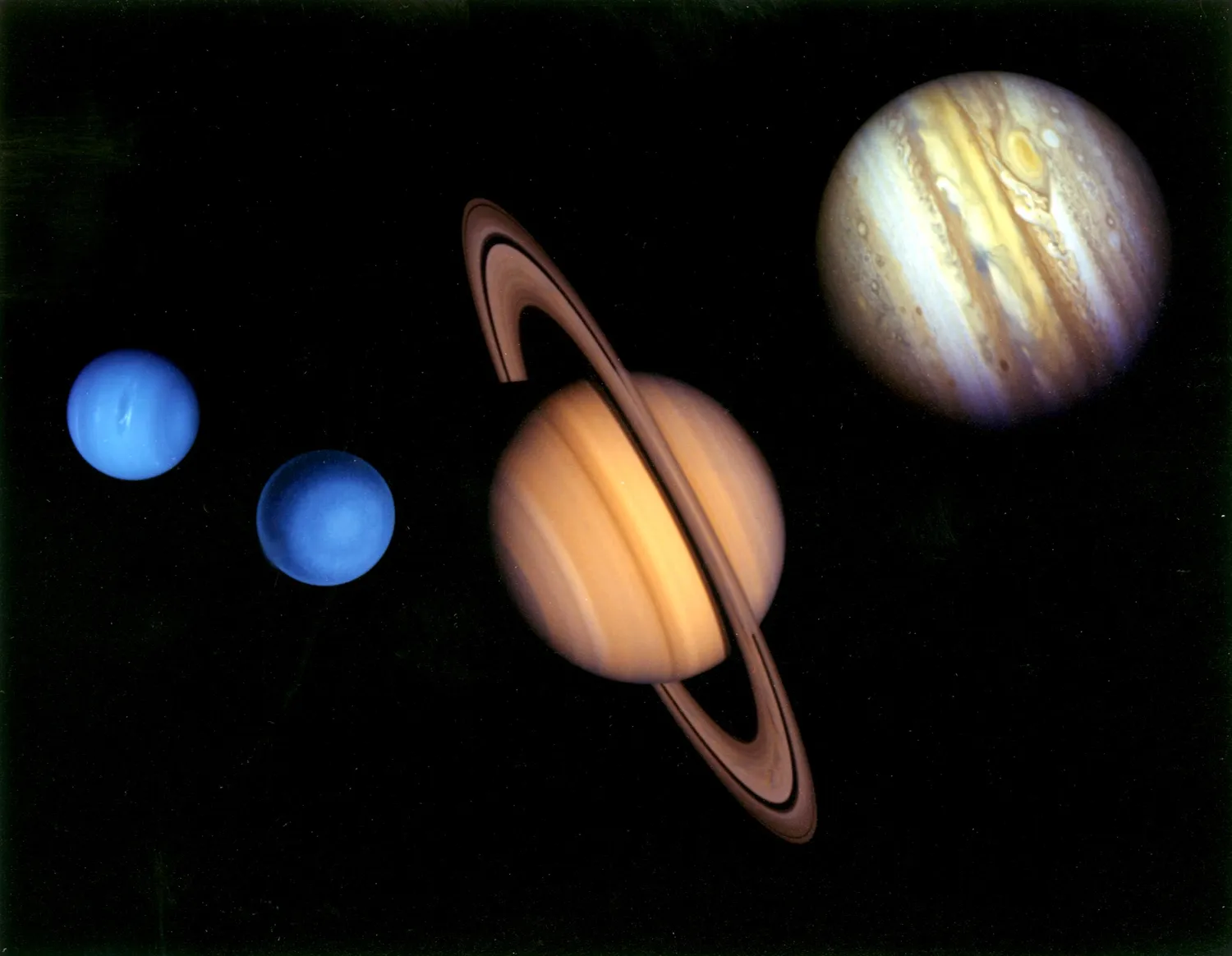
"Gas giants in the solar system" by NASA / Wikimedia Commons (Public domain).
The four largest planets in our solar system are called the gas giants. These planets are Jupiter, Saturn, Uranus, and Neptune. They are much bigger than Earth and are found far from the Sun. Unlike the inner planets, which are made mostly of rock, gas giants are made mostly of gases like hydrogen and helium.
Jupiter is the largest planet in our solar system. It is known for its colorful clouds and the Great Red Spot, a huge storm that has been blowing for hundreds of years. Jupiter has more than 75 moons, including Ganymede, the biggest moon in the solar system.
Saturn is famous for its bright, beautiful rings. These rings are made of ice, rock, and dust. Saturn is also very large and has more than 80 moons. The biggest is Titan, which has thick clouds and lakes of liquid methane.
Uranus and Neptune are called "ice giants" because they have more ice and water in their atmospheres. Uranus is unique because it spins on its side, making its seasons very different from those on other planets. Neptune is the farthest planet from the Sun and is known for its deep blue color. It has the fastest winds in the solar system, blowing up to 1,200 miles per hour!
The gas giants do not have solid surfaces like Earth. Instead, they have thick atmospheres of gas and small rocky cores deep inside. Because they are so far from the Sun, they are much colder than the inner planets. Scientists study gas giants to learn more about how planets form and what makes our solar system special.
Interesting Fact: Jupiter is so big that over 1,300 Earths could fit inside it!
Which planet has the Great Red Spot?
JupiterSaturnNeptuneUranus
What are Saturn's rings made of?
Ice, rock, and dustFire and lavaWater and sandGas only
Which planet spins on its side?
UranusJupiterSaturnNeptune
Why are Uranus and Neptune called ice giants?
More ice and waterCloser to the SunHave volcanoesSmallest planets
What do gas giants NOT have?
Solid surfacesMoonsRingsAtmospheres
How do gas giants differ from inner planets?
Made of gasesHave treesSmaller in sizeCloser to Sun
Jupiter is the largest planet.
TrueFalse
What is a moon?
Orbits a planetA type of starA planet's ringA gas cloud
Perfect For:
👩🏫 Teachers
• Reading comprehension practice
• Auto-graded assessments
• Literacy skill development
👨👩👧👦 Parents
• Reading practice at home
• Comprehension improvement
• Educational reading time
🏠 Homeschoolers
• Reading curriculum support
• Independent reading practice
• Progress monitoring
Reading Features:
📖
Reading Passage
Engaging fiction or nonfiction text
❓
Comprehension Quiz
Auto-graded questions
📊
Instant Feedback
Immediate results and scoring
📄
Printable Version
Download for offline reading
🔊
Read Aloud
Voice-over with word highlighting
Reviews & Ratings
No reviews yet. Be the first to share your experience!
Related Content
Earth: Our Home in Space
This engaging Grade 4-5 science passage, aligned to NGSS, introduces students to Earth's special place in the solar syst...
Tools and Technology in Earth Science
This middle school science reading passage explores the wide range of tools and technologies used in Earth science, from...
MS-ESS2-2MS-ESS3-2MS-ETS1-1MS-PS4-3
Earth's Place in the Universe
This reading passage explains Earth's place in the universe, supporting NGSS 1-ESS1-1. It describes how Earth is one of ...
1-ESS1-1
Scientific Inquiry in Earth Science
This passage explores scientific inquiry in Earth science for grades 6-8, aligned with NGSS standards MS-ESS1-4, MS-ESS2...
MS-ESS1-4MS-ESS2-1MS-ESS3-5SEP
What Is Space Weather and How Does It Affect the Earth?
This NGSS-aligned science passage for middle school explains what space weather is and how it affects Earth. Students le...
MS-ESS2-2
Escape Velocity and Space Travel
This middle school science passage introduces students to the concept of escape velocity—the minimum speed required to b...
MS-ESS1-2MS-PS2-4
Space Stations
This informational science reading passage for grades 6-8 explores the complex systems and technology behind space stati...
MS-ESS1-3MS-ETS1-1
What Is Earth Science?
This engaging middle school science passage introduces students to the field of Earth science, aligning with NGSS standa...
MS-ESS1MS-ESS2MS-ESS3SEP
The Space Garden
This innovative passage combines plant science with space exploration, aligning with NGSS standards for life sciences an...
RL.3.1RL.2.1RL.4.9
Measuring Distances in Space
This middle school science passage explores how astronomers measure the vast distances in space, aligning with NGSS stan...
MS-ESS1-3
Earth: Our Home Planet
This comprehensive science passage for grades 6-8 explores Earth’s unique characteristics and the interconnected systems...
MS-ESS1-2
Meteorite Impacts on Earth
This engaging science reading passage for Grades 4-5 explores meteorite impacts on Earth, aligning with NGSS standards. ...
Exploring Space: Rockets and Spacecraft
Space exploration has been one of humanity's greatest achievements, made possible by rockets and spacecraft. Rockets act...
RI.4.4RI.4.2
Earth's Rotation
This middle school science passage, aligned with NGSS standard MS-ESS1-1, focuses on Earth's rotation—how Earth spins on...
MS-ESS1-1
Facts About Earth
This engaging science reading passage introduces Grade 4 and 5 students to Earth, our home planet. Aligned with NGSS sta...
Earth's Moon Facts
This engaging science passage, 'The Moon: Earth's Companion,' is designed for Grade 4-5 students and aligns with NGSS ge...
Earth's Seasons
This comprehensive reading passage for grades 6-8 explains why Earth has seasons, revealing the scientific mechanisms be...
MS-ESS1-1
International Space Station
Discover the wonders of the International Space Station with this informative coloring page showcasing the orbiting outpost where astronauts live and work in space. As children color the complex modul...
Venus: Earth's Twin?
This comprehensive science passage for grades 6-8 examines Venus—often called Earth's twin—by exploring its similarities...
MS-ESS1-2MS-ESS1-3
What Makes Earth Perfect for Life?
This Grade 4-5 science passage, aligned with NGSS standards, explores the essential features that make Earth the perfect...