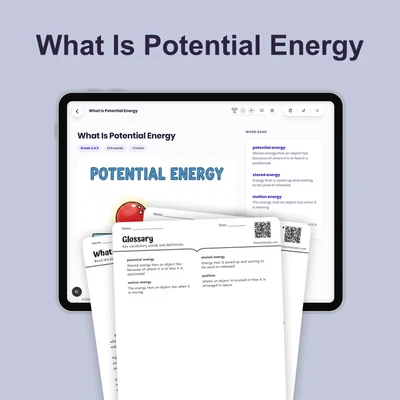
This learning resource is available in interactive and printable formats. The interactive worksheet can be played online and assigned to students. The Printable PDF version can be downloaded and printed for completion by hand.
This reading passage, designed for 4th-grade students, delves into the fascinating world of energy transformations using the example of a pendulum swing. Aligned with the NGSS disciplinary core concept PS3.B: Conservation of Energy and Energy Transfer, the passage explains how a pendulum's energy changes from potential energy, which is stored energy due to its position, to kinetic energy, which is the energy of motion. Students will learn that at the highest points of its swing, the pendulum has maximum potential energy and zero kinetic energy. As it swings downward, this potential energy is converted into kinetic energy, reaching its maximum at the lowest point. The passage uses simple language and an engaging narrative to help students grasp these fundamental concepts of physics and how energy is never created or destroyed, but simply changes form. The text includes definitions of key terms and a fun fact to keep students engaged. This resource is perfect for introducing the topic of energy to young learners.
CONTENT PREVIEW
Expand content preview
Pendulum Swing
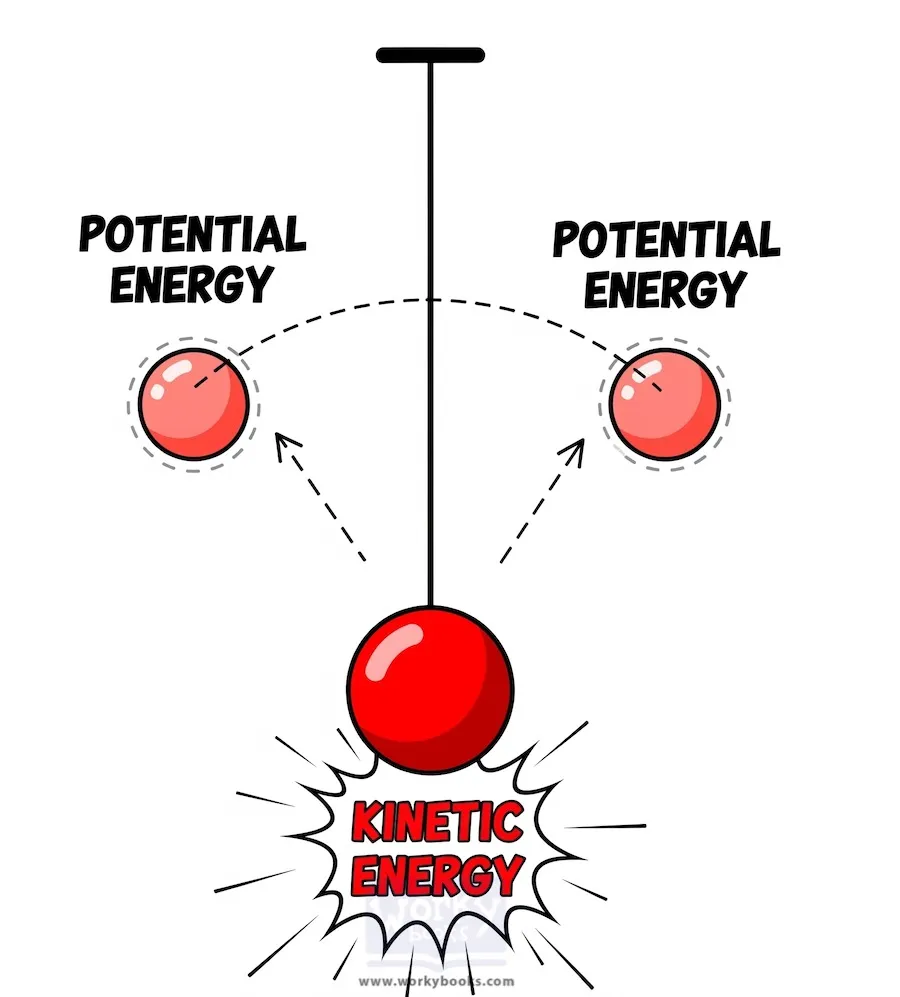
A pendulum is a weight hanging from a string or rod that swings back and forth. You can see pendulums in clocks, playground swings, and even wrecking balls. A pendulum is like an energy see-saw—energy bounces back and forth between stored (potential energy) and moving (kinetic energy) with every swing!
At the very top of its swing, the pendulum is not moving. All its energy is stored as potential energy because of its height. As the pendulum starts to move downward, gravity pulls it down, turning potential energy into kinetic energy. The pendulum moves faster as it goes down.
At the bottom of the swing, the pendulum is moving the fastest. Here, almost all the energy is kinetic. As it swings up to the other side, the pendulum slows down. Its kinetic energy changes back into potential energy until it stops again at the top. This cycle repeats with every swing!
But a pendulum never swings forever. Friction with the air and at the pivot point (where the string is attached) takes away a little energy each time. This energy turns into heat, making the pendulum slow down and finally stop.
The speed of a pendulum’s swing depends only on the length of the string. A longer pendulum swings more slowly, while a shorter one swings faster. The weight of the pendulum does not change the speed!
Pendulums are used in real life to keep time in grandfather clocks, make playground swings fun, and help wrecking balls knock things down. The famous scientist Galileo discovered that pendulums take the same time to swing, no matter how heavy they are, by watching a lamp swing in a church.
Interesting Fact: The word "oscillation" means one full back-and-forth swing of a pendulum!
What is a pendulum?
A weight on a stringA spinning topA bouncing ballA floating balloon
Where is potential energy highest?
At the top of swingAt the bottomIn the middleWhen stopped
What makes a pendulum slow down?
FrictionRainSunlightElectricity
What affects pendulum swing speed?
String lengthWeightColorShape
What does kinetic energy mean?
Energy of motionStored energySlowing energyAir energy
Playground swings are an example of?
PendulumsEnginesMirrorsMagnets
A pendulum will swing forever. True or false?
TrueFalse
What is 'oscillation'?
One back-and-forth swingA loud noiseA balloon flyingA type of plant
Perfect For:
👩🏫 Teachers
• Reading comprehension practice
• Auto-graded assessments
• Literacy skill development
👨👩👧👦 Parents
• Reading practice at home
• Comprehension improvement
• Educational reading time
🏠 Homeschoolers
• Reading curriculum support
• Independent reading practice
• Progress monitoring
Reading Features:
📖
Reading Passage
Engaging fiction or nonfiction text
❓
Comprehension Quiz
Auto-graded questions
📊
Instant Feedback
Immediate results and scoring
📄
Printable Version
Download for offline reading
🔊
Read Aloud
Voice-over with word highlighting
Reviews & Ratings
No reviews yet. Be the first to share your experience!
Related Content
How Speed Affects Energy
This Grade 4 physical science reading passage introduces students to the relationship between speed and kinetic energy, ...
NGSS 4-PS3-2
Science Vocabulary
This worksheet on domain-specific words will help students learn some science vocabulary. Students will be asked to matc...
L.3.6L.3.4.A
How Electric Current Transfers Energy
This 250-word reading passage introduces fourth-grade students to the concept of energy transfer through electric curren...
NGSS 4-PS3-2
What Is Potential Energy
This 250-word reading passage introduces fourth-grade students to the fundamental concept of potential energy aligned wi...
NGSS 4-PS3-1
Simple Machines Science Report
This science writing task requires students to clearly explain how three simple machines work using precise domain-speci...
W.5.4
What Is Energy
This engaging 250-word reading passage introduces fourth-grade students to the fundamental concept of energy as outlined...
NGSS 4-PS3-1
Work and Energy
This science reading passage for grades 6-8 introduces students to the concepts of work and energy, aligned with NGSS st...
MS-PS3-1
Motion Energy
This NGSS-aligned science passage for 4th graders focuses on the disciplinary core concept of Motion Energy (PS1.A). It'...
Energy Transformation
This middle school science passage aligned to NGSS standard MS-PS3-5 explains the concept of energy transformation—the p...
MS-PS3-5
Heat Energy Transfer
This Grade 4 physical science reading passage explores heat energy transfer aligned to NGSS standard 4-PS3-2 and Discipl...
NGSS 4-PS3-2
Thermal Energy
This comprehensive passage explores the concept of thermal energy, aligning with NGSS standards MS-PS3-3 and MS-PS3-4. S...
MS-PS3-3MS-PS3-4
Beach Day Science
This passage addresses NGSS K-PS3-1 by comparing temperature differences in materials exposed to sunlight versus shade. ...
K-PS3-1RL.1.1
How Circuits Convert Energy
This 250-word reading passage introduces Grade 4 students to the concept of energy conversion in electric circuits, alig...
NGSS 4-PS3-2
Sound Energy
This engaging science passage, titled "What is Sound Energy?", is designed for 4th-grade students and aligns with the NG...
What Happens When Cars Collide
This 250-word reading passage introduces fourth-grade students to the concept of energy transfer and transformation duri...
NGSS 4-PS3-3
Pool Table Physics
The Pool Table Physics reading passage is a highly engaging educational resource designed for fourth-grade science stude...
Energy Transformations
This engaging middle school science passage explores the concept of energy transformations, aligning with NGSS standards...
MS-PS3-1MS-PS3-2MS-PS3-5
Where Does Our Energy Come From
This 250-word reading passage aligns with NGSS standard ESS3.A and introduces fourth-grade students to the fundamental c...
NGSS 4-ESS3-1
Energy Transfer
This NGSS-aligned science passage introduces middle school students to the concept of energy transfer, aligned to standa...
MS-PS3-5
What Are Physical Changes?
This engaging Grade 4-5 science passage introduces students to the concept of physical changes in matter, aligning with ...