What Are Punnett Squares
Interactive passage with audio narration, comprehension questions, and printable PDF.
By completing this purchase you agree to our Terms of Use and Privacy Policy. Your subscription renews automatically until you cancel. You can cancel anytime from your account settings. All sales are final and non-refundable. Digital content is available for download in your account immediately upon purchase.
What's included
What Are Punnett Squares preview and details
About this printable What Are Punnett Squares science reading passage, NGSS-aligned (Grades 5-8)
Sample passage and quiz from What Are Punnett Squares
Reading passage and comprehension quiz preview
Punnett Squares: Predicting Patterns of Inheritance
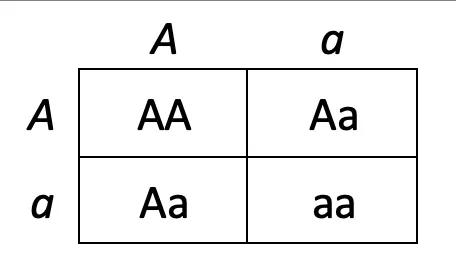
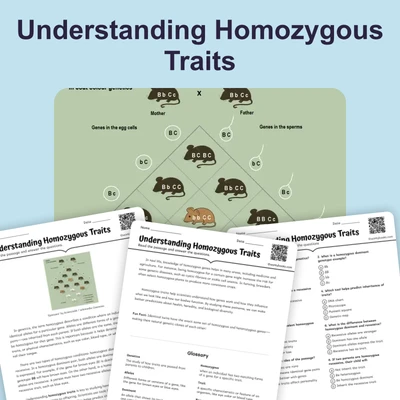
"Monohybrid Punnett Square (Aa x Aa)" by RobNobody / Wikimedia Commons (CC0).
Punnett squares are essential tools in genetics for predicting the likelihood of offspring inheriting certain traits. When scientists want to determine the probability of characteristics, such as flower color or fur type, they use Punnett squares to model the combinations of alleles—the different forms of a gene—that parents can pass on. This method is especially important for understanding patterns of inheritance in both plants and animals. By setting up a Punnett square, scientists can forecast which traits are more likely to appear in the next generation.
How Punnett Squares Work
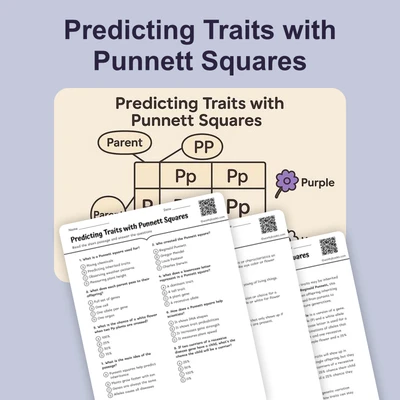
A Punnett square is a diagram with rows and columns representing the possible alleles from each parent. The alleles from one parent are written across the top, and the alleles from the other parent are listed along the side. When these alleles are combined in the boxes inside the square, they show all possible genotypes—the genetic makeup—of the offspring. Each genotype can result in a certain phenotype, which is the observable trait, like purple or white flowers. For example, if a purple-flowered plant with two dominant alleles (homozygous dominant, "PP") is crossed with a white-flowered plant with two recessive alleles (homozygous recessive, "pp"), all offspring will have the genotype "Pp" and display the purple phenotype. In contrast, if both parents are heterozygous ("Pp"), the Punnett square predicts a 75% chance of purple flowers and a 25% chance of white flowers in the offspring.
Calculating Ratios and Real-World Examples
Punnett squares do not guarantee results; instead, they show the probability for each outcome. The ratio of genotypes and phenotypes can be calculated by counting the number of times each appears in the Punnett square. For example, when crossing two heterozygous pea plants ("Pp" x "Pp"), the square predicts a genotype ratio of 1 "PP": 2 "Pp": 1 "pp" and a phenotype ratio of 3 purple: 1 white. This system applies to many traits, such as fur color in animals (black or brown) or even human features like attached or detached earlobes. These patterns help scientists study heredity and make predictions for breeding programs, agriculture, and medicine.
Homozygous and Heterozygous Crosses
Punnett squares are especially helpful when analyzing crosses between homozygous and heterozygous parents. Homozygous individuals have two identical alleles (like "PP" or "pp"), while heterozygous individuals have one dominant and one recessive allele ("Pp"). The type of cross affects the possible outcomes. For instance, a homozygous dominant crossed with a homozygous recessive produces only heterozygous offspring, but a heterozygous crossed with another heterozygous can produce all three possible genotypes. Understanding these crosses allows scientists and breeders to predict and select for desirable traits.
Punnett squares are a key part of the science of inheritance. They help connect observable traits to underlying genetic mechanisms, showing how probability and chance play a role in the diversity of living things. As our knowledge of genetics grows, Punnett squares remain a vital tool for research and real-world applications in health, agriculture, and conservation.
Interesting Fact: The Punnett square is named after Reginald C. Punnett, the scientist who first described this method in the early 1900s.
Comprehension quiz (10 questions)
1. What is the main purpose of a Punnett square?
2. What do the rows and columns of a Punnett square represent?
3. What is a genotype?
4. Which of the following best describes a phenotype?
5. What does the term 'homozygous' mean in the passage?
6. Based on the passage, what happens when two heterozygous plants ('Pp' x 'Pp') are crossed?
7. If a homozygous dominant ('PP') is crossed with a homozygous recessive ('pp'), what genotype will the offspring have?
8. True or False: Punnett squares show the exact traits each offspring will have.
9. True or False: The phenotype is always the same as the genotype.
10. What is the main reason Punnett squares are important in science?
Perfect for the way you teach
- Build comprehension skills
- Auto-graded quiz
- Differentiated reading
- Read together at home
- Improve fluency
- Quiet reading time
- Reading curriculum support
- Independent practice
- Track Lexile growth