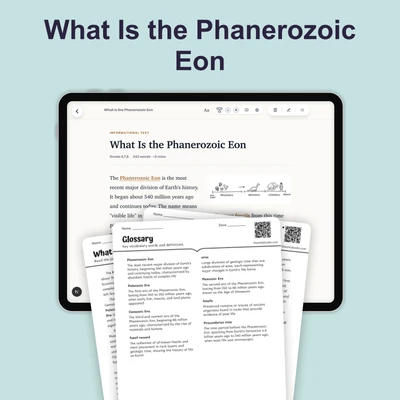
This learning resource is available in interactive and printable formats. The interactive worksheet can be played online and assigned to students. The Printable PDF version can be downloaded and printed for completion by hand.
This engaging science passage for grades 4-5 explores how rock layers reveal the history of the Earth. Aligned with NGSS standards, it explains important concepts such as sedimentary rocks, fossils, and the Law of Superposition. Students will discover how scientists use clues in rocks to learn about past environments and ancient life. The passage includes key vocabulary with clear definitions, real-world examples, and an 'Interesting Fact' to spark curiosity. Activities include a multiple-choice quiz testing comprehension and vocabulary, as well as writing prompts that encourage students to make connections to everyday life and analyze cause and effect in nature. The passage is also audio-integrated, supporting diverse learners. This resource is perfect for classroom or independent study, helping students build scientific literacy and critical thinking skills.
CONTENT PREVIEW
Expand content preview
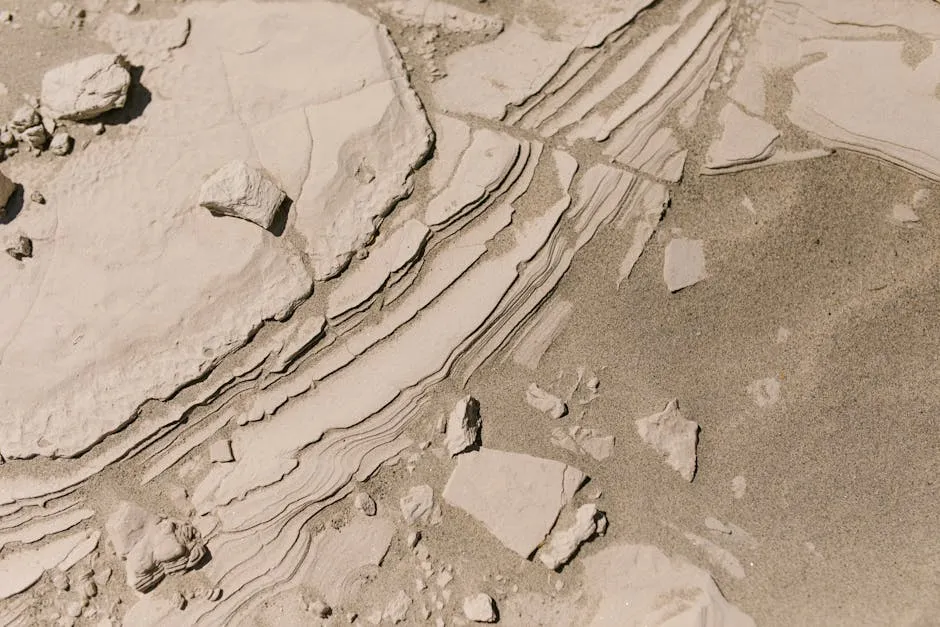
"High-angle shot capturing intricate rock layers and sandy texture in an arid landscape." by RDNE Stock project / Source: Pexels.
The Earth is made up of many different layers of rock. These layers, called rock layers, can tell us a lot about what happened on Earth long ago. Each layer forms over time as materials like mud, sand, and small pieces of rock settle and get pressed together. This process creates sedimentary rocks.
One important idea is the Law of Superposition. This law says that in a stack of rock layers, the oldest layers are at the bottom, and the youngest layers are at the top. Scientists, called geologists, use this law to figure out the order of events in Earth's history.
Sometimes, fossils are found inside sedimentary rocks. Fossils are the remains or traces of plants and animals that lived long ago. By studying fossils in different layers, geologists can learn what kinds of living things existed at different times. For example, dinosaur bones found in lower layers tell us dinosaurs lived before the animals found in higher layers.
Rock layers can also show past events like volcanic eruptions or earthquakes. A layer of ash from a volcano or a crack caused by an earthquake can be seen in the rocks. This helps scientists understand how Earth has changed over millions of years.
People use knowledge of rock layers in real life. For example, workers look at rock layers to find places with oil, water, or minerals. Builders check rock layers before making roads or tall buildings to make sure the ground is safe and strong.
Interesting Fact: Some rock layers are so old they formed over 3 billion years ago, long before the first plants or animals lived on land!
What are rock layers made of?
Mud, sand, and small rocksMetal and plasticOnly fossilsPlants and animals
What do fossils show us?
Kinds of living things beforeWeather patternsHow to build roadsOil locations
Who studies rocks and Earth's history?
GeologistsAstronautsDoctorsFarmers
What does the Law of Superposition say?
Oldest layers at bottomYoungest layers at bottomAll layers are same ageOnly one layer exists
If fossils are deeper, what does it mean?
They are olderThey are youngerThey are the same ageThey are newer animals
What could a layer of ash show?
Volcanic eruption happenedAnimals lived thereOil is presentWater was there
Rock layers help find oil. True or false?
TrueFalse
What is a fossil?
Remains of old plants/animalsLayer of mudA mineralA type of rock
Perfect For:
👩🏫 Teachers
• Reading comprehension practice
• Auto-graded assessments
• Literacy skill development
👨👩👧👦 Parents
• Reading practice at home
• Comprehension improvement
• Educational reading time
🏠 Homeschoolers
• Reading curriculum support
• Independent reading practice
• Progress monitoring
Reading Features:
📖
Reading Passage
Engaging fiction or nonfiction text
❓
Comprehension Quiz
Auto-graded questions
📊
Instant Feedback
Immediate results and scoring
📄
Printable Version
Download for offline reading
🔊
Read Aloud
Voice-over with word highlighting
Reviews & Ratings
No reviews yet. Be the first to share your experience!
Related Content
Tools and Technology in Earth Science
This middle school science reading passage explores the wide range of tools and technologies used in Earth science, from...
MS-ESS2-2MS-ESS3-2MS-ETS1-1MS-PS4-3
Scientific Inquiry in Earth Science
This passage explores scientific inquiry in Earth science for grades 6-8, aligned with NGSS standards MS-ESS1-4, MS-ESS2...
MS-ESS1-4MS-ESS2-1MS-ESS3-5SEP
What Is Earth Science?
This engaging middle school science passage introduces students to the field of Earth science, aligning with NGSS standa...
MS-ESS1MS-ESS2MS-ESS3SEP
Earth: Our Home in Space
This engaging Grade 4-5 science passage, aligned to NGSS, introduces students to Earth's special place in the solar syst...
Earth's Spheres
This middle school science passage introduces students to Earth's four major spheres: the geosphere, hydrosphere, atmosp...
MS-ESS2-4MS-ESS2-6
What Is Space Weather and How Does It Affect the Earth?
This NGSS-aligned science passage for middle school explains what space weather is and how it affects Earth. Students le...
MS-ESS2-2
Earth's Energy Balance
This engaging, NGSS-aligned science passage for grades 6–8 explores Earth's energy balance, a key process that keeps our...
MS-ESS2-6
Earth's Rotation
This middle school science passage, aligned with NGSS standard MS-ESS1-1, focuses on Earth's rotation—how Earth spins on...
MS-ESS1-1
Earth's Interior
This comprehensive passage for grades 6-8 explores Earth's layered interior, including the crust, mantle, outer core, an...
MS-ESS2-1MS-ESS2-2
Facts About Earth
This engaging science reading passage introduces Grade 4 and 5 students to Earth, our home planet. Aligned with NGSS sta...
Meteorite Impacts on Earth
This engaging science reading passage for Grades 4-5 explores meteorite impacts on Earth, aligning with NGSS standards. ...
Venus: Earth's Twin?
This comprehensive science passage for grades 6-8 examines Venus—often called Earth's twin—by exploring its similarities...
MS-ESS1-2MS-ESS1-3
Earth Changes Over Millions of Years
This engaging, audio-integrated science passage for Grade 4-5 students explores how Earth has changed over millions of y...
Earth's Moon Facts
This engaging science passage, 'The Moon: Earth's Companion,' is designed for Grade 4-5 students and aligns with NGSS ge...
Earth's Revolution
This middle school science passage explores the science behind Earth's revolution around the Sun, closely aligned with N...
MS-ESS1-1
Earth's Quick and Slow Changes
In 'Earth's Quick and Slow Changes,' students categorize 12 Earth events by their speed of occurrence, enhancing underst...
Earth: Our Home Planet
This comprehensive science passage for grades 6-8 explores Earth’s unique characteristics and the interconnected systems...
MS-ESS1-2
Earth's Seasons
This comprehensive reading passage for grades 6-8 explains why Earth has seasons, revealing the scientific mechanisms be...
MS-ESS1-1
Earth's Place in the Universe
This reading passage explains Earth's place in the universe, supporting NGSS 1-ESS1-1. It describes how Earth is one of ...
1-ESS1-1
Aphelion and Perihelion
This engaging reading passage, 'Aphelion and Perihelion,' delves into the fascinating aspects of Earth's elliptical orbi...
MS-ESS1-1: DEVELOP AND USE A MODEL OF THE EARTH-SUN-MOON SYSTEM TO DESCRIBE THE CYCLIC PATTERNS OF LUNAR PHASESECLIPSES OF THE SUN AND MOONAND SEASONS.