Reading PassagePremium

Seeds and Fruits

Interactive passage with audio narration, comprehension questions, and printable PDF.

No ratings yet
Grades 3–5ScienceElaReadingEnglish · SpanishInteractive · Printable
Aligned toNGSS 4-LS1-1
Just this resource
$1.50
One-time purchase
Best value
Unlock everything
$49.99$24.99/yr
50% off until Sept 15 — 10,000+ resources
Renews at $49.99/year.
Unlock above to use these actions

What's included

Reading passage
Audio narration
Comprehension quiz
Writing activity
Glossary & flashcards
Differentiated version
Spanish translation

Part of this bundle

Seeds and Fruits preview and details

About this printable Seeds and Fruits science reading passage, NGSS-aligned (Grades 3-5)

This engaging 250-word reading passage introduces fourth-grade students to the important relationship between seeds and fruits, aligned with NGSS standard 4-LS1-1 and the Disciplinary Core Idea LS1.A. Students discover that fruits are specialized plant structures that form around seeds to protect them and help them spread to new locations. The passage uses familiar examples like apples, strawberries, nuts, bean pods, and dandelion puffs to illustrate how diverse fruits can be. Students learn about seed dispersal methods, including how animals help spread seeds by eating fruits. The content is presented in clear, age-appropriate language with bolded vocabulary terms and concrete examples. This passage is audio-integrated, allowing students to read along while listening, which supports diverse learning styles and reading abilities. A Spanish translation is included for English language learners. The passage comes with comprehension questions, writing activities, and graphic organizers to reinforce understanding of plant structures and their functions in seed protection and dispersal.
Written by Workybooks TeamPublished by Workybooks
Preview

Sample passage and quiz from Seeds and Fruits

Reading passage and comprehension quiz preview

Seeds and Fruits
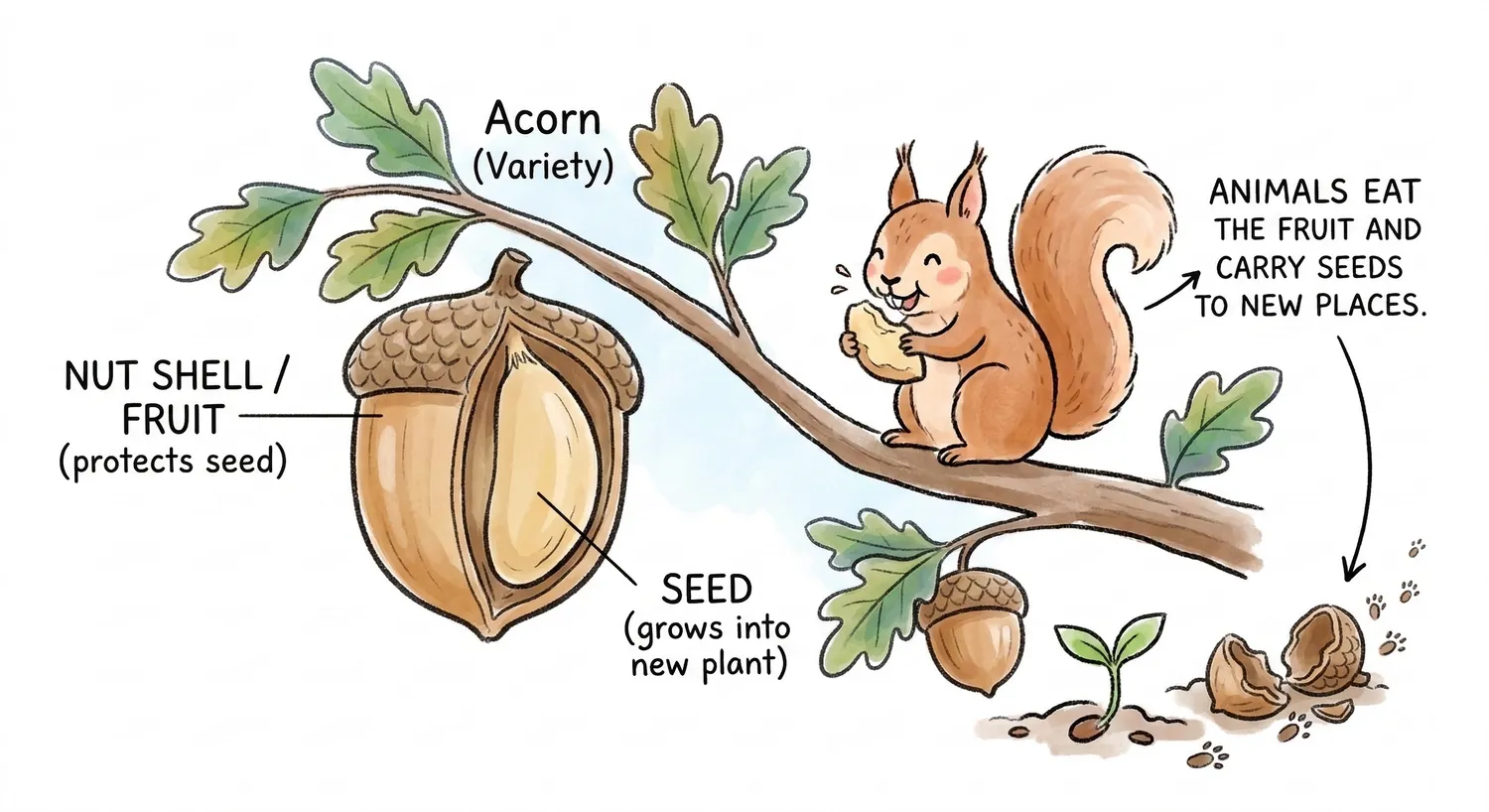
Squirrel dispersing acorn.
Nuts protect seeds and aid dispersal.

A fruit is the part of a plant that forms around seeds to protect them. Fruits help plants by keeping seeds safe as they grow and by helping seeds spread to new places where they can grow into new plants.

Many foods we call fruits are actually fruits in the scientific sense too. An apple is a fruit with seeds tucked inside its core. When you bite into an apple, you are eating the protective covering around the seeds. A strawberry is also a fruit, but it has tiny seeds on the outside instead of inside. Even foods we don't usually think of as fruits are fruits to scientists. Nuts are fruits with hard shells. Bean pods are fruits that split open when they dry out. A dandelion puff is a fruit too—each fluffy piece carries one seed through the air.

Fruits have an important job called seed dispersal, which means spreading seeds away from the parent plant. Some fruits attract animals with bright colors, sweet tastes, or good smells. When animals eat these fruits, they carry the seeds inside their bodies to new locations. Other fruits have special features like wings, hooks, or parachutes that help them travel by wind or stick to animal fur. This way, seeds don't all fall in one spot where they would compete with each other and the parent plant for sunlight, water, and nutrients.

Interesting Fact: A single strawberry can have more than 200 seeds on its surface, making it one of the only fruits that wears its seeds on the outside!

Comprehension quiz (8 questions)

1. What does a fruit do for seeds?

Protects and helps spread them
Makes them taste better
Changes their color
Makes them grow faster

2. Where are the seeds in an apple?

On the outside surface
Inside the core
On the stem
Under the skin only

3. Which is a fruit with seeds outside?

Apple
Nut
Strawberry
Bean pod

4. Why do fruits help spread seeds?

So seeds don't compete for resources
To make plants look pretty
To feed more animals
To make fruits taste sweeter

5. How do animals help with seed dispersal?

They plant seeds in gardens
They eat fruits and carry seeds
They water the seeds
They remove fruit from trees

6. What helps dandelion seeds travel?

Bright colors
Sweet taste
Fluffy parachutes
Hard shells

7. Scientists consider nuts to be fruits.

True
False

8. What does seed dispersal mean?

Planting seeds in rows
Spreading seeds to new places
Collecting seeds from fruits
Watering seeds regularly
Who it's for

Perfect for the way you teach

Teachers
  • Build comprehension skills
  • Auto-graded quiz
  • Differentiated reading
Parents
  • Read together at home
  • Improve fluency
  • Quiet reading time
Homeschoolers
  • Reading curriculum support
  • Independent practice
  • Track Lexile growth
Topics

Reviews & Ratings

No reviews yet. Be the first to share your experience!

More reading you might love

20 more
Passage
How Animals See Differently - reading educational content
Grades 3–5

How Animals See Differently

life science · NGSS 4-LS1-1

$1.50
Passage
Animal Internal Structure - reading educational content
Grades 3–5

Animal Internal Structure

life science · NGSS 4-LS1-1

$1.50
Passage
What Are Bones Made Of - reading educational content
Grades 3–5

What Are Bones Made Of

life science · NGSS 4-LS1-1

$1.50
Passage
How Bones Protect Organs - reading educational content
Grades 3–5

How Bones Protect Organs

life science · NGSS 4-LS1-1

$1.50
Passage
How Joints Connect Bones - reading educational content
Grades 3–5

How Joints Connect Bones

life science · NGSS 4-LS1-1

$1.50
Passage
How Muscles Move Bones - reading educational content
Grades 3–5

How Muscles Move Bones

life science · NGSS 4-LS1-1

$1.50
Passage
Two Types of Muscles - reading educational content
Grades 3–5

Two Types of Muscles

life science · NGSS 4-LS1-1

$1.50
Passage
What Are Muscles - reading educational content
Grades 3–5

What Are Muscles

life science · NGSS 4-LS1-1

$1.50
Passage
How Skin Protects Body - reading educational content
Grades 3–5

How Skin Protects Body

life science · NGSS 4-LS1-1

$1.50
Passage
Layers of the Skin - reading educational content
Grades 3–5

Layers of the Skin

life science · NGSS 4-LS1-1

$1.50
Passage
What Are Plant Structures - reading educational content
Grades 3–5

What Are Plant Structures

life science · NGSS 4-LS1-1

$1.50
Passage
Parts of Plant Stems - reading educational content
Grades 3–5

Parts of Plant Stems

life science · NGSS 4-LS1-1

$1.50
Passage
How Water Moves Inside Plants - reading educational content
Grades 3–5

How Water Moves Inside Plants

life science · NGSS 4-LS1-1

$1.50
Passage
Parts of a Flower - reading educational content
Grades 3–5

Parts of a Flower

life science · NGSS 4-LS1-1

$1.50
Passage
How Fish Gills Work - reading educational content
Grades 3–5

How Fish Gills Work

life science · NGSS 4-LS1-1

$1.50
Passage
How Leaves Make Food - reading educational content
Grades 3–6

How Leaves Make Food

life science · NGSS 4-LS1-1

Free
Passage
How Animal Hearts Work - reading educational content
Grades 3–5

How Animal Hearts Work

life science · NGSS 4-LS1-1

Free
Passage
Animal Skeleton Structure - reading educational content
Grades 3–5

Animal Skeleton Structure

life science · NGSS 4-LS1-1

$1.50
Passage
How Animal Lungs Work - reading educational content
Grades 3–5

How Animal Lungs Work

life science · NGSS 4-LS1-1

$1.50
Passage
What Is Inside a Seed - reading educational content
Grades 3–5

What Is Inside a Seed

life science · NGSS 4-LS1-1

$1.50
Copyright © 2026 Workybooks. Made with ♥ in California.