This learning resource is available in interactive and printable formats. The interactive worksheet can be played online and assigned to students. The Printable PDF version can be downloaded and printed for completion by hand.
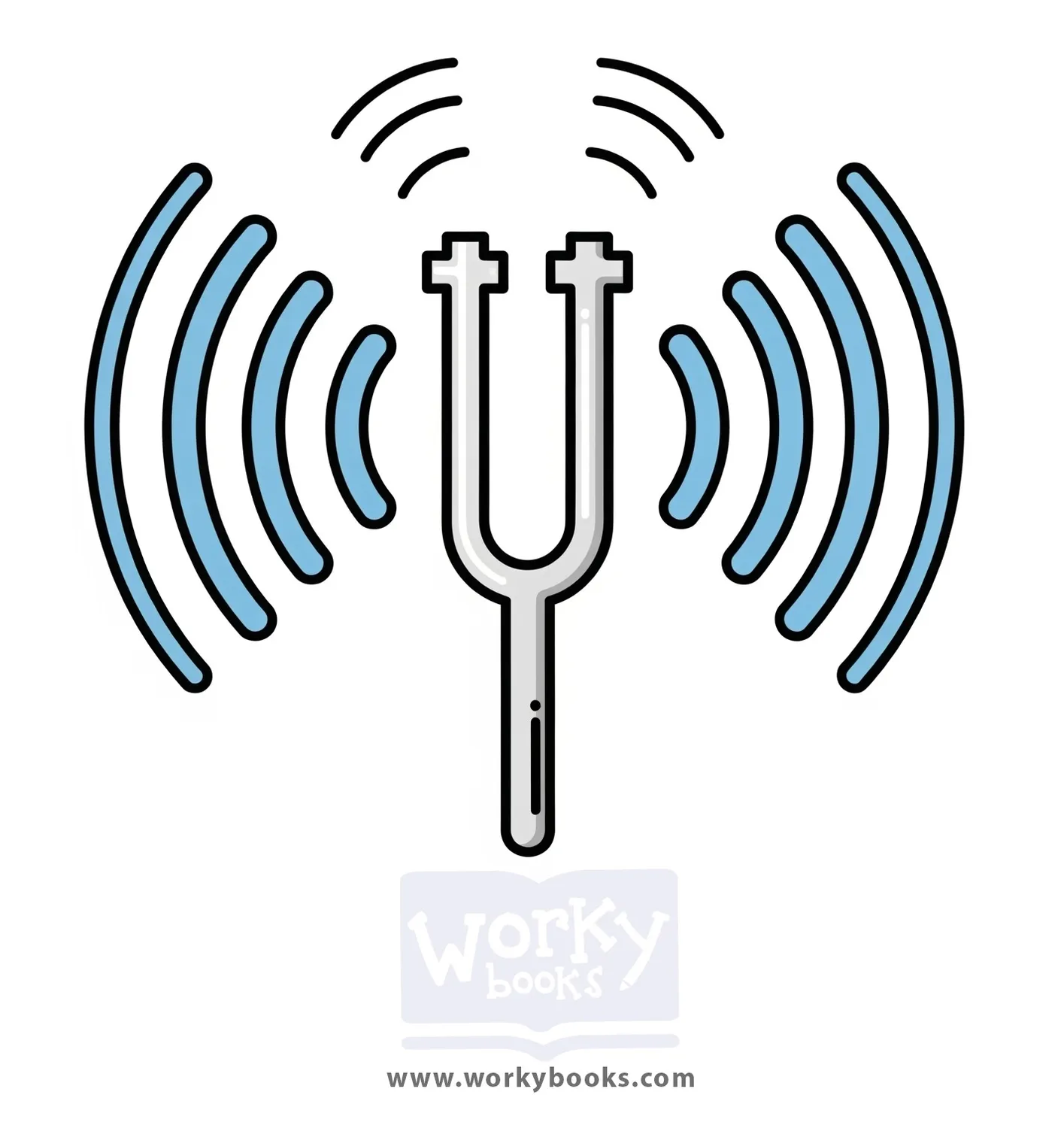
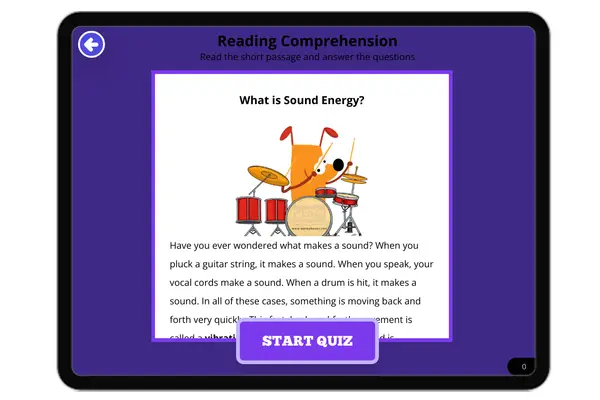
This 4th-grade science passage explores the concept of sound energy, a key topic in the NGSS standards. Students will learn that sound is a form of energy created by vibrations, which travel in waves. The passage provides a simple definition of energy and explains how a tuning fork can be used to demonstrate how sound waves are created and transferred. This resource is designed to improve reading comprehension skills while teaching foundational science concepts. It aligns with the NGSS standard PS3.A, focusing on the definition of energy and its transfer.
CONTENT PREVIEW
Expand content preview
What Are Sound Waves?
Sound waves are vibrations that travel through air and other materials. When something makes a sound, like a drum or your voice, it quickly pushes and pulls the air. This action creates invisible waves that move out in all directions. These sound waves carry energy from the source to your ears.
How Do Sound Waves Work?
A sound wave works a lot like a wave in a stadium. When people do the "wave," each person stands up and sits down, but they don’t move seats. The wave travels even though the people stay in place. In a sound wave, air molecules squeeze together in some places, called compressions, and spread apart in other places, called rarefactions. This push-and-pull pattern moves the sound through the air.
Parts of a Sound Wave
The wavelength is the distance between one wave peak and the next. Short wavelengths mean a high-pitched sound, like a whistle. Long wavelengths make low-pitched sounds, like a bass drum. The amplitude is how tall the wave is. Tall waves mean loud sounds. Short waves mean quiet sounds. The frequency is how many waves pass by each second, measured in Hertz (Hz). High frequencies are high-pitched; low frequencies are low-pitched.
Animals and Sound
Different animals hear different frequencies. Dogs can hear higher pitches than people. Elephants hear lower pitches that humans cannot hear. Bats and dolphins use echoes, or sound waves that bounce back, to find their way in the dark. This is called echolocation.
Seeing Sound Waves
You can see how sound waves move by using a slinky. Push one end and watch the waves travel along the coils. The slinky shows how compressions and rarefactions move, just like sound in the air.
Sound waves are like invisible dominos in the air—when you speak, you knock over the first domino and the waves keep moving until they reach someone’s ear!
Interesting Fact: Some whales can hear sounds from hundreds of kilometers away because sound travels well through water!
What is a vibration?
A quick back-and-forth movementA loud noiseA slow movementA type of animal
What do we call the part where air squeezes together?
CompressionRarefactionAmplitudeEcho
What does amplitude measure?
How loud a sound isWhat animal made itHow far it travelsHow high pitch is
If a sound has a short wavelength, what is its pitch?
High pitchLow pitchVery quietVery loud
Why do bats use echolocation?
To find food in the darkTo make loud noisesTo sleepTo run faster
What happens if you push a slinky?
You see a wave travelIt makes a loud soundIt turns into a drumIt lights up
Sound waves are invisible vibrations. True or false?
TrueFalse
Which word means using echoes to find things?
EcholocationWavelengthAmplitudeCompression
Perfect For:
👩🏫 Teachers
• Reading comprehension practice
• Auto-graded assessments
• Literacy skill development
👨👩👧👦 Parents
• Reading practice at home
• Comprehension improvement
• Educational reading time
🏠 Homeschoolers
• Reading curriculum support
• Independent reading practice
• Progress monitoring
Reading Features:
📖
Reading Passage
Engaging fiction or nonfiction text
❓
Comprehension Quiz
Auto-graded questions
📊
Instant Feedback
Immediate results and scoring
📄
Printable Version
Download for offline reading
🔊
Read Aloud
Voice-over with word highlighting
Reviews & Ratings
No reviews yet. Be the first to share your experience!
Related Content
How Speed Affects Energy
This Grade 4 physical science reading passage introduces students to the relationship between speed and kinetic energy, ...
NGSS 4-PS3-2
Science Vocabulary
This worksheet on domain-specific words will help students learn some science vocabulary. Students will be asked to matc...
L.3.6L.3.4.A
How Electric Current Transfers Energy
This 250-word reading passage introduces fourth-grade students to the concept of energy transfer through electric curren...
NGSS 4-PS3-2
What Is Potential Energy
This 250-word reading passage introduces fourth-grade students to the fundamental concept of potential energy aligned wi...
NGSS 4-PS3-1
Simple Machines Science Report
This science writing task requires students to clearly explain how three simple machines work using precise domain-speci...
W.5.4
What Is Energy
This engaging 250-word reading passage introduces fourth-grade students to the fundamental concept of energy as outlined...
NGSS 4-PS3-1
Work and Energy
This science reading passage for grades 6-8 introduces students to the concepts of work and energy, aligned with NGSS st...
MS-PS3-1
Motion Energy
This NGSS-aligned science passage for 4th graders focuses on the disciplinary core concept of Motion Energy (PS1.A). It'...
Energy Transformation
This middle school science passage aligned to NGSS standard MS-PS3-5 explains the concept of energy transformation—the p...
MS-PS3-5
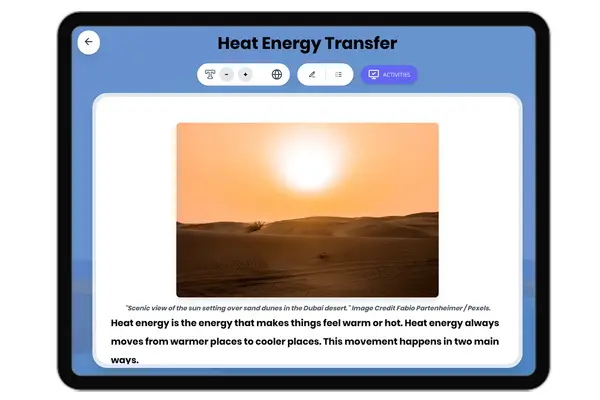
Heat Energy Transfer
This Grade 4 physical science reading passage explores heat energy transfer aligned to NGSS standard 4-PS3-2 and Discipl...
NGSS 4-PS3-2
Thermal Energy
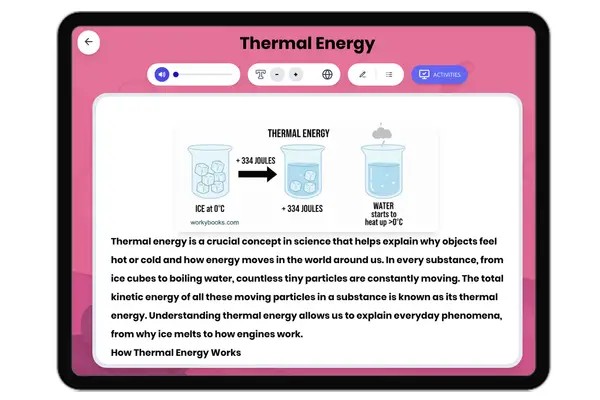
This comprehensive passage explores the concept of thermal energy, aligning with NGSS standards MS-PS3-3 and MS-PS3-4. S...
MS-PS3-3MS-PS3-4
Beach Day Science
This passage addresses NGSS K-PS3-1 by comparing temperature differences in materials exposed to sunlight versus shade. ...
K-PS3-1RL.1.1
How Circuits Convert Energy
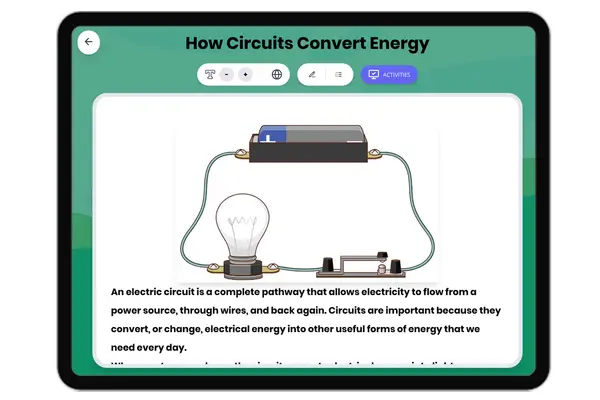
This 250-word reading passage introduces Grade 4 students to the concept of energy conversion in electric circuits, alig...
NGSS 4-PS3-2
Sound Energy
This engaging science passage, titled "What is Sound Energy?", is designed for 4th-grade students and aligns with the NG...
What Happens When Cars Collide
This 250-word reading passage introduces fourth-grade students to the concept of energy transfer and transformation duri...
NGSS 4-PS3-3
Energy Transformations
This engaging middle school science passage explores the concept of energy transformations, aligning with NGSS standards...
MS-PS3-1MS-PS3-2MS-PS3-5
Pool Table Physics
The Pool Table Physics reading passage is a highly engaging educational resource designed for fourth-grade science stude...
Energy Transfer
This NGSS-aligned science passage introduces middle school students to the concept of energy transfer, aligned to standa...
MS-PS3-5
Where Does Our Energy Come From
This 250-word reading passage aligns with NGSS standard ESS3.A and introduces fourth-grade students to the fundamental c...
NGSS 4-ESS3-1
The Future of Energy
This engaging science passage for grades 6-8, aligned with NGSS standards MS-PS3-4, MS-ESS3-3, and MS-ESS3-4, introduces...