Mercury: Closest to the Sun — Reading Comprehension
Rate this
Premium Resource
Present
Present in classroom. No work saved
Assign
Classroom with student accounts, Track progress
Quick Play
No student accounts, assign with a link
Grades
5
6
7
8
Standards
MS-ESS1-2
MS-ESS1-3
PRINT+DIGITAL RESOURCE
This learning resource is available in interactive and printable formats. The interactive worksheet can be played online and assigned to students. The Printable PDF version can be downloaded and printed for completion by hand.
This comprehensive, standards-aligned passage explores Mercury—the smallest and closest planet to the Sun. Students in grades 6-8 discover Mercury’s orbit, rotation, extreme temperature swings, and unique features such as the Caloris Basin and massive scarps. The text explains how Mercury’s weak exosphere and large iron core contribute to its characteristics, and highlights key scientific discoveries from spacecraft like Mariner 10 and MESSENGER. Students learn about cause-and-effect relationships, surface processes, and planetary systems, connecting these to NGSS standards MS-ESS1-2 and MS-ESS1-3. Audio integration supports diverse learners, while accompanying activities deepen comprehension and critical thinking. This resource is ideal for engaging middle school learners in planetary science and the mechanisms shaping our solar system.
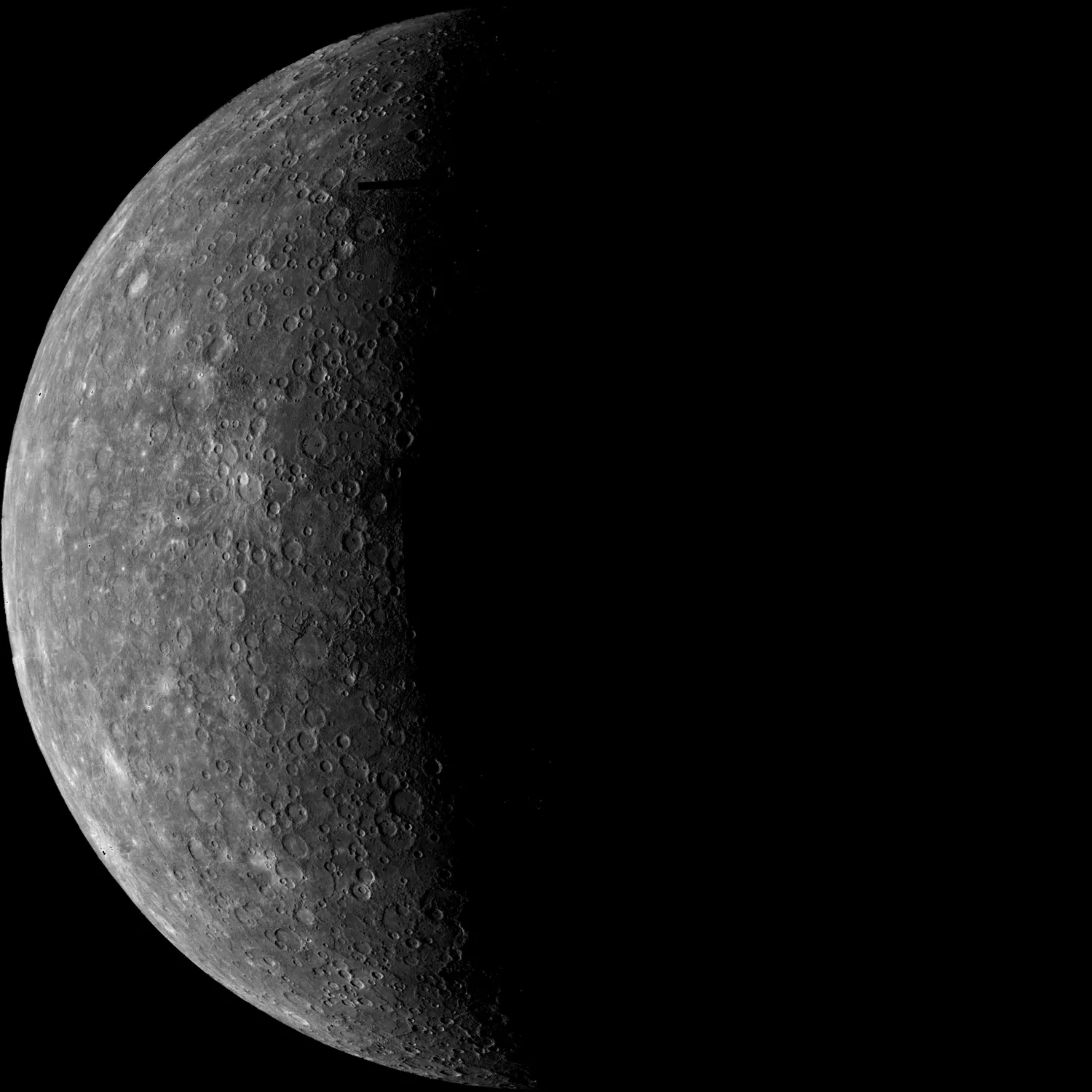
Mercury is the smallest planet in our solar system, with a diameter of only 4,880 kilometers—just slightly larger than Earth's Moon. As the planet closest to the Sun, Mercury is located about 0.4 astronomical units (AU) from our star. This proximity has major effects on Mercury’s environment, making it a fascinating example for scientists studying how planets form and change.
Speedy Orbit, Slow Rotation Mercury’s orbit is the fastest of all the planets, completing one trip around the Sun in only 88 Earth days. However, Mercury rotates slowly on its axis, taking about 59 Earth days to spin once. Because of a phenomenon called orbital resonance, Mercury rotates three times for every two orbits around the Sun. This means a single day, from sunrise to sunrise, lasts 176 Earth days! These unique movements create long, hot days and equally long, freezing nights.
Surface Features and Extreme Temperatures Mercury’s surface is heavily cratered, resembling the Moon because it lacks significant weather or erosion. The planet’s most striking feature is the Caloris Basin, a colossal impact crater stretching 1,550 kilometers across—nearly a third of Mercury’s diameter. Mercury also has gigantic scarps, or cliffs, which formed as the planet cooled and contracted over time. Without a thick atmosphere, Mercury cannot retain heat. Instead, it has a thin exosphere, made up of atoms knocked off the surface by the solar wind. As a result, temperatures swing dramatically, from 430°C (800°F) during the day to -180°C (-290°F) at night—the largest temperature range of any planet.
Internal Structure, Magnetic Field, and Exploration Mercury contains a massive iron core, which makes up about 60% of its mass and helps generate a weak magnetic field. Scientists have learned about Mercury’s structure and surface by observing it from Earth and sending spacecraft, such as Mariner 10 in the 1970s and MESSENGER from 2011 to 2015. These missions used cameras and instruments to map the surface, measure the magnetic field, and analyze the exosphere. Observing Mercury is challenging because it always appears close to the Sun from Earth, but astronomers look for it when it is at its greatest elongation—its farthest point from the Sun in our sky.
Mercury’s extreme conditions and surface features reveal much about the processes that shape rocky planets. By studying Mercury, scientists gain insight into planetary formation, internal structure, and the impact of solar energy on planetary bodies. Understanding Mercury helps us better grasp the complex systems at work in our own solar system and beyond.
Interesting Fact: On Mercury, a single day from sunrise to sunrise is twice as long as its year!
A huge impact crater on MercuryA type of cloud on MercuryA volcano on MercuryA moon of Mercury
Which best describes 'scarps' on Mercury?
Steep cliffs formed as the planet cooled and shrankRivers on Mercury's surfaceWinds that blow across MercuryCraters formed by asteroids
What is Mercury’s atmosphere like?
It has a very thin exosphere, almost no atmosphereIt has thick clouds and strong windsIt is full of water vaporIt is mostly nitrogen and oxygen
What does 'orbital resonance' mean in the passage?
Mercury rotates three times for every two orbits around the SunMercury and Venus move at the same speedMercury’s orbit changes direction each yearMercury always faces the Sun
Why does Mercury have such extreme temperature changes?
It has no thick atmosphere to hold in heatIt is covered with iceIt spins very quicklyIt is far from the Sun
How have scientists learned about Mercury’s surface and core?
By sending spacecraft and using telescopesBy visiting Mercury in personBy studying Mercury’s moonsBy measuring the air on Mercury
True or False: Mercury’s day is shorter than its year.
FalseTrue
True or False: Mercury is easy to see in the night sky.
FalseTrue
Perfect For:
👩🏫 Teachers
• Reading comprehension practice
• Auto-graded assessments
• Literacy skill development
👨👩👧👦 Parents
• Reading practice at home
• Comprehension improvement
• Educational reading time
🏠 Homeschoolers
• Reading curriculum support
• Independent reading practice
• Progress monitoring
Reading Features:
📖
Reading Passage
Engaging fiction or nonfiction text
❓
Comprehension Quiz
Auto-graded questions
📊
Instant Feedback
Immediate results and scoring
📄
Printable Version
Download for offline reading
🔊
Read Aloud
Voice-over with word highlighting
Reviews & Ratings
No reviews yet. Be the first to share your experience!
Related Content
Comets
This middle school science passage explores the fascinating world of comets, commonly known as 'dirty snowballs.' Studen...
MS-ESS1-2
Venus: Earth's Twin?
This comprehensive science passage for grades 6-8 examines Venus—often called Earth's twin—by exploring its similarities...
MS-ESS1-2MS-ESS1-3
Earth: Our Home Planet
This comprehensive science passage for grades 6-8 explores Earth’s unique characteristics and the interconnected systems...
MS-ESS1-2
Mars: The Red Planet
This middle school science passage explores Mars, the Red Planet, providing students in grades 6-8 with a comprehensive ...
MS-ESS1-2MS-ESS1-3
What Is Gravity?
This comprehensive middle school science reading passage explores the concept of gravity, aligning with NGSS standards M...
MS-ESS1-2MS-PS2-4
Kepler's Laws of Planetary Motion
This comprehensive middle school science passage explores Kepler's Laws of Planetary Motion, meeting NGSS Standard MS-ES...
MS-ESS1-2
Tides and Tidal Forces
This middle school science passage explores the mechanisms of tides and tidal forces, aligning with NGSS standards MS-ES...
MS-ESS1-1MS-ESS1-2
Escape Velocity and Space Travel
This middle school science passage introduces students to the concept of escape velocity—the minimum speed required to b...
MS-ESS1-2MS-PS2-4
Weightlessness and Microgravity
This science reading passage for middle school students explores the phenomenon of weightlessness and microgravity. Alig...
MS-PS2-4MS-ESS1-2
Orbits and Orbital Motion
This middle school science passage, aligned with NGSS MS-ESS1-2 and MS-PS2-4, explores the science of orbits and orbital...
MS-ESS1-2MS-PS2-4
What Is the Solar System?
This passage provides a comprehensive overview of the solar system for grades 6-8, aligned with NGSS standards MS-ESS1-2...
MS-ESS1-2MS-ESS1-3
Structure of the Solar System
This comprehensive science reading passage introduces middle school students (grades 6-8) to the structure of the solar ...
MS-ESS1-2MS-ESS1-3
Moons of the Solar System
This comprehensive passage, designed for grades 6-8 and aligned to NGSS standard MS-ESS1-2, delves into the fascinating ...
MS-ESS1-2
Defining Life: What Are We Looking For?
This informational science passage for middle school students explores the question: What is life, and how do we define ...
MS-LS1-1MS-ESS1-2
Astronomy
This comprehensive reading passage introduces middle school students to the science of astronomy, which is the study of ...
MS-ESS1-2MS-ESS1-3MS-PS4-2MS-ETS1-1
The Solar System
This middle school science passage introduces students to the solar system, aligning with NGSS standards MS-ESS1-2 and M...
MS-ESS1-2MS-ESS1-3
Gravity and Orbits
This comprehensive passage for grades 6-8 explains the science of gravity and orbits, aligning with NGSS standard MS-ESS...
MS-ESS1-2
The Inner Planets
This comprehensive science passage for grades 6-8 explores the inner (terrestrial) planets of our solar system—Mercury, ...
MS-ESS1-2MS-ESS1-3
The Outer Planets
This engaging science passage for grades 6-8 introduces students to the outer planets—Jupiter, Saturn, Uranus, and Neptu...