This learning resource is available in interactive and printable formats. The interactive worksheet can be played online and assigned to students. The Printable PDF version can be downloaded and printed for completion by hand.
This middle school science passage, aligned with NGSS standard MS-ESS1-3, examines the scientific and technological challenges of communicating with alien life. Students will learn about the vast distances separating stars, the time it takes for messages to travel across space, and real-world efforts like the Arecibo message and Voyager Golden Records. The passage explains why mathematical concepts and prime numbers might be used for universal communication, explores the debate over whether humanity should intentionally announce itself to unknown civilizations, and discusses what alien life forms might be like from an evolutionary perspective. Activities include a glossary, reading comprehension quiz, writing prompts, and graphic organizers to deepen understanding. Designed for grades 6-8, this resource also includes Spanish translations and audio integration, supporting diverse learners and enhancing science literacy. Key concepts include the systems and interactions involved in interstellar communication and the profound impact that discovering even microbial extraterrestrial life could have on our understanding of the universe.
CONTENT PREVIEW
Expand content preview
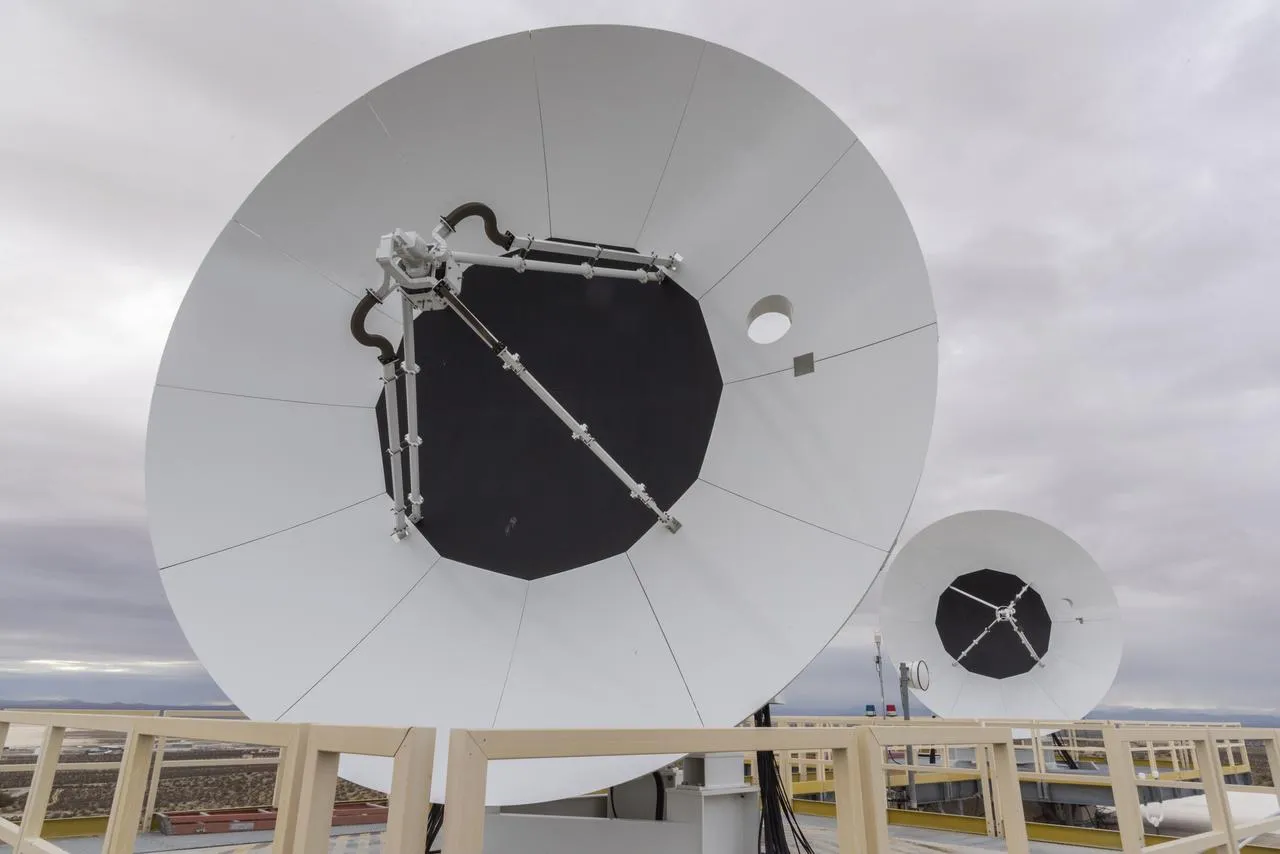
DATR Supports Space Communication / NASA (Public domain).
Extraterrestrial communication is a scientific challenge that involves sending and receiving messages across vast distances in space. The question of whether we could ever talk to intelligent alien life is important because it addresses our place in the universe and the limits of technology. The nearest stars, such as Proxima Centauri, are over four light-years away, which means even a simple exchange would take decades. Scientists have already attempted to contact potential alien civilizations and are still debating if we should continue these efforts.
Distance and Time: The Challenge of Space Communication Space is incredibly vast. A light-year is the distance light travels in one year—about 9.46 trillion kilometers. Proxima Centauri, the closest star system to Earth, is 4.2 light-years away. This means any message sent from Earth would take 4.2 years to arrive, and a reply would take another 4.2 years. Communicating with even the nearest alien civilization would be extremely slow. For example, the famous Arecibo message was sent in 1974 toward a star cluster 25,000 light-years away. The Voyager spacecraft, launched in the 1970s, carry Golden Records containing sounds and images from Earth, but they are not directed at any specific star and will take thousands of years to reach another system.
What Messages Should We Send? Because we do not know what alien life is like, scientists focus on sending universal concepts such as mathematics. Prime numbers—numbers that can only be divided by 1 and themselves, like 2, 3, 5, 7, and 11—are often used because they show an understanding of mathematics and intelligence. The Arecibo message used a pattern of 1,679 bits (a product of two prime numbers) to demonstrate this. Pictures and music are also sent in hopes that images and sounds might be interpreted by other intelligent beings. However, there is a controversy called Active SETI (or METI): some scientists warn that announcing ourselves could be dangerous if unknown civilizations are hostile. Others argue that the potential for knowledge outweighs the risks.
What Would Aliens Be Like? Scientists think it is unlikely that aliens would look like humans. Evolution on another planet would probably lead to life forms very different from us, possibly even microbial or beyond our current understanding. The discovery of even simple life, such as bacteria, would be transformative for science, showing that life can arise in many places. The existence of intelligent aliens would have even greater impact, potentially changing our view of ourselves and our place in the universe. The search for extraterrestrial intelligence connects to the scientific principle that systems interact and evolve in response to their environments.
In summary, communicating with aliens involves overcoming huge distances and making careful choices about what to send. It raises scientific, ethical, and philosophical questions about contact with other life forms. Whether or not we ever receive a reply, the search for extraterrestrial communication continues to drive scientific discovery.
Interesting Fact: The Voyager Golden Records include greetings in 55 languages, music from around the world, and even the sounds of a heartbeat and a whale song.
How far away is Proxima Centauri from Earth?
4.2 light-years25,000 light-years93 million miles1 light-year
What was the Arecibo message?
A radio message sent to a star cluster in 1974A spacecraft sent to Proxima CentauriA signal from aliensA type of telescope on Earth
What are Golden Records?
Records on Voyager spacecraft with Earth's sounds and imagesBooks about aliensA radio signal sent by AreciboA kind of telescope
What does 'extraterrestrial' mean in the passage?
From outside the planet EarthA kind of telescopeA type of mathOnly existing on Earth
In the passage, what does 'universal' mean?
Something true or accepted everywhereSomething found only on EarthA kind of radio signalA star system
Why do scientists use prime numbers in messages to aliens?
To show understanding of mathematics and intelligenceBecause they are easy to sayBecause aliens use the same languageBecause they are pictures
Why is there a debate about Active SETI or METI?
Some think it might be risky to contact unknown civilizationsIt is too expensive to send messagesAliens do not existMessages travel too fast
If a message is sent to Proxima Centauri, how long would it take to get a reply?
About 8.4 yearsAbout 1 yearLess than one dayAbout 4.2 years
True or False: The Voyager Golden Records are directed to a specific planet.
TrueFalse
True or False: Scientists expect that aliens will look just like humans.
TrueFalse
Perfect For:
👩🏫 Teachers
• Reading comprehension practice
• Auto-graded assessments
• Literacy skill development
👨👩👧👦 Parents
• Reading practice at home
• Comprehension improvement
• Educational reading time
🏠 Homeschoolers
• Reading curriculum support
• Independent reading practice
• Progress monitoring
Reading Features:
📖
Reading Passage
Engaging fiction or nonfiction text
❓
Comprehension Quiz
Auto-graded questions
📊
Instant Feedback
Immediate results and scoring
📄
Printable Version
Download for offline reading
🔊
Read Aloud
Voice-over with word highlighting
Reviews & Ratings
No reviews yet. Be the first to share your experience!
Related Content
Sunspots and Solar Flares
This quiz is designed to test your understanding of the fascinating phenomena of sunspots and solar flares, as described...
RI.4.1RI.4.4RI.5.1ESS1.A
The Hottest Planet in the Solar System
This NGSS-aligned middle school reading passage explains why Venus is the hottest planet in our solar system. Students l...
MS-ESS1-3
Mercury: Closest to the Sun
This comprehensive, standards-aligned passage explores Mercury—the smallest and closest planet to the Sun. Students in g...
MS-ESS1-2MS-ESS1-3
Venus: Earth's Twin?
This comprehensive science passage for grades 6-8 examines Venus—often called Earth's twin—by exploring its similarities...
MS-ESS1-2MS-ESS1-3
Mars: The Red Planet
This middle school science passage explores Mars, the Red Planet, providing students in grades 6-8 with a comprehensive ...
MS-ESS1-2MS-ESS1-3
What Is the Solar System?
This passage provides a comprehensive overview of the solar system for grades 6-8, aligned with NGSS standards MS-ESS1-2...
MS-ESS1-2MS-ESS1-3
Structure of the Solar System
This comprehensive science reading passage introduces middle school students (grades 6-8) to the structure of the solar ...
MS-ESS1-2MS-ESS1-3
Scale of the Solar System
This passage, aligned to NGSS standard MS-ESS1-3, helps middle school students grasp the immense scale of the solar syst...
MS-ESS1-3
Exploration of the Solar System
This comprehensive passage for grades 6-8 examines how humans explore the solar system, aligning with NGSS standards MS-...
MS-ESS1-3MS-ETS1-1
Optical Telescopes
This comprehensive passage explores the science of optical telescopes for middle school students, aligning with NGSS sta...
MS-ESS1-3MS-ETS1-1
Future of Alien Search
This informational passage for grades 6-8 explores how scientists are using cutting-edge missions and technology to sear...
MS-ESS1-3MS-ETS1-1
Measuring Distances in Space
This middle school science passage explores how astronomers measure the vast distances in space, aligning with NGSS stan...
MS-ESS1-3
Astronomy
This comprehensive reading passage introduces middle school students to the science of astronomy, which is the study of ...
MS-ESS1-2MS-ESS1-3MS-PS4-2MS-ETS1-1
The Solar System
This middle school science passage introduces students to the solar system, aligning with NGSS standards MS-ESS1-2 and M...
MS-ESS1-2MS-ESS1-3
The Inner Planets
This comprehensive science passage for grades 6-8 explores the inner (terrestrial) planets of our solar system—Mercury, ...
MS-ESS1-2MS-ESS1-3
The Outer Planets
This engaging science passage for grades 6-8 introduces students to the outer planets—Jupiter, Saturn, Uranus, and Neptu...
MS-ESS1-2MS-ESS1-3
Light-Years and Cosmic Distances
This middle school science passage, aligned to NGSS MS-ESS1-3, explores how astronomers measure the vast distances in sp...
MS-ESS1-3
Space Stations
This informational science reading passage for grades 6-8 explores the complex systems and technology behind space stati...
MS-ESS1-3MS-ETS1-1
Types of Spacecraft
This passage introduces middle school students to the various types of spacecraft used to explore our solar system and b...