Structure of the Solar System — Reading Comprehension
Rate this
Premium Resource
Present
Present in classroom. No work saved
Assign
Classroom with student accounts, Track progress
Quick Play
No student accounts, assign with a link
Grades
5
6
7
8
Standards
MS-ESS1-2
MS-ESS1-3
PRINT+DIGITAL RESOURCE
This learning resource is available in interactive and printable formats. The interactive worksheet can be played online and assigned to students. The Printable PDF version can be downloaded and printed for completion by hand.
This comprehensive science reading passage introduces middle school students (grades 6-8) to the structure of the solar system, aligning with NGSS standards MS-ESS1-2 and MS-ESS1-3. The passage explores the organization of the solar system, including inner and outer planets, the asteroid belt, Kuiper Belt, and Oort Cloud, explaining the mechanisms and scientific reasoning behind their arrangement. It integrates key vocabulary, graphic organizers, and activities to foster understanding of complex systems and cause-and-effect relationships. The resource provides both standard and differentiated Lexile-level passages, as well as Spanish translations for accessibility. Activities include a quiz, writing prompts, and graphic organizers designed to deepen comprehension. Audio integration supports diverse learners. This resource is ideal for teachers seeking NGSS-aligned, interactive science content that explains not just what is in the solar system, but how and why it is organized as it is.
CONTENT PREVIEW
Expand content preview
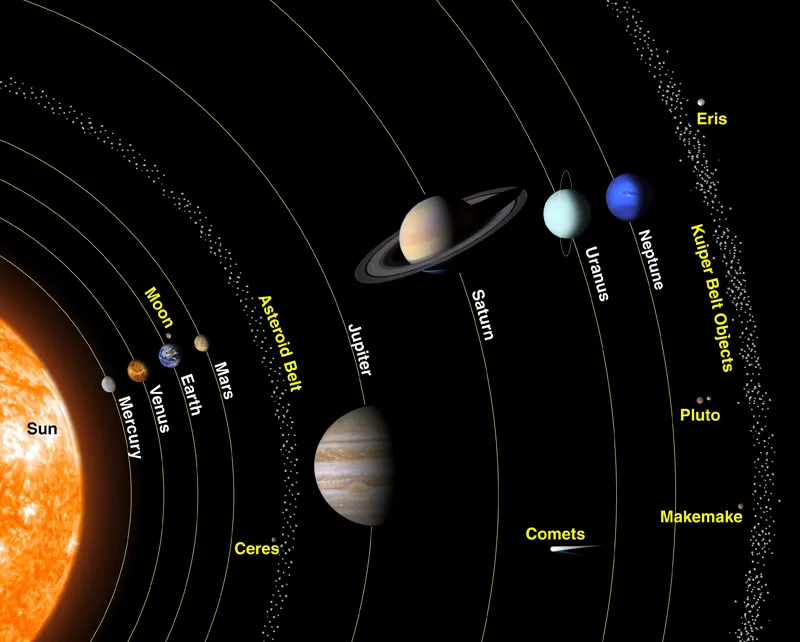
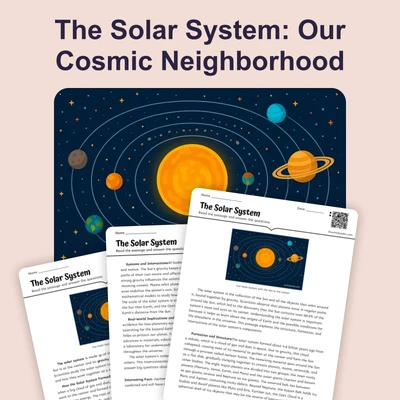
"Solar System graphic by NASA" by NASA / Source: Wikimedia Commons (Public domain).
The solar system is a complex system that includes the Sun, planets, and many smaller objects. Observations with telescopes and space probes have revealed that the solar system is organized into regions with different characteristics. Understanding its structure helps scientists explain why planets and other objects are found where they are, and how they interact as a system.
Regions of the Solar System
At the center of the solar system lies the Sun, a massive ball of hot gas that provides energy to all its parts. Closest to the Sun are the inner planets: Mercury, Venus, Earth, and Mars. These are called terrestrial planets because they have solid, rocky surfaces, are relatively small and dense, and have few moons. Next comes the asteroid belt, a region between Mars and Jupiter filled with millions of rocky objects. The asteroid belt acts as a boundary between the inner solar system and the outer planets (Jupiter, Saturn, Uranus, Neptune). These outer planets are much larger, made mostly of gas or ice, have many moons, and possess ring systems.
Beyond the Main Planets
After Neptune, the Kuiper Belt extends outward, containing icy bodies such as dwarf planets like Pluto, Eris, and Makemake. Farther still, the scattered disk and the distant Oort Cloud form the outermost regions. The Oort Cloud is a vast, spherical shell of icy objects that may stretch from about 1,000 to 100,000 times the distance between Earth and the Sun (astronomical units, or AU). These distant regions are thought to be sources of comets that travel into the inner solar system.
Explaining the Structure
Scientists believe that temperature and distance from the Sun determined how the solar system formed its regions. The frost line—about 5 AU from the Sun—marks where temperatures were cold enough for water ice to form in the early solar system. Inside the frost line, only rocky materials could solidify, leading to the formation of the terrestrial planets. Beyond the frost line, planets could accumulate ice and gas, forming the giant planets. The arrangement of objects also shows orbital resonances, where the orbits of some bodies, like Neptune and Pluto, are synchronized in simple ratios. These relationships help keep the system stable over billions of years.
The structure of the solar system reveals how physical processes, such as gravity, temperature, and collisions, shape planetary systems. Studying these patterns helps scientists predict where to find planets around other stars and understand the history of our own solar system.
Interesting Fact: The Oort Cloud is so distant that no spacecraft has ever reached it, and it may contain trillions of icy objects!
What separates the inner planets from the outer planets?
The Kuiper BeltThe asteroid beltThe Oort CloudThe frost line
What is the main difference between the inner and outer planets?
Inner planets are rocky and small; outer planets are large and made mostly of gas or ice.Inner planets have rings; outer planets do not.Outer planets are closer to the Sun.Inner planets have more moons than outer planets.
What is the Kuiper Belt?
A region between Mars and Jupiter filled with rocky objectsA region beyond Neptune containing icy bodies and dwarf planetsA ring system around SaturnA large moon of Jupiter
What does the term 'frost line' refer to in the passage?
The boundary where water ice could form in the early solar systemThe edge of the Oort CloudThe location of the asteroid beltThe coldest planet in the solar system
How does the frost line help explain the difference between inner and outer planets?
Inside the frost line, planets formed from rock; beyond it, planets could gather ice and gas.It marks where the asteroid belt formed.It separates the Kuiper Belt from the Oort Cloud.It created the Sun’s energy.
Why are orbital resonances important in the solar system?
They help keep the system stable over long periods.They cause planets to collide.They produce energy for the Sun.They create the asteroid belt.
True or False: The Oort Cloud is a region between Mars and Jupiter.
TrueFalse
True or False: Scientists use the structure of the solar system to predict where to find planets around other stars.
TrueFalse
Perfect For:
👩🏫 Teachers
• Reading comprehension practice
• Auto-graded assessments
• Literacy skill development
👨👩👧👦 Parents
• Reading practice at home
• Comprehension improvement
• Educational reading time
🏠 Homeschoolers
• Reading curriculum support
• Independent reading practice
• Progress monitoring
Reading Features:
📖
Reading Passage
Engaging fiction or nonfiction text
❓
Comprehension Quiz
Auto-graded questions
📊
Instant Feedback
Immediate results and scoring
📄
Printable Version
Download for offline reading
🔊
Read Aloud
Voice-over with word highlighting
Reviews & Ratings
No reviews yet. Be the first to share your experience!
Related Content
Sunspots and Solar Flares
This quiz is designed to test your understanding of the fascinating phenomena of sunspots and solar flares, as described...
RI.4.1RI.4.4RI.5.1ESS1.A
The Hottest Planet in the Solar System
This NGSS-aligned middle school reading passage explains why Venus is the hottest planet in our solar system. Students l...
MS-ESS1-3
Comets
This middle school science passage explores the fascinating world of comets, commonly known as 'dirty snowballs.' Studen...
MS-ESS1-2
Mercury: Closest to the Sun
This comprehensive, standards-aligned passage explores Mercury—the smallest and closest planet to the Sun. Students in g...
MS-ESS1-2MS-ESS1-3
Venus: Earth's Twin?
This comprehensive science passage for grades 6-8 examines Venus—often called Earth's twin—by exploring its similarities...
MS-ESS1-2MS-ESS1-3
Earth: Our Home Planet
This comprehensive science passage for grades 6-8 explores Earth’s unique characteristics and the interconnected systems...
MS-ESS1-2
Mars: The Red Planet
This middle school science passage explores Mars, the Red Planet, providing students in grades 6-8 with a comprehensive ...
MS-ESS1-2MS-ESS1-3
What Is Gravity?
This comprehensive middle school science reading passage explores the concept of gravity, aligning with NGSS standards M...
MS-ESS1-2MS-PS2-4
Kepler's Laws of Planetary Motion
This comprehensive middle school science passage explores Kepler's Laws of Planetary Motion, meeting NGSS Standard MS-ES...
MS-ESS1-2
Tides and Tidal Forces
This middle school science passage explores the mechanisms of tides and tidal forces, aligning with NGSS standards MS-ES...
MS-ESS1-1MS-ESS1-2
Escape Velocity and Space Travel
This middle school science passage introduces students to the concept of escape velocity—the minimum speed required to b...
MS-ESS1-2MS-PS2-4
Weightlessness and Microgravity
This science reading passage for middle school students explores the phenomenon of weightlessness and microgravity. Alig...
MS-PS2-4MS-ESS1-2
Orbits and Orbital Motion
This middle school science passage, aligned with NGSS MS-ESS1-2 and MS-PS2-4, explores the science of orbits and orbital...
MS-ESS1-2MS-PS2-4
What Is the Solar System?
This passage provides a comprehensive overview of the solar system for grades 6-8, aligned with NGSS standards MS-ESS1-2...
MS-ESS1-2MS-ESS1-3
Moons of the Solar System
This comprehensive passage, designed for grades 6-8 and aligned to NGSS standard MS-ESS1-2, delves into the fascinating ...
MS-ESS1-2
Scale of the Solar System
This passage, aligned to NGSS standard MS-ESS1-3, helps middle school students grasp the immense scale of the solar syst...
MS-ESS1-3
Exploration of the Solar System
This comprehensive passage for grades 6-8 examines how humans explore the solar system, aligning with NGSS standards MS-...
MS-ESS1-3MS-ETS1-1
Optical Telescopes
This comprehensive passage explores the science of optical telescopes for middle school students, aligning with NGSS sta...
MS-ESS1-3MS-ETS1-1
Future of Alien Search
This informational passage for grades 6-8 explores how scientists are using cutting-edge missions and technology to sear...