This learning resource is available in interactive and printable formats. The interactive worksheet can be played online and assigned to students. The Printable PDF version can be downloaded and printed for completion by hand.
This middle school science passage explores Mars, the Red Planet, providing students in grades 6-8 with a comprehensive overview of its physical characteristics, atmosphere, surface features, evidence of water, and exploration history. Aligned to NGSS standards MS-ESS1-2 and MS-ESS1-3, the passage uses accessible academic vocabulary and includes a glossary, differentiated reading levels, Spanish translations, and multiple interactive activities such as quizzes, writing prompts, and graphic organizers. The content emphasizes scientific thinking, cause-and-effect relationships, and real-world applications, making it highly engaging and educational. Audio integration ensures accessibility for diverse learners. Key topics include Mars’ diameter, mass, orbit, seasons, volcanoes like Olympus Mons, canyons like Valles Marineris, atmospheric composition, temperature extremes, the search for water and life, and plans for human missions. This resource is ideal for classroom instruction, independent study, or science enrichment.
CONTENT PREVIEW
Expand content preview
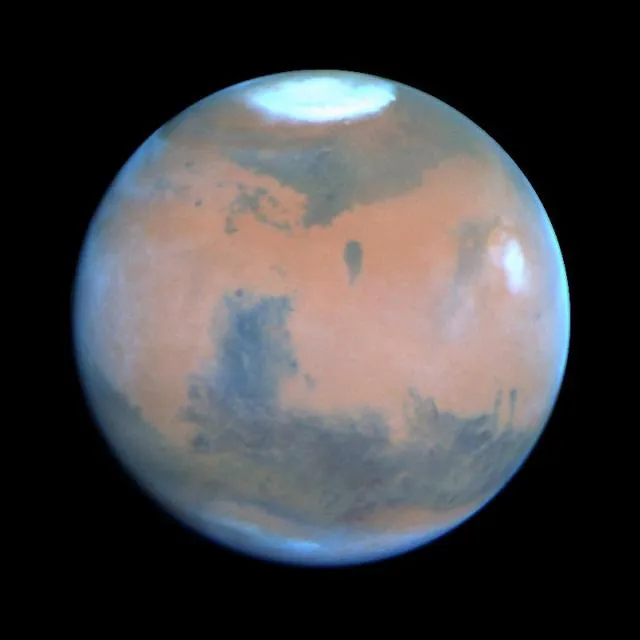
"Springtime on Mars: Hubble Best View of the Red Planet" / NASA (Public domain).
Mars is the fourth planet from the Sun and is known as the Red Planet because of its reddish appearance in the night sky. This color comes from iron oxide, or rust, that covers the planet’s surface. Mars is the most studied planet after Earth, and scientists focus on it to learn about planetary systems and the possibility of life beyond Earth. Understanding Mars helps us answer important questions about the history of our solar system.
Unique Features and Surface With a diameter of about 6,779 kilometers (0.53 times Earth’s), Mars is much smaller than our planet. Its mass is only 11% of Earth’s. Mars is famous for its dramatic surface features. The planet’s surface is dry and cold, with expansive deserts, enormous volcanoes, and deep canyons. Olympus Mons is the largest volcano in the solar system, standing 22 kilometers high and spanning 600 kilometers wide. Valles Marineris is a canyon system that stretches over 4,000 kilometers and is up to 7 kilometers deep. Mars also has polar ice caps made of frozen water and carbon dioxide, which expand and shrink with the seasons.
Orbit, Rotation, and Atmosphere Mars orbits the Sun at a distance of about 1.5 astronomical units (AU), taking 687 Earth days to complete one orbit, nearly twice as long as an Earth year. Its rotation period is about 24.6 hours, very close to Earth’s day. Mars has a similar tilt (25°) to Earth, which creates seasons. However, its thin atmosphere—with only 1% of Earth’s pressure and made up of 95% carbon dioxide—cannot trap heat well. As a result, Mars is very cold, with average temperatures around -60°C, ranging from -125°C at the poles in winter to 20°C at the equator in summer. The atmosphere is too thin for liquid water to exist on the surface today, but there is water ice at the poles and evidence of past rivers and lakes.
Evidence of Water and Exploration Scientists study Mars to find out if it ever supported life. Images from orbiters and data from rovers show dry riverbeds, lake beds, and minerals that form in water, suggesting that Mars once had liquid water on its surface. Some researchers believe there may still be liquid water underground. Mars has two small, irregularly shaped moons, Phobos and Deimos, which may be captured asteroids. Over the past few decades, several robotic rovers—including Sojourner, Spirit, Opportunity, Curiosity, and Perseverance—have landed on Mars to study its surface, climate, and geology. These missions help us learn how planets change over time and whether Mars could have supported life. In the future, humans may travel to Mars, with missions possible in the 2030s or 2040s.
By studying Mars, scientists gain insight into planetary evolution, climate systems, and the conditions needed for life. Mars continues to inspire exploration and scientific discovery that can help us understand our own planet’s past and future.
Interesting Fact: Olympus Mons on Mars is so large that it would cover the entire state of Arizona and is nearly three times as tall as Mount Everest!
What gives Mars its red color?
Iron oxide (rust) on its surfaceIts thin atmosphereVolcano eruptionsRed clouds in the sky
How long does it take Mars to complete one orbit around the Sun?
365 Earth days687 Earth days24.6 hours1 Earth year
What is the largest volcano in the solar system called?
Mount EverestOlympus MonsValles MarinerisPhobos
What does the term 'atmosphere' mean in the passage?
A layer of water on a planetThe outer shell of a volcanoThe layer of gases surrounding a planetA type of moon around Mars
What does 'astronomical unit' mean?
A measure of timeA distance equal to Earth's distance from the SunA type of volcanoA layer of Mars' surface
Why do scientists think Mars once had liquid water on its surface?
Because Mars has two moonsBecause Mars is close to the SunBecause of dry riverbeds and certain minerals foundBecause of its thin atmosphere
How does Mars' atmosphere compare to Earth's?
It is much thicker and mostly oxygenIt is about the same as Earth'sIt is much thinner and mostly carbon dioxideIt is made of water vapor
If a new rover discovered liquid water underground on Mars, what would scientists likely do next?
Send more missions to study the water and search for lifeIgnore the discoveryRemove all robots from MarsChange Mars' orbit
Mars has two small, irregularly shaped moons. (True/False)
TrueFalse
The average temperature on Mars is about 20°C. (True/False)
TrueFalse
Perfect For:
👩🏫 Teachers
• Reading comprehension practice
• Auto-graded assessments
• Literacy skill development
👨👩👧👦 Parents
• Reading practice at home
• Comprehension improvement
• Educational reading time
🏠 Homeschoolers
• Reading curriculum support
• Independent reading practice
• Progress monitoring
Reading Features:
📖
Reading Passage
Engaging fiction or nonfiction text
❓
Comprehension Quiz
Auto-graded questions
📊
Instant Feedback
Immediate results and scoring
📄
Printable Version
Download for offline reading
🔊
Read Aloud
Voice-over with word highlighting
Reviews & Ratings
No reviews yet. Be the first to share your experience!
Related Content
Comets
This middle school science passage explores the fascinating world of comets, commonly known as 'dirty snowballs.' Studen...
MS-ESS1-2
Mercury: Closest to the Sun
This comprehensive, standards-aligned passage explores Mercury—the smallest and closest planet to the Sun. Students in g...
MS-ESS1-2MS-ESS1-3
Venus: Earth's Twin?
This comprehensive science passage for grades 6-8 examines Venus—often called Earth's twin—by exploring its similarities...
MS-ESS1-2MS-ESS1-3
Earth: Our Home Planet
This comprehensive science passage for grades 6-8 explores Earth’s unique characteristics and the interconnected systems...
MS-ESS1-2
What Is Gravity?
This comprehensive middle school science reading passage explores the concept of gravity, aligning with NGSS standards M...
MS-ESS1-2MS-PS2-4
Kepler's Laws of Planetary Motion
This comprehensive middle school science passage explores Kepler's Laws of Planetary Motion, meeting NGSS Standard MS-ES...
MS-ESS1-2
Tides and Tidal Forces
This middle school science passage explores the mechanisms of tides and tidal forces, aligning with NGSS standards MS-ES...
MS-ESS1-1MS-ESS1-2
Escape Velocity and Space Travel
This middle school science passage introduces students to the concept of escape velocity—the minimum speed required to b...
MS-ESS1-2MS-PS2-4
Weightlessness and Microgravity
This science reading passage for middle school students explores the phenomenon of weightlessness and microgravity. Alig...
MS-PS2-4MS-ESS1-2
Orbits and Orbital Motion
This middle school science passage, aligned with NGSS MS-ESS1-2 and MS-PS2-4, explores the science of orbits and orbital...
MS-ESS1-2MS-PS2-4
What Is the Solar System?
This passage provides a comprehensive overview of the solar system for grades 6-8, aligned with NGSS standards MS-ESS1-2...
MS-ESS1-2MS-ESS1-3
Structure of the Solar System
This comprehensive science reading passage introduces middle school students (grades 6-8) to the structure of the solar ...
MS-ESS1-2MS-ESS1-3
Moons of the Solar System
This comprehensive passage, designed for grades 6-8 and aligned to NGSS standard MS-ESS1-2, delves into the fascinating ...
MS-ESS1-2
Defining Life: What Are We Looking For?
This informational science passage for middle school students explores the question: What is life, and how do we define ...
MS-LS1-1MS-ESS1-2
Astronomy
This comprehensive reading passage introduces middle school students to the science of astronomy, which is the study of ...
MS-ESS1-2MS-ESS1-3MS-PS4-2MS-ETS1-1
The Solar System
This middle school science passage introduces students to the solar system, aligning with NGSS standards MS-ESS1-2 and M...
MS-ESS1-2MS-ESS1-3
Gravity and Orbits
This comprehensive passage for grades 6-8 explains the science of gravity and orbits, aligning with NGSS standard MS-ESS...
MS-ESS1-2
The Inner Planets
This comprehensive science passage for grades 6-8 explores the inner (terrestrial) planets of our solar system—Mercury, ...
MS-ESS1-2MS-ESS1-3
The Outer Planets
This engaging science passage for grades 6-8 introduces students to the outer planets—Jupiter, Saturn, Uranus, and Neptu...