This learning resource is available in interactive and printable formats. The interactive worksheet can be played online and assigned to students. The Printable PDF version can be downloaded and printed for completion by hand.
This passage provides a comprehensive overview of the solar system for grades 6-8, aligned with NGSS standards MS-ESS1-2 and MS-ESS1-3. Students will discover the structure of our planetary system, including the Sun, planets, moons, asteroids, comets, and distant regions like the Kuiper Belt and Oort Cloud. The passage explains how gravity holds the system together, how the Sun's magnetic influence creates the heliosphere, and the process of planetary formation from a disk of dust and gas. Real-world implications and scientific thinking are integrated, with vocabulary support, differentiated text, and engaging activities. The reading is suitable for audio integration and provides relevant keywords for educators. Activities include multiple-choice and writing prompts, plus two graphic organizers for deepening understanding.
CONTENT PREVIEW
Expand content preview
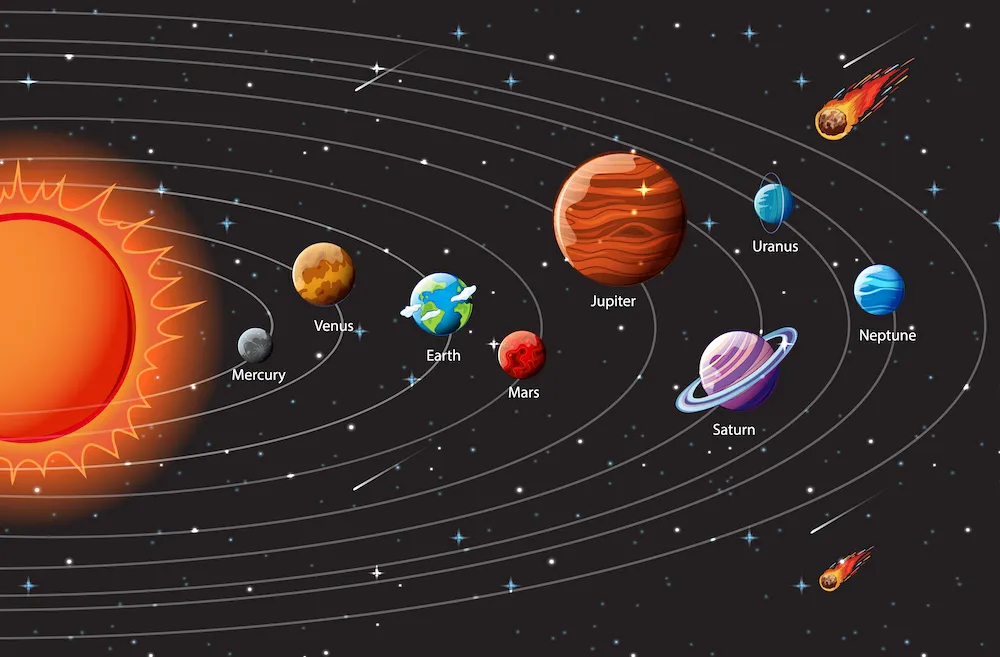
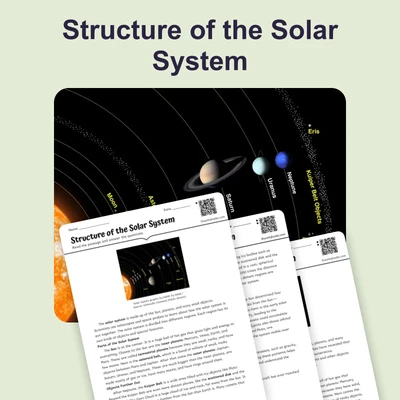
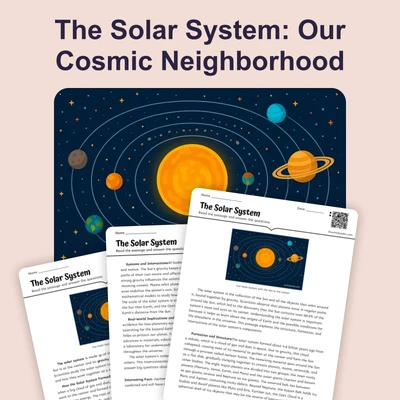
The solar system is the group of objects, including the Sun and everything that orbits it, bound together by gravity. Our solar system includes the Sun, eight planets, more than 200 moons, millions of asteroids, trillions of comets, several dwarf planets, and clouds of dust and gas. The importance of the solar system lies in how it connects all these objects into a single, dynamic system that shapes our cosmic neighborhood.
How the Solar System Works
At the center of the solar system is the Sun, which makes up about 99.86% of all the mass in the system. The Sun's strong gravity holds the planets and other objects in orbit. All eight planets—Mercury, Venus, Earth, Mars, Jupiter, Saturn, Uranus, and Neptune—move around the Sun in the same direction and nearly the same flat plane, called the ecliptic. The asteroid belt, located between Mars and Jupiter, contains millions of rocky bodies. Beyond Neptune lies the Kuiper Belt, home to icy objects like Pluto. Even farther is the Oort Cloud, a vast region filled with comets, which stretches halfway to the nearest star.
Structure, Boundaries, and Interactions
The solar system is divided into several regions. The four inner planets are rocky and small, while the four outer planets are much larger and made mostly of gas and ice. The Sun's magnetic field creates a bubble called the heliosphere, which protects the system from harmful cosmic rays. The heliopause marks the edge of this bubble, where the Sun's influence ends and interstellar space begins. All these regions interact through gravity and energy flows. For example, comets from the Oort Cloud sometimes enter the inner solar system, influenced by gravitational changes.
Origins and Broader Context
Scientists have learned about the solar system through telescopes, robotic spacecraft, and mathematical models. Evidence shows that our solar system formed about 4.6 billion years ago from a rotating disk of gas and dust. As the disk spun, gravity pulled materials together to form the Sun and planets. Today, our solar system is just one of billions in the Milky Way galaxy. Understanding its structure helps us learn about planet formation, the possibility of life elsewhere, and Earth's place in the universe.
In summary, the solar system is a complex and interconnected system shaped by gravity, motion, and the Sun's energy. Its study reveals important scientific principles and inspires exploration far beyond our planet.
Interesting Fact: The Oort Cloud, the solar system's farthest region, may contain up to two trillion icy objects and marks the true outer edge of our planetary system.
What is at the center of the solar system?
The SunEarthThe Kuiper BeltThe Oort Cloud
Which region of the solar system contains icy objects like Pluto?
Asteroid BeltOort CloudKuiper BeltHeliosphere
How many planets are there in the solar system?
SevenEightNineTen
What does the term 'heliosphere' mean in the passage?
A region filled with asteroidsThe bubble created by the Sun's magnetic fieldThe orbit of NeptuneA type of comet
In the passage, what is the ecliptic?
A region of the Oort CloudA flat plane where most planets orbitThe direction the Sun spinsA region between stars
Why do all planets orbit the Sun?
Because of the Sun's gravityBecause of the Oort CloudBecause of the asteroid beltBecause of comets
What causes comets from the Oort Cloud to enter the inner solar system?
Extreme heat from the SunGravitational changesThe Kuiper BeltThe heliosphere
The solar system includes only the Sun and the eight planets. True or False?
TrueFalse
The Milky Way galaxy contains billions of planetary systems like ours. True or False?
TrueFalse
Which of the following is NOT part of the solar system according to the passage?
AsteroidsCometsBlack holesDwarf planets
Perfect For:
👩🏫 Teachers
• Reading comprehension practice
• Auto-graded assessments
• Literacy skill development
👨👩👧👦 Parents
• Reading practice at home
• Comprehension improvement
• Educational reading time
🏠 Homeschoolers
• Reading curriculum support
• Independent reading practice
• Progress monitoring
Reading Features:
📖
Reading Passage
Engaging fiction or nonfiction text
❓
Comprehension Quiz
Auto-graded questions
📊
Instant Feedback
Immediate results and scoring
📄
Printable Version
Download for offline reading
🔊
Read Aloud
Voice-over with word highlighting
Reviews & Ratings
No reviews yet. Be the first to share your experience!
Related Content
Sunspots and Solar Flares
This quiz is designed to test your understanding of the fascinating phenomena of sunspots and solar flares, as described...
RI.4.1RI.4.4RI.5.1ESS1.A
The Hottest Planet in the Solar System
This NGSS-aligned middle school reading passage explains why Venus is the hottest planet in our solar system. Students l...
MS-ESS1-3
Comets
This middle school science passage explores the fascinating world of comets, commonly known as 'dirty snowballs.' Studen...
MS-ESS1-2
Mercury: Closest to the Sun
This comprehensive, standards-aligned passage explores Mercury—the smallest and closest planet to the Sun. Students in g...
MS-ESS1-2MS-ESS1-3
Venus: Earth's Twin?
This comprehensive science passage for grades 6-8 examines Venus—often called Earth's twin—by exploring its similarities...
MS-ESS1-2MS-ESS1-3
Earth: Our Home Planet
This comprehensive science passage for grades 6-8 explores Earth’s unique characteristics and the interconnected systems...
MS-ESS1-2
Mars: The Red Planet
This middle school science passage explores Mars, the Red Planet, providing students in grades 6-8 with a comprehensive ...
MS-ESS1-2MS-ESS1-3
What Is Gravity?
This comprehensive middle school science reading passage explores the concept of gravity, aligning with NGSS standards M...
MS-ESS1-2MS-PS2-4
Kepler's Laws of Planetary Motion
This comprehensive middle school science passage explores Kepler's Laws of Planetary Motion, meeting NGSS Standard MS-ES...
MS-ESS1-2
Tides and Tidal Forces
This middle school science passage explores the mechanisms of tides and tidal forces, aligning with NGSS standards MS-ES...
MS-ESS1-1MS-ESS1-2
Escape Velocity and Space Travel
This middle school science passage introduces students to the concept of escape velocity—the minimum speed required to b...
MS-ESS1-2MS-PS2-4
Weightlessness and Microgravity
This science reading passage for middle school students explores the phenomenon of weightlessness and microgravity. Alig...
MS-PS2-4MS-ESS1-2
Orbits and Orbital Motion
This middle school science passage, aligned with NGSS MS-ESS1-2 and MS-PS2-4, explores the science of orbits and orbital...
MS-ESS1-2MS-PS2-4
Structure of the Solar System
This comprehensive science reading passage introduces middle school students (grades 6-8) to the structure of the solar ...
MS-ESS1-2MS-ESS1-3
Moons of the Solar System
This comprehensive passage, designed for grades 6-8 and aligned to NGSS standard MS-ESS1-2, delves into the fascinating ...
MS-ESS1-2
Scale of the Solar System
This passage, aligned to NGSS standard MS-ESS1-3, helps middle school students grasp the immense scale of the solar syst...
MS-ESS1-3
Exploration of the Solar System
This comprehensive passage for grades 6-8 examines how humans explore the solar system, aligning with NGSS standards MS-...
MS-ESS1-3MS-ETS1-1
Optical Telescopes
This comprehensive passage explores the science of optical telescopes for middle school students, aligning with NGSS sta...
MS-ESS1-3MS-ETS1-1
Future of Alien Search
This informational passage for grades 6-8 explores how scientists are using cutting-edge missions and technology to sear...